
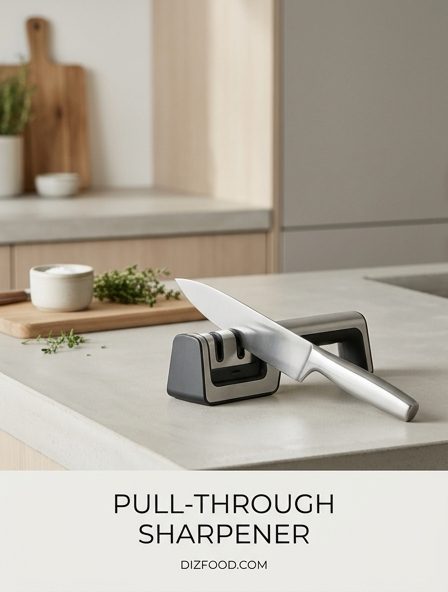
Mechanics of Pull-Through Sharpening Stages
The mechanics of a pull-through sharpener rely on fixed-angle abrasive inserts arranged in a V-shape. As the knife blade is drawn through the slot, the abrasive material makes contact with both sides of the edge simultaneously. This dual-sided contact ensures that the sharpening process occurs at a consistent angle, which is typically preset between 15 and 20 degrees per side. Most modern sharpeners utilize a multi-stage approach to refine the metal progressively. The initial stage usually employs coarse abrasives to reset the bevel, while subsequent stages use finer materials to hone the apex.
The physics of this process involves high friction and localized pressure. Because the contact area between the V-shaped notch and the blade is extremely small, the force applied by the user is concentrated onto the very tip of the edge. This concentration allows the tool to shave off metal shavings quickly. However, the fixed nature of the angles means the user must maintain a level pull to avoid asymmetrical grinding. This mechanical simplicity is what makes these tools accessible to novices while providing a predictable result across various kitchen cutlery types.
Efficiency Benchmarks for Home Cooks
For the average home cook, efficiency is measured by the speed of restoration versus the quality of the resulting edge. Pull-through sharpeners excel in this metric, often requiring fewer than ten strokes to return a dull blade to a functional state. Unlike whetstones, which require soaking, setup, and significant practice to master the steady hand required for angle consistency, pull-through devices are ready for immediate use. This makes them ideal for high-paced kitchen environments where a dull knife must be addressed mid-preparation.
- Total setup time: Zero minutes.
- Average sharpening duration: 30 to 60 seconds.
- Skill acquisition time: Minimal to none.
- Resulting sharpness: Sufficient for standard culinary tasks like slicing vegetables and proteins.
While professional chefs might prefer the surgical precision of manual stones, the home cook benefits from the "good enough" threshold achieved by these devices. The benchmark for success in a residential context is the ability to pass a basic paper-cut test or to slice through a tomato skin without resistance. Pull-through sharpeners consistently meet these benchmarks with a fraction of the effort required by traditional methods, solidifying their place as a staple in modern kitchen maintenance.
Quantifying Metal Removal Rates
Metal removal rates in pull-through sharpeners are significantly higher than those found in honing steels or fine-grit stones. This is primarily due to the aggressive nature of tungsten carbide inserts often used in the coarse stage. These inserts act almost like a plane, shearing off strips of steel rather than slowly abrading them. Quantifying this removal is essential for understanding how often a knife can be sharpened before the blade profile is substantially altered. Heavy-handed use can lead to visible "swarf" or metal dust accumulating rapidly in the sharpening channel.
| Stage Type | Abrasive Material | Estimated Metal Loss |
|---|---|---|
| Coarse | Tungsten Carbide | High (Significant Reshaping) |
| Medium | Diamond Grit | Moderate (Edge Correction) |
| Fine | Ceramic/Honing | Low (Polishing Only) |
Measurement of the blade's width over time reveals that frequent use of the coarse stage can reduce the lifespan of a knife by several years. For high-end forged knives, this aggressive removal rate is often viewed as a drawback. However, for inexpensive stamped blades, the rapid removal is a benefit, as it quickly overcomes significant dulling or minor chips that would otherwise take hours to repair manually.
Carbide Versus Ceramic Sharpening Elements
The two most common materials found in pull-through sharpeners are tungsten carbide and ceramic, each serving a distinct purpose in the sharpening hierarchy. Tungsten carbide is an extremely hard intermetallic compound that excels at "re-profiling." Its primary function is to bite into the steel and shave away material to create a new V-angle. Because it is harder than most knife steels, it can easily overcome rolls and blunted edges. However, the finish left by carbide is often jagged and "toothy," which may not be ideal for delicate slicing tasks.
Ceramic elements, usually made of alumina or similar oxides, serve as the finishing or honing stage. These components are smoother and less aggressive. Instead of shearing away large amounts of metal, they burnish the edge, aligning microscopic teeth and removing the burr created by the carbide stage. The interaction between these two materials provides a balance; the carbide provides the geometry, while the ceramic provides the refinement. Understanding this distinction allows users to choose the correct slot based on the knife's current condition, avoiding unnecessary wear by skipping the carbide stage when only a light touch-up is required.
Impact on Blade Geometry and Edge Profile
Continuous use of pull-through sharpeners inevitably alters the original factory geometry of a knife. Most kitchen knives come with a specific grind, such as a full flat grind or a taper, and a specific edge angle. Pull-through sharpeners impose a rigid, standardized angle that may not match the original manufacturer's specifications. If a knife with a 15-degree Japanese-style edge is pulled through a 20-degree Western-style sharpener, the primary bevel will be widened, and the cutting performance will change significantly.
Beyond the angle, these sharpeners can affect the "smile" or curve of the blade. Because users often apply more pressure at the start or end of the stroke, the heel and tip of the knife may wear unevenly. This can lead to a recurve profile, where the middle of the blade becomes concave over time, preventing the knife from making full contact with the cutting board. Furthermore, the aggressive nature of the V-notch can create a "shoulder" at the top of the edge bevel, increasing drag during deep cuts in dense vegetables like carrots or potatoes.
Long-Term Effects on Knife Longevity
The long-term survival of a kitchen knife is directly tied to the volume of steel removed during maintenance. Pull-through sharpeners, particularly those utilizing carbide blades, are known for their "shaving" action. Over years of weekly use, the height of the blade will noticeably decrease. As the blade is ground down, the thickness of the steel at the new edge increases, because the knife is being pushed into the thicker part of the primary grind. This phenomenon makes the knife feel "thick" and less efficient, even when it is technically sharp.
Another concern regarding longevity is the potential for stress fractures along the edge. The high-pressure, high-friction environment of a pull-through device can create heat and microscopic chips if the steel is particularly brittle, such as in high-carbon Japanese knives. For expensive heirloom cutlery, the cumulative damage to the profile and the accelerated thinning of the metal often make pull-through sharpeners a secondary choice. Conversely, for "workhorse" knives that are replaced every few years, the convenience of the tool often outweighs the concern for extreme longevity, making it a pragmatic trade-off for the busy cook.
Manual Versus Electric Pull-Through Performance
The choice between manual and electric pull-through sharpeners typically comes down to precision and consistency. Manual sharpeners rely entirely on the user's physical force and speed. While this allows for more control over the amount of metal removed, it also introduces human error, such as varying pressure or an unsteady draw. Manual units are portable, affordable, and require no power source, making them versatile for any kitchen setting or even outdoor use.
Electric sharpeners utilize motorized abrasive wheels that spin at high speeds. These wheels provide a much more consistent grind because the abrasive is moving at a constant velocity, regardless of how fast the user pulls the knife through the guide. Most electric models feature multiple stages with precision-angled guides that hold the blade in the exact position required. This reduces the risk of creating an uneven edge. However, the motorized nature can lead to excessive metal removal if the user is not careful, as the high-speed disks can grind away steel far faster than a manual pull. Electric versions are generally preferred for heavy-duty restoration of very dull knives.
Microscopic Analysis of the Refined Edge
Under microscopic magnification, the edge produced by a pull-through sharpener reveals a distinct topography. When using a carbide stage, the apex often appears jagged, with deep longitudinal scratches running parallel to the edge. These are "micro-serrations," which can actually be beneficial for tasks like cutting through tomato skins or crusty bread, as they provide a "bite" into the material. However, this edge is structurally weaker than a polished one, as the deep grooves act as stress concentrators where the metal can fold or chip more easily.
After passing through a ceramic honing stage, the microscopic view shows a significant smoothing of these ridges. The burr-a thin flap of metal that hangs off the side of the edge-is typically broken off or centered during this phase. A high-quality pull-through sharpener can achieve a refined apex that, while not as mirrored as a stone-polished edge, is remarkably clean. The limitation remains the "v-shaped" geometry; the microscope often shows a lack of the slightly convex shoulders that are prized in hand-sharpened knives for their durability and food-release properties. The resulting edge is sharp but lacks the sophisticated refinement of professional-grade manual work.
Common Pitfalls of High-Pressure Sharpening
One of the most frequent errors when using a pull-through sharpener is the application of excessive downward pressure. Users often believe that pressing harder will sharpen the knife faster; however, the opposite is true. High pressure can cause the carbide inserts to "chatter" against the steel, creating an uneven, wavy edge or even visible nicks in the blade. It can also lead to the removal of far more metal than is necessary, prematurely aging the knife.
- Applying too much force, leading to blade chipping.
- Pulling the knife backward and forward instead of in a single direction.
- Failing to clean the abrasive inserts, resulting in metal-on-metal sliding without abrasion.
- Attempting to sharpen serrated blades in a standard V-notch slot.
- Starting the pull mid-blade instead of at the heel.
Another pitfall is the "sawing" motion. Most sharpeners are designed for a single-direction pull, from the heel to the tip. Moving the blade back and forth can misalign the edge and damage the abrasive surfaces. Proper technique involves a light, consistent stroke that allows the abrasives to do the work, ensuring a smooth finish and preserving the integrity of both the tool and the knife.
Maintaining Optimal Abrasive Surface Integrity
To ensure consistent performance, the abrasive surfaces within a pull-through sharpener must be maintained. Over time, the ceramic rods and carbide inserts become "loaded" with swarf-microscopic metal filings that fill the pores of the abrasive. When this happens, the sharpener loses its "bite," and the knife may slide through the slot without being sharpened. This can lead the user to apply more pressure, which, as established, is detrimental to the blade. Cleaning these components is essential for long-term functionality.
For sharpeners with exposed ceramic rods, a simple eraser or a damp cloth with mild abrasive cleaner can remove the metal buildup. Some high-end manual and electric models feature replaceable inserts, allowing the user to swap out worn carbide or diamond wheels without replacing the entire unit. It is also important to keep the housing clean of metal dust to prevent it from scratching the sides of the knife during use. By periodically inspecting the inserts for wear-such as rounding of the carbide edges or cracking of the ceramic-users can ensure that every pull results in a crisp, functional edge rather than a frustrated struggle.



Comments