
When it comes to the ultimate kitchen showdown, the debate between Vitamix and Ninja centers on whether you want a budget-friendly multitasker or a professional-grade powerhouse. While Ninja offers impressive versatility with its stacked blade technology and high-wattage bursts, Vitamix remains the undisputed king of texture, utilizing high-torque motors and friction-heating capabilities to pulverize even the most fibrous kale, blackberry seeds, and frozen amaranth into a velvet-like consistency. If you are looking to transform your toughest ingredients into a truly seamless silk, choosing between these two depends on whether you prioritize the raw, refined pulverization of a culinary workhorse or the accessible, feature-rich convenience of a modern countertop appliance.
| Feature | Vitamix (Explorian/Ascent) | Ninja (Professional/Foodi) |
|---|---|---|
| Blade Engineering | Fixed, laser-cut, blunt stainless steel. | Removable, "Total Crushing" stacked blades. |
| Blending Texture | Commercial-grade silk; zero pulp or grit. | Consistent but often slightly fibrous/grainy. |
| Motor Durability | High-torque; built to last 10+ years. | High-wattage; consumer-grade lifespan. |
| Hot Blending | Yes; creates friction-heated hot soups. | No; requires specific "Heat" models only. |
| Warranty | Industry-leading 5 to 10 years. | Standard 1-year limited warranty. |
| Typical Price | Premium investment ($300 - $650). | Budget-friendly ($100 - $250). |
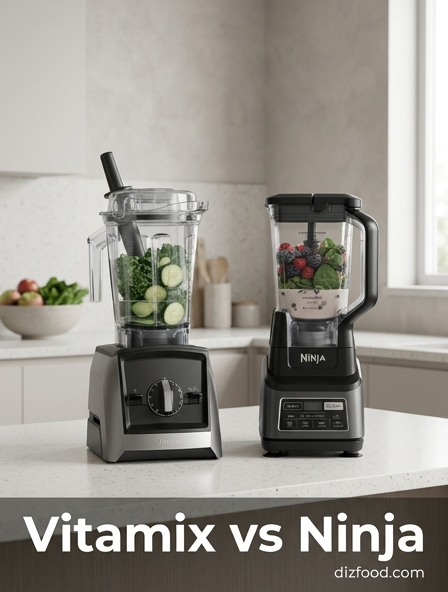
Vitamix vs Ninja The Ultimate Blender Showdown
The debate between Vitamix and Ninja has dominated the kitchen appliance market for over a decade, representing a fundamental choice between professional-grade engineering and consumer-focused versatility. Vitamix, a family-owned American company, has long been the gold standard for high-performance blending, favored by professional chefs and health enthusiasts who demand absolute precision. On the other hand, Ninja, a brand under SharkNinja, disrupted the market by offering high-wattage machines at a fraction of the cost, often bundling their motors with a wide array of attachments like food processor bowls and single-serve cups.
Understanding the core differences requires looking past the marketing jargon. Vitamix focuses on a "less is more" philosophy, perfecting a single, high-torque motor base and a specialized container design that creates a controlled vortex. Ninja utilizes a "more is more" strategy, providing "Auto-iQ" technology and unique blade towers designed to crush ice instantly. While both machines can pulverize kale and turn frozen fruit into sorbet, the experience of using them differs significantly in terms of noise, tactile feedback, and the final texture of the food. This showdown isn't just about which motor is stronger; it is about whether you value a lifetime investment or a multi-functional kitchen gadget that fits a modern, fast-paced lifestyle.
Motor Power and Blending Performance Comparison
When comparing motor power, it is easy to be misled by peak wattage ratings. Ninja blenders often boast higher wattage, sometimes reaching 1500 to 1600 watts, which suggests immense power. However, Vitamix focuses on high-torque motors that maintain consistent speed even when faced with heavy loads like thick nut butters or dense dough. The Vitamix motor is engineered to run for extended periods without overheating, thanks to advanced thermal protection systems.
| Feature | Vitamix (Explorian/Ascent) | Ninja (Professional/Foodi) |
|---|---|---|
| Typical Wattage | 1200 - 1440 Watts | 1000 - 1600 Watts |
| Motor Type | High-Torque, Variable Speed | High-Wattage, Pulse-Oriented |
| Cooling System | Advanced Radial Cooling Fan | Standard Airflow |
| Drive Socket | Metal-to-Metal | Plastic-to-Plastic or Reinforced |
In real-world performance, the Vitamix vortex pulls ingredients down into the blades, ensuring every particle is processed. Ninja's Total Crushing technology uses a vertical blade tower that excels at "chopping" and "crushing" ice but can struggle to create the same fluid motion required for a perfectly homogenized green juice. The Vitamix's ability to maintain high RPMs under load allows it to achieve a level of smoothness that most Ninja models simply cannot replicate.
Build Quality and Long Term Durability Analysis
The physical construction of these two brands reveals why their price points vary so drastically. Vitamix blenders are built with a focus on mechanical longevity. The most critical component, the drive socket-where the motor connects to the blade-is made of aircraft-grade metal. This prevents the stripping and melting often seen in cheaper blenders. The containers are made of BPA-free Eastman Tritan copolyester, designed to withstand the immense pressure and heat generated during high-speed blending without cracking or clouding over time.
Ninja blenders rely more heavily on plastic components. While the plastic is high-quality and durable for occasional use, the gear connections are often plastic-on-plastic. Over years of heavy use, these components are more prone to wear and tear. Furthermore, Ninja's multi-blade systems involve more moving parts and locking mechanisms in the lids, which increases the number of potential failure points. Vitamix units are frequently known to last 15 to 20 years with daily use, whereas a Ninja is typically viewed as a 3-to-5-year appliance. For the serious home cook, the Vitamix represents an heirloom-quality tool, while the Ninja serves as a highly capable but ultimately semi-disposable household appliance.
Evaluating Consistency in Smoothies and Nut Butters
Consistency is the hallmark of a premium blender. If you are making a green smoothie containing fibrous ingredients like kale, celery, or berry seeds, the Vitamix is undisputed. Its blades rotate fast enough to rupture cell walls, turning solid mass into a true liquid. This results in a silky mouthfeel without any "chewiness." In contrast, Ninja smoothies often retain a slightly gritty texture because the blade design is optimized for crushing rather than microscopic pulverizing.
- Green Smoothies: Vitamix produces a pulp-free liquid; Ninja may leave small bits of fiber.
- Nut Butters: Vitamix uses a tamper to push thick mixtures into the blades, creating creamy results in minutes.
- Frozen Desserts: Ninja excels at "snow-like" ice textures; Vitamix creates dense, soft-serve consistencies.
- Flours: Vitamix can grind grains into fine flour; Ninja tends to produce a coarser meal.
The ability to make nut butter is perhaps the ultimate test of a blender's endurance. A Vitamix can handle the high friction of grinding peanuts or almonds into a smooth paste without the motor cutting out. While some high-end Ninja models with "Twisti" technology have improved in this area, the traditional vertical blade Ninja models often require the user to stop, scrape the sides, and shake the jar repeatedly to get an even grind.
Price Point vs Overall Value for Money
The price gap between Vitamix and Ninja is significant, often ranging from $200 to $500. A basic Vitamix Explorian model starts around $300, with high-end Ascent models exceeding $600. Ninja systems are much more accessible, with powerful sets available for $100 to $200. To determine value, one must calculate the "cost per blend" over the life of the machine. A $400 Vitamix that lasts 10 years costs $40 per year, while a $150 Ninja that lasts 2 years costs $75 per year.
For a casual user who only makes a protein shake three times a week, the Ninja provides exceptional value. It offers versatility through its various attachments-such as food processor bowls and travel cups-that Vitamix often sells separately at high prices. However, for the "power user" who blends daily, makes their own flours, soups, and nut milks, the Vitamix's performance and reliability justify the steep initial investment. Value is subjective; Ninja wins on upfront affordability and kitchen-in-a-box versatility, while Vitamix wins on performance, durability, and long-term satisfaction.
Blade Design and Safety Feature Differences
The blade systems of these two brands represent two entirely different engineering philosophies. Vitamix uses a fixed, four-pronged stainless steel blade assembly at the bottom of the pitcher. These blades are surprisingly dull to the touch; they rely on speed and power to pulverize ingredients rather than sharpness. This is a safety advantage during cleaning, as you are less likely to cut yourself. Because they are permanently attached to the container, there is no risk of the blades falling out while pouring.
Ninja's "Total Crushing" system features a removable vertical plastic shaft with multiple sets of razor-sharp blades staggered at different heights. While this is incredibly effective for crushing ice without needing a tamper, it poses a significant safety risk. The blades are notoriously sharp and must be handled with extreme care during washing. Furthermore, if you forget to hold the blade shaft while pouring, it can fall out of the pitcher, potentially causing injury or damage. Ninja has addressed some of these concerns in newer models with locking lids and different blade styles, but the traditional "tower" design remains a distinct, and sometimes polarizing, feature of the brand.
Ease of Cleaning and Dishwasher Compatibility
Cleaning a blender can be the deciding factor in how often it actually gets used. Vitamix promotes a "self-cleaning" method that is highly effective. Because the blades are fixed at the base, you simply fill the container halfway with warm water and a drop of dish soap, then run the machine on high for 30 to 60 seconds. The centrifugal force cleans under the blades and up the sides of the walls. Most modern Vitamix containers are also dishwasher safe, though the self-cleaning method is usually sufficient.
Ninja blenders are generally marketed as dishwasher safe, which is a major selling point for busy families. However, the design of the Ninja can make hand-washing difficult. The removable blade tower has many nooks and crannies where food can get trapped, and the sharpness of the blades makes manual scrubbing risky. Additionally, Ninja lids often have complex locking mechanisms and gaskets that can trap moisture and food particles, leading to mold if not dried thoroughly. While Ninja's ability to throw everything into the dishwasher is convenient, Vitamix's 60-second self-wash is often faster and more thorough for daily maintenance.
Warranty Coverage and Brand Reliability
Warranty coverage is where Vitamix demonstrates its confidence in the product's lifespan. Most new Vitamix blenders come with a 5-year to 10-year full warranty that covers parts, labor, and even shipping both ways for repairs. This is one of the most comprehensive warranties in the appliance industry. Their customer service is US-based and highly rated, often helping users troubleshoot issues over the phone to avoid unnecessary shipping.
- Vitamix Warranty: 5-10 years, covers nearly everything including "wear and tear."
- Ninja Warranty: Typically 1 year limited; often requires the consumer to pay for shipping.
- Replacement Parts: Vitamix parts are available for decades; Ninja parts can be harder to find once a model is discontinued.
- Resale Value: Vitamix blenders hold their value exceptionally well on the used market.
Ninja typically offers a 1-year limited warranty. While they are generally reliable within that first year, getting repairs or replacements after the warranty expires can be difficult and often costs nearly as much as buying a new unit. This difference reflects the brand positioning: Vitamix is an investment piece, while Ninja is a consumer electronic intended to be replaced as technology or trends evolve.
Heat Friction Cooking vs Pulse Technology
One of the most famous features of a Vitamix is its ability to cook soup. Because the blades reach speeds of over 270 mph, the friction alone can bring cold ingredients to a steaming boil in about six minutes. This allows users to throw in raw vegetables, broth, and seasonings and walk away, returning to a hot, fully emulsified soup. This friction heat is also vital for creating smooth fondues and sauces without the need for a stovetop.
Ninja blenders generally lack the bearing and motor endurance to run long enough to cook via friction. Instead, Ninja focuses on "Pulse" technology and "Auto-iQ" programs. These programs use timed patterns of pulsing and pausing to ensure ingredients fall back onto the blades, which is excellent for making chunky salsas or consistent cookie dough. While some newer Ninja "Foodi" models include an actual heating element in the base to cook soups, the standard Ninja models rely on mechanical chopping rather than the high-velocity friction that defines the Vitamix experience. For those who want a "hot and cold" machine without an extra heating element, Vitamix is the clear choice.
Final Verdict Which Blender Brand Wins
The "winner" in the Vitamix vs. Ninja battle depends entirely on your kitchen goals and budget. If you are a culinary enthusiast who demands the smoothest textures, plans to use the blender daily for everything from flour milling to hot soups, and wants a machine that will last for a decade or more, Vitamix is the undisputed champion. Its superior vortex, metal-to-metal drive system, and industry-leading warranty make it a professional tool that happens to live on a kitchen counter. It is a classic case of "paying more now to save more later."
However, if you are a casual user, a student, or a family on a budget who needs a versatile appliance that can handle frozen margaritas, morning protein shakes, and occasional food processing tasks, Ninja is the better choice. Ninja provides incredible power and a suite of useful accessories for a very accessible price. While it may not produce the same microscopic smoothness as a Vitamix, it is more than capable for 90% of household tasks. Ultimately, Vitamix wins on performance and durability, while Ninja wins on affordability and multi-functional convenience. Choose Vitamix for the craft; choose Ninja for the convenience.

Comments