
Stacked blade technology has revolutionized the way modern kitchen appliances handle tough ingredients, turning ice and frozen fruits into smooth textures in seconds. Unlike traditional single-plane blades, this multi-tiered design features sharp edges positioned at various heights along a central shaft. This innovative configuration creates a powerful vertical vortex that pulls food downward while simultaneously crushing it from top to bottom, ensuring uniform results without any stubborn chunks left behind. It is a game-changing feature for home cooks who prioritize speed and efficiency during meal prep. When deciding which brand best utilizes these engineering styles, it is essential to compare the performance of Vitamix vs Ninja to see which fits your culinary needs.
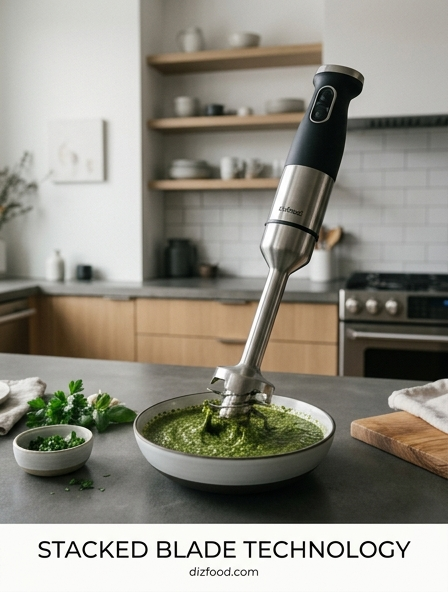
The Mechanics of Stacked Blade Systems
Stacked blade technology utilizes a central vertical shaft that supports multiple sets of blades at varying heights throughout the blender pitcher. Unlike traditional designs where the cutting assembly is confined strictly to the base, this configuration extends the cutting surface across the entire vertical profile of the container. Each tier of blades is strategically angled to capture ingredients as they move, ensuring that material at the top of the pitcher is processed just as effectively as material at the bottom. This mechanical arrangement allows for a higher volume of material to be processed simultaneously, significantly reducing the total time required to achieve a fine grind.
- Central Drive Spindle: The core column that transfers rotational energy from the motor to every blade level.
- Staggered Blade Tiers: Multiple cutting edges positioned at specific vertical intervals to maximize contact.
- Reinforced Locking Mechanism: Ensures the removable blade assembly stays secure during high-RPM operation.
- Aerodynamic Geometry: Works in tandem with blade placement to facilitate constant ingredient movement.
By distributing the workload vertically, the system minimizes the mechanical stress on any single set of blades, allowing for more efficient power distribution across the entire batch.
Maximizing Crushing Efficiency in Modern Blenders
Modern kitchen appliances leverage stacked blades to handle high-resistance tasks like pulverizing ice or frozen fruits with unprecedented speed. The efficiency stems from the ability of the upper blades to break down large, solid chunks into manageable pieces before they even reach the lower assembly. This tiered approach prevents the motor from stalling and ensures a continuous flow of ingredients toward the primary cutting zones. While traditional blades often spin beneath a frozen mass, stacked blades bite into the ingredients immediately upon activation.
| Efficiency Metric | Stacked Blade Performance |
|---|---|
| Ice Crushing Time | Sub-10 seconds for full pitchers |
| Hard Vegetable Processing | Rapid reduction without manual tamping |
| Motor Heat Management | Lowered through distributed resistance |
This results in a snow-like consistency for frozen drinks and ensures that dense materials are thoroughly processed without the need for additional liquid or frequent user intervention. The "top-down" crushing effect creates a faster path to homogenization compared to single-layer designs.
Multi Level Cutting for Uniform Food Consistency
Achieving a uniform texture is one of the most significant challenges in food preparation, particularly when dealing with varying densities. Stacked blade systems address this by creating multiple "cutting zones" within the container. As ingredients are tossed around the pitcher, they are guaranteed to encounter a sharp edge regardless of their vertical position. This eliminates the "dead zones" typically found in traditional blenders where chunks of food can hide above the reach of the blades.
- Initial Impact: Upper blades fracture large pieces into medium shards.
- Intermediate Processing: Middle blades refine the texture as ingredients circulate.
- Final Liquefaction: Lower blades finish the process by handling the smallest particles near the base.
This sequential reduction is essential for recipes that require precision, such as salsas or nut butters, where consistency is the primary marker of quality. By processing the entire column of food at once, the system prevents over-processing the bottom layer while the top remains chunky, leading to a perfectly balanced mouthfeel in every serving.
How Vertical Blade Alignment Prevents Ingredient Trapping
In traditional blender designs, ingredients often become trapped beneath the blade assembly or wedged in the corners of the pitcher base. Vertical blade alignment mitigates this issue by creating a constant upward and downward motion. Because the blades occupy the center of the pitcher rather than just the floor, they effectively "scramble" the ingredients, preventing any single piece from settling in a stagnant area. This design is particularly useful when working with leafy greens or sticky textures that tend to cling to the walls.
- Active Displacement: The motion of the blades pushes food away from the center and towards the walls.
- Gravity-Fed Processing: As food hits the walls and falls back down, it is intercepted by the next blade tier.
- Reduced Manual Intervention: Less need for spatulas or tampers to push food into the cutting path.
The result is a more hygienic and efficient blending experience. Since fewer ingredients remain untouched or stuck in the base, the cleanup process is simplified, and the yield of the recipe is maximized, ensuring no nutritional content is left behind in the crevices of the hardware.
The Science of Vortex Creation in Cooking Appliances
The physics of blending relies on the creation of a vortex, a funnel-shaped flow that pulls ingredients down into the blades. Stacked blades modify this traditional fluid dynamics model by creating multiple mini-vortices at different heights. This complex turbulence ensures that the mixture is not just spinning in a circle, but is being actively folded in on itself. This "turbulent flow" is much more effective at incorporating air and liquids into solids than a simple laminar flow found in basic kitchen tools.
| Flow Characteristic | Stacked Blade Effect |
|---|---|
| Vortex Depth | Spans the entire height of the pitcher |
| Ingredient Circulation | Cyclical vertical and horizontal paths |
| Aeration Quality | High, resulting in lighter textures |
This scientific approach to movement is what allows high-speed blenders to emulsify fats and liquids so effectively. By disrupting the path of the ingredients at multiple levels, the stacked system ensures that every milliliter of liquid is subjected to high-shear forces, resulting in stable emulsions and silky smooth purees.
Comparing Stacked Blades to Traditional Bottom Designs
Choosing between stacked blades and traditional bottom-mounted blades often depends on the intended kitchen task. Traditional blades are frequently designed for heavy liquid-based blending, where the weight of the liquid forces ingredients down. However, stacked blades excel in dry or frozen applications where gravity alone isn't enough to move the ingredients. The difference lies in the reach and the method of engagement with the food load. Traditional blades rely on a singular high-power point, whereas stacked blades distribute that power.
- Reach: Traditional blades cover 5-10% of the pitcher height; stacked blades cover 60-80%.
- Versatility: Stacked blades handle "dry" pulses better without adding water.
- Texture: Bottom blades often produce a smoother finish for hot soups; stacked blades excel at "crushed ice" textures.
The engineering trade-off usually involves the ease of cleaning versus the speed of processing. While traditional blades are often fixed to the base, many stacked blade assemblies are removable, offering a different approach to maintenance. Ultimately, the stacked design provides a more aggressive intervention for solid ingredients, making it the preferred choice for modern high-performance food processors.
Optimizing Texture for Smoothies and Frozen Bases
For smoothie enthusiasts, the primary goal is a texture devoid of ice crystals or unblended fruit skin. Stacked blade technology optimizes this by ensuring that frozen bases are continuously pulverized. In a standard blender, a "bridge" of frozen fruit often forms over the blades, causing them to spin air. The vertical reach of stacked blades shatters these bridges as soon as they form. This allows for thicker smoothies with less liquid, preserving the flavor concentration and providing a more "sorbet-like" quality.
- Ice Pulverization: Rapidly turns cubes into fine snow.
- Fiber Reduction: Shreds tough kale or spinach stems through multi-level contact.
- Emulsification: Blends fats like avocado or nut butters into the base for creaminess.
This level of optimization is particularly noticeable in frozen margaritas or acai bowls. The ability to maintain a cold temperature while achieving a fine grind is a direct result of the speed and coverage of the stacked tiers, which minimize the heat generated by prolonged blending cycles.
Engineering Durability for High Speed Kitchen Tasks
With great speed comes the need for robust engineering. Stacked blade assemblies are subject to intense centrifugal forces and must be constructed from high-grade materials, typically hardened stainless steel. The durability of these systems is not just in the sharpness of the blades, but in the integrity of the central spindle. Engineers must balance the thickness of the blades to ensure they are sharp enough to cut but thick enough to withstand the impact of frozen ingredients without bending.
| Engineering Factor | Design Implementation |
|---|---|
| Material | Food-grade 301 or 304 Stainless Steel |
| Drive Linkage | Metal-on-metal couplings for longevity |
| Thermal Resistance | Coating to prevent friction heat buildup |
Furthermore, the bearings within the assembly are often sealed to prevent liquid ingress, which is a common cause of failure in kitchen hardware. By distributing the torque across several blade levels, the engineering reduces the "kickback" force on the motor, which can extend the lifespan of the appliance under heavy-duty daily use in both residential and commercial settings.
The Role of Multi Tiered Blades in Nutrient Extraction
Nutrient extraction refers to the process of breaking down plant cell walls to release vitamins and minerals that are otherwise difficult to digest. Multi-tiered blades are exceptionally efficient at this because they increase the frequency of "impact events" per rotation. When a piece of fruit passes through the pitcher, it is hit by three or four different blades in a single revolution. This micro-level pulverization is what turns seeds, skins, and stems into a drinkable liquid, unlocking the nutritional potential of the entire ingredient.
- Cell Wall Rupture: High-velocity impact breaks down tough cellulose.
- Homogenization: Ensures nutrients are evenly dispersed throughout the liquid.
- Bioavailability: Smaller particle sizes allow for easier absorption by the digestive system.
By effectively liquefying the "pulp" that is often discarded in traditional juicing, stacked blade systems provide a more "whole food" approach to nutrition. This ensures that the fiber content remains in the drink while still providing the smooth consistency of a refined juice, offering the best of both worlds for health-conscious users.
Future Innovations in Professional Grade Kitchen Hardware
The evolution of stacked blade technology is moving toward smarter, more adaptive systems. Future innovations may include "variable geometry" blades that can change their angle based on the resistance they encounter. Sensor-integrated spindles could detect the density of ingredients and communicate with the motor to adjust RPMs in real-time. This would allow for even more precision in texture control, automatically switching from a "crushing" mode to an "emulsifying" mode as the mixture transforms from solid to liquid.
- AI Integration: Blades that adjust speed based on ingredient density sensors.
- Magnetic Drive Systems: Removing the physical drive shaft for easier cleaning and less friction.
- Advanced Metallurgy: Using titanium coatings to increase edge retention and decrease oxidation.
As professional kitchens demand more versatility, we may also see stacked blades designed for specific molecular gastronomy tasks, such as ultra-fine foaming or cold-milling spices. The intersection of material science and fluid dynamics continues to push the boundaries of what these central kitchen components can achieve, promising a future of faster, quieter, and more efficient food preparation.

Comments