
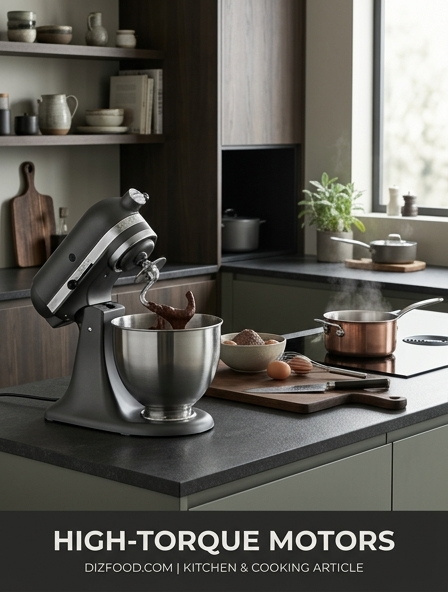
The Mechanics of High-Torque Power
The fundamental principle behind high-torque motors in kitchen appliances lies in the conversion of electrical energy into rotational force, measured in Newton-meters. Unlike standard motors that prioritize high revolutions per minute (RPM) without significant strength, high-torque variants utilize dense copper windings and powerful permanent magnets to generate substantial turning force. This mechanical advantage allows the appliance to overcome the initial resistance of dense food items, ensuring that the blades or beaters do not stall when they first make contact with solid mass.
To understand the efficiency of these systems, it is helpful to look at the primary components that contribute to torque production:
- Stator and Rotor Alignment: Precision spacing maximizes the magnetic flux, leading to higher force.
- Gear Reduction Systems: Many high-torque appliances use internal gearing to trade high speed for increased crushing power.
- Wire Gauge: Thicker copper wiring allows for higher current throughput without excessive heat buildup.
When these elements work in harmony, the motor can maintain its structural integrity while performing tasks that would cause a lesser motor to burn out. This mechanical foundation is what differentiates a professional-grade blender or mixer from a standard consumer model.
Achieving Perfectly Smooth Blending Textures
The quality of a blended mixture is directly proportional to the motor's ability to maintain a consistent vortex under pressure. High-torque motors excel at processing fibrous vegetables and frozen fruits by applying enough force to rupture cellular walls and pulverize seeds. In traditional blending, a drop in speed occurs as the mixture thickens, leading to uneven chunks and a gritty mouthfeel. However, a high-torque system provides the necessary shear force to emulsify liquids and solids into a completely homogenous state.
| Ingredient Type | Standard Motor Result | High-Torque Result |
|---|---|---|
| Leafy Greens | Visible flecks | Cellular breakdown |
| Frozen Berries | Grainy seeds | Silky puree |
| Raw Nuts | Coarse meal | Smooth butter |
By ensuring the blades never slow down significantly, the appliance creates a high-velocity impact that creates a micron-level finish. This is particularly essential for modernist cuisine, where perfectly smooth coulis and foams are required for professional presentation and optimal flavor release.
Why Motor Torque Prevents Overheating
Overheating is the primary cause of motor failure in small kitchen appliances. When a motor lacks sufficient torque, it struggles against the resistance of the food, drawing excessive electrical current in an attempt to maintain its speed. This surge in current generates waste heat within the windings, eventually triggering thermal protection switches or melting internal components. High-torque motors are engineered to operate comfortably within their power band, meaning they do not have to "work" as hard to achieve the same results as a low-torque motor.
Several design factors contribute to this thermal efficiency:
- Reduced Friction: Superior bearings and balanced rotors minimize heat-generating drag.
- Optimized Airflow: High-torque designs often include dedicated cooling fans that sync with the motor's output.
- Current Stability: By maintaining a steady rotation, the motor avoids the "stall-and-spike" cycle that ruins electronics.
Because the motor remains cool during intensive tasks like kneading dough or crushing ice, users can run the appliance for longer durations without the risk of an automatic shutoff or permanent damage to the motor's insulation.
The Relationship Between Torque and Longevity
Investing in high-torque kitchen equipment is essentially an investment in the appliance's lifespan. In the world of mechanical engineering, stress is the enemy of longevity. When a motor is consistently pushed to its limit to process heavy loads, the physical components-such as the brushes, commutator, and drive socket-experience accelerated wear. High-torque motors are built with overhead capacity, meaning they rarely reach their ultimate breaking point during daily kitchen operations.
This durability is further enhanced by the use of premium materials. Manufacturers of high-torque systems typically employ all-metal drive trains rather than plastic gears, ensuring that the force generated by the motor is safely transferred to the blades without stripping the connections. Over years of use, a high-torque motor will retain its efficiency, whereas a lower-quality motor will gradually lose power as its internal components degrade from repeated strain. For the frequent home cook or professional chef, this translates to fewer replacements and consistent performance over a decade or more of service, making the initial higher cost a more economical choice in the long run.
Handling Tough Ingredients with Ease
Certain ingredients pose a significant challenge to standard kitchen hardware. Items with low moisture content or high structural density require more than just speed; they require brute force. High-torque motors provide the "crushing power" necessary to handle these difficult materials without stalling. Whether it is grinding parmigiano-reggiano, processing dried spices, or turning chickpeas into a smooth paste, the torque ensures that the resistance of the ingredient does not dictate the performance of the machine.
- Fibrous Roots: Easily slices through ginger and turmeric without clogging the blade assembly.
- Hard Grains: Can mill wheat or corn into fine flour through sheer rotational impact.
- Ice and Frozen Fruit: shatters crystalline structures instantly, preventing the "air pocket" effect often seen in weaker blenders.
- Nut Butters: Maintains the constant motion required to release natural oils from almonds or peanuts.
The ability to process these ingredients effortlessly expands the culinary possibilities for the user. Instead of being limited by what the machine can handle, the cook is free to experiment with dense textures and complex raw ingredients that would otherwise require manual labor or specialized commercial equipment.
The Science of Rotational Force in Cooking
In the context of food preparation, rotational force-or torque-is the physical work done to overcome the viscosity and friction of ingredients. The science involves the relationship between the motor's wattage and its actual output at the blade. While many consumers focus on peak wattage, high-torque engineering focuses on "continuous duty" power. This means the motor is tuned to provide maximum force at lower speeds, which is often more useful in the kitchen than high-speed, low-force rotation.
Consider the physics of a stand mixer. When mixing a heavy bread dough, the resistance is immense. A motor with high torque can maintain a slow, steady turn that stretches the gluten strands effectively. If the motor relied solely on speed, it would either fail to turn the hook or move so fast that it would tear the dough rather than knead it. High-torque design utilizes the principles of mechanical leverage, often through planetary gear systems, to ensure that the force applied is concentrated where it matters most: at the point of contact between the tool and the food. This scientific approach ensures that energy is used for work rather than being wasted as noise or vibration.
Eliminating Lumps in Thick Mixtures
Thick mixtures like hummus, nut butters, and heavy batters create a high-drag environment that often results in "lumping." This occurs when the blades of a blender or mixer spin too fast to catch the ingredients, creating a vacuum or cavitation bubble. A high-torque motor solves this by providing the power to move through the thick mass at a controlled speed, ensuring every part of the mixture is pulled into the cutting or mixing zone. The result is a level of homogenization that is impossible to achieve with manual stirring or underpowered machines.
Because the motor does not slow down when it hits a dense pocket of ingredients, the shear forces remain constant. This constant pressure is what eventually breaks down the smallest lumps, resulting in a velvety texture. For culinary applications where smoothness is a hallmark of quality-such as a chocolate ganache or a thick béchamel-the ability to maintain consistent torque under a heavy load is the secret to a professional-grade finish. It removes the need for frequent stopping and scraping, as the motor has the strength to keep the entire mass in motion throughout the processing cycle.
Engineering Durability for Professional Kitchens
In a commercial environment, kitchen equipment must withstand near-constant use. Engineers design professional high-torque motors with a "high duty cycle," meaning they can run for extended periods without rest. This requires a different class of internal engineering compared to standard household appliances. The components are often oversized to handle the thermal and mechanical stresses of a busy restaurant or bakery.
| Feature | Professional Spec | Consumer Spec |
|---|---|---|
| Gear Material | Hardened Steel | Plastic/Nylon |
| Cooling | Active Heat Sinks | Passive Vents |
| Bearing Type | Dual Ball Bearing | Sleeve Bearing |
| Seal Integrity | Industrial Grade | Standard Rubber |
This "over-engineering" ensures that the motor can handle back-to-back tasks, from morning prep to evening service, without a drop in performance. The durability of these motors means they are less likely to suffer from "vibration fatigue," a common issue where the rapid movement of internal parts eventually shakes the appliance apart. In a professional setting, a high-torque motor is not a luxury; it is a critical piece of infrastructure.
Maintaining Constant Speed Under Heavy Loads
The hallmark of a high-quality motor is its ability to maintain a set speed regardless of the resistance it encounters. This is often achieved through an electronic feedback loop known as a governor or a PID controller. When you add a heavy load to a high-torque motor-such as adding flour to a wet batter-the sensor detects the potential drop in RPM and immediately adjusts the power delivery to compensate. This keeps the rotational speed constant, ensuring that the mixing or blending process remains rhythmic and predictable.
Maintaining a constant speed is vital for delicate culinary tasks. For example, when making an emulsion like mayonnaise, a sudden drop or spike in speed can cause the oil and egg to separate. High-torque motors provide the stability needed to keep the emulsion intact. This feature also prevents the motor from "bogging down," which can lead to uneven processing where the bottom of the container is over-processed while the top remains chunky. By delivering a steady, unstoppable force, these motors provide the cook with total control over the timing and texture of their recipes.
Essential Benefits of High-Torque Motor Design
The shift toward high-torque motor design in the kitchen reflects a broader demand for versatility and reliability. Modern cooks expect a single appliance to perform a wide range of tasks, from crushing ice for cocktails to kneading stiff brioche dough. High-torque motors make this versatility possible by providing a broad "power band" that remains effective at both high and low speeds. This eliminates the need for multiple specialized machines, saving counter space and reducing overall costs for the consumer.
Key benefits of integrating high-torque technology into kitchenware include:
- User Confidence: No fear of the motor "smoking" or failing during difficult tasks.
- Time Efficiency: Faster processing times due to consistent power delivery.
- Noise Reduction: High-torque motors often run more quietly because they aren't straining at their limit.
- Precision: Better control over texture and consistency in complex recipes.
Ultimately, high-torque design represents the intersection of physics and culinary art. It provides the raw power necessary to transform ingredients, allowing the chef to focus on flavor and creativity rather than the limitations of their equipment.


Comments