
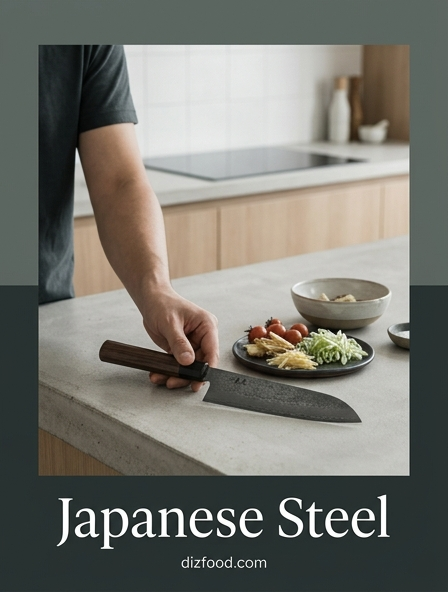
Elevate your culinary skills by mastering the surgical precision and high performance of authentic Japanese steel. These blades are world-renowned for their exceptional hardness and razor-sharp edges, allowing chefs to execute intricate cuts with effortless grace. Forged through centuries of tradition, Japanese knives utilize high-carbon alloys that maintain their keenness far longer than standard cutlery, making them the ultimate choice for those seeking absolute control in the kitchen. Understanding how to handle these delicate yet powerful tools is the key to achieving professional-grade results in your home cooking. Before making your next investment, it is essential to understand the distinct differences between German Steel vs Japanese Steel.
Understanding Japanese Carbon Steel Grades
Japanese cutlery is defined by its steel composition, primarily categorized into "White" and "Blue" steels produced by Hitachi Metals. White Steel, or Shirogami, is the purest form of high-carbon steel, favored for its ability to achieve a hair-splitting edge. It lacks significant impurities, making it easier to sharpen but more prone to oxidation. Blue Steel, or Aogami, introduces chromium and tungsten to the mix, enhancing wear resistance and edge longevity. These steels are preferred by professionals who demand surgical precision and are willing to maintain the blade against rust.
| Steel Grade | Carbon Content | Key Characteristic |
|---|---|---|
| Shirogami #1 | 1.25% - 1.35% | Highest purity and sharpness |
| Aogami #2 | 1.00% - 1.20% | Excellent balance of toughness |
| Aogami Super | 1.40% - 1.50% | Maximum edge retention |
Choosing between these grades depends on the chef's priorities. Shirogami offers the cleanest cut for delicate tasks like sashimi, while Aogami provides a durable edge that survives long shifts in a busy kitchen environment.
The Art of Forging Damascus Layers
Modern Damascus steel in Japanese knifemaking, often referred to as Suminagashi, is a celebratory fusion of aesthetics and structural support. This technique involves forge-welding multiple layers of softer stainless or nickel steel over a hard high-carbon core. The resulting "ink-drift" pattern is unique to every blade, revealed through acid etching or bead blasting. Beyond the visual appeal, these layers serve a functional purpose by protecting the brittle inner core from lateral stress and corrosive elements.
- Core Steel: The central cutting edge, usually Hagane or VG10.
- Cladding: Multiple outer layers that provide flexibility and shock absorption.
- Food Release: The textured surface creates air pockets, preventing sticky ingredients from clinging.
- Heritage: Techniques derived from ancient Katana forging traditions.
A high-quality Damascus blade is not just a tool but a testament to the blacksmith's skill in heat treatment and hammer control. While the layers do not inherently make the edge sharper, they ensure the knife remains resilient throughout years of thinning and sharpening, maintaining the structural integrity of the thin geometry.
Single Bevel Versus Double Bevel Precision
The distinction between single bevel (Kataba) and double bevel (Ryoba) blades is fundamental to Japanese culinary technique. Traditional Japanese knives like the Yanagiba or Usuba feature a single bevel, where only one side of the blade is ground to an angle while the back remains slightly concave (Urasuki). This geometry allows for unmatched precision, enabling chefs to slice through proteins with zero food compression and minimal cell damage. However, these knives require specialized skills to master and are generally task-specific.
In contrast, double bevel knives are sharpened on both sides, typically at a 50/50 or 70/30 ratio. These are more intuitive for Western users and versatile for general kitchen tasks. While they lack the extreme "steering" capability of a single bevel, they are sturdier and easier to maintain for home cooks. Understanding the bevel is crucial for achieving the desired texture in ingredients; for example, the clean, reflective surface of a single-bevel-cut fish is essential for traditional sushi presentation. Most modern home chefs opt for double bevels for their approachability and multi-functional nature across different vegetable and meat prep tasks.
Essential Whetstone Sharpening Techniques
Maintaining a Japanese blade requires the use of water stones rather than honing rods, which can chip the hard steel. The process is a meditative discipline involving three primary stages: repairing, sharpening, and polishing. Success depends on maintaining a consistent angle, usually between 10 to 15 degrees, and developing a "burr" or wire edge along the length of the blade before switching sides.
- Coarse Grit (200-600): Used for repairing chips or resetting a dull edge.
- Medium Grit (800-2000): The essential stone for sharpening and refining the geometry.
- Fine Grit (3000-8000+): Used for polishing the edge to a mirror finish and honing for smooth cuts.
Lubrication is vital; stones must be soaked or splashed with water to create a slurry. This paste of abrasive particles and water acts as the cutting medium. Proper technique involves using the entire surface of the stone to keep it flat, as a dished stone will result in an inconsistent edge. Consistent pressure on the "push" stroke and light pressure on the "pull" stroke helps in achieving a razor-sharp, professional-grade result.
Mastering the Push Cut Motion
Unlike the rocking motion common with Western chef knives, Japanese blades are designed for a "push cut" or "pull cut" technique. Because the steel is thinner and harder, rocking the knife can lead to micro-chipping when the edge twists against the cutting board. The push cut involves moving the knife forward and down simultaneously, utilizing the entire length of the blade. This motion ensures that the edge passes through the food cleanly, preserving the internal juices and structural integrity of the produce.
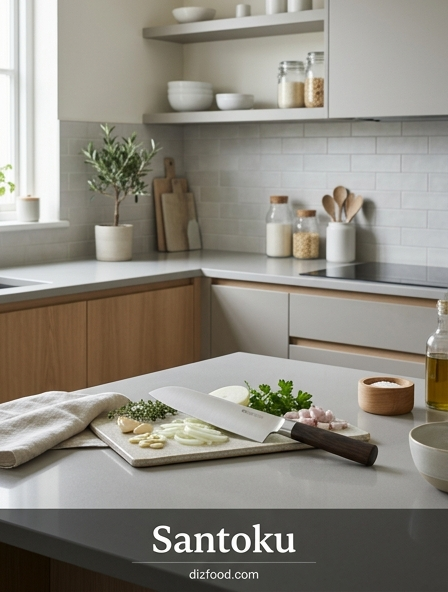
This technique is particularly effective with knives like the Nakiri or Santoku, which have flatter profiles. By lifting the knife slightly and pushing away from the body, the chef allows the weight of the steel and the sharpness of the edge to do the work. This minimizes physical fatigue and provides a rhythmic, efficient workflow. Mastery of this motion is the key to achieving the uniform julienne and paper-thin slices that define Japanese vegetable preparation. It requires a relaxed grip and a focused vertical path, ensuring the blade never encounters lateral torque during the slice.
Why Rockwell Hardness Matters Most
The Rockwell Scale (HRC) measures the indentation hardness of steel, and it is the primary indicator of a Japanese knife's performance capabilities. While Western knives typically range between 54 and 58 HRC, Japanese blades often sit between 60 and 66 HRC. This extreme hardness is what allows Japanese blacksmiths to grind blades to such thin, acute angles without the edge collapsing immediately. Higher hardness translates directly to superior edge retention, meaning the knife stays sharp for weeks rather than days.
- 58-60 HRC: Durable, easier to sharpen, suitable for general heavy-duty use.
- 61-63 HRC: The "sweet spot" for high-end kitchen knives, balancing sharpness and fragility.
- 64+ HRC: Exceptional retention but very brittle; requires expert handling to avoid chips.
However, hardness comes with a trade-off in "toughness." A harder blade is more susceptible to chipping if it hits a bone, frozen food, or a hard ceramic plate. This is why Japanese knives require a dedicated wooden or soft plastic cutting board. Understanding HRC helps a chef choose a tool that matches their skill level and their willingness to provide the necessary care.
Traditional Wa Handle Ergonomics Explained
The traditional Japanese "Wa" handle is a hallmark of authentic cutlery, differing significantly from the heavy, riveted "Yo" handles found on Western knives. Wa handles are lightweight, shifting the balance of the knife toward the blade. This forward-balance encourages a "pinch grip," giving the user better control over the tip for intricate tasks. These handles are typically made from natural woods like Ho (Magnolia), Ebony, or Rosewood, often capped with a horn or wood ferrule.
| Handle Shape | Grip Style | Best Use |
|---|---|---|
| Octagonal | Ambidextrous | Universal precision and comfort |
| D-Shape | Right-handed | Traditional ergonomic support |
| Oval | Neutral | Smooth transitions and classic feel |
The light weight of the handle reduces wrist fatigue during long periods of preparation. Furthermore, Wa handles are designed to be replaceable. If the wood becomes damaged or worn over decades of use, a blacksmith can heat the tang and install a brand-new handle, allowing the high-quality steel blade to serve for multiple generations.
Maintaining High Performance Edge Retention
Edge retention is the hallmark of premium Japanese steel, but it is a temporary state without proper maintenance. Beyond sharpening, daily care dictates how long a blade remains functional. Carbon steel knives require a disciplined cleaning routine: they must be wiped dry immediately after every use, especially when cutting acidic ingredients like lemons or onions. Over time, these blades develop a "patina"-a grey or blue oxidation layer that actually helps protect the steel from more harmful red rust.
- Tsubaki Oil: Apply Camellia oil to the blade before long-term storage.
- Leather Stropping: Use a strop daily to realign the microscopic edge.
- Board Selection: Use only wood or soft rubber boards; avoid glass or marble.
- Storage: Use a wooden "Saya" or magnetic rack to protect the edge from contact.
A well-maintained edge doesn't just make cooking easier; it makes it safer. A sharp knife requires less pressure, reducing the likelihood of the blade slipping. By understanding the reactive nature of the steel, a chef can ensure that their Gyuto or Petty remains a high-performance instrument for a lifetime of culinary creation.
Selecting the Ultimate Gyuto Knife
The Gyuto is the Japanese equivalent of the Western chef's knife, yet it is refined for greater agility and precision. When selecting the ultimate Gyuto, one must consider the "profile"-the curve of the edge. Some Gyutos are flatter, favoring the push-cut, while others have a slight belly for those who prefer a subtle rocking motion. The length is another critical factor; 210mm is the standard for home cooks, while 240mm is the preferred choice for professional environments where volume is high.
Weight and balance are equally important. A stainless-clad carbon steel Gyuto offers the best of both worlds: a high-performance carbon edge with the ease of rust-resistant sides. The thickness of the spine, or "distal taper," determines how the knife moves through food; a thin tip is essential for delicate work like dicing shallots, while a sturdier heel provides power for denser vegetables. Ultimately, the best Gyuto should feel like an extension of the hand, providing a "laser-like" cutting experience that makes kitchen work feel effortless and artistically satisfying.
Bridging Ancient Craft and Modern Cooking
The contemporary Japanese kitchen knife is the result of a thousand-year evolution, transitioning from the battlefields of the Samurai to the modern culinary stage. When the production of swords was restricted during the Meiji Restoration, master swordsmiths redirected their expertise toward cutlery, bringing secret heat-treatment techniques and forging disciplines to the kitchen. This lineage ensures that every hand-hammered blade carries a piece of cultural history, blending the spiritual dedication of the forge with the practical demands of modern gastronomy.
Today, this bridge between ancient craft and modern cooking is seen in the global demand for Japanese steel. Professional chefs worldwide have adopted these tools not just for their performance, but for the philosophy they represent: a commitment to precision, respect for ingredients, and the pursuit of perfection. Using a Japanese knife requires a shift in mindset-a move toward more deliberate, thoughtful movements. By integrating these traditional tools into modern kitchens, cooks honor a legacy of craftsmanship while elevating the simple act of food preparation into a refined art form that transcends borders and eras.

Comments