
The Power of Increased Surface Area
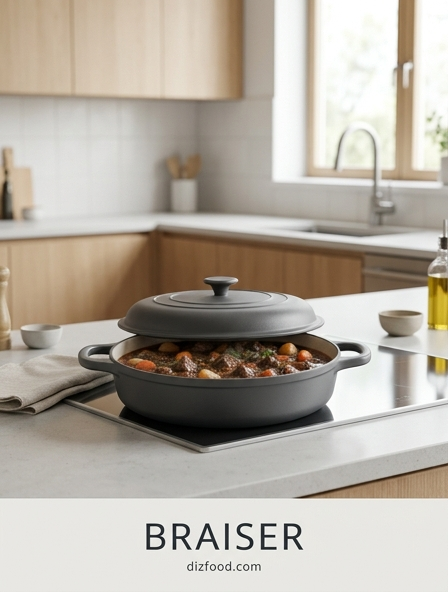
The primary architectural advantage of a braiser lies in its expansive, flat base. Unlike a narrow stockpot or a deep Dutch oven, the braiser provides a significant amount of floor space relative to its volume. This increased surface area is critical for home chefs who wish to prepare larger batches of protein without the detrimental effects of overcrowding. When meat is packed too tightly in a vessel, it releases moisture that becomes trapped, effectively steaming the food rather than browning it. By utilizing a wide-bottomed braiser, you ensure that each piece of meat has direct contact with the heated surface.
- Prevents moisture buildup that leads to grey, boiled-looking meat.
- Allows for multiple chicken thighs or short ribs to sear simultaneously.
- Facilitates even fat rendering across the entire cooking surface.
- Optimizes the heat distribution from the burner to the ingredients.
This design choice is not merely about volume but about the quality of the initial sear. The wide diameter allows for better movement of ingredients and easier access for tongs or spatulas, ensuring that every inch of the food is treated with consistent heat. Ultimately, the surface area serves as the foundation for all subsequent flavor-building steps in the braising process.
Maximizing the Maillard Reaction
The Maillard reaction is a chemical process between amino acids and reducing sugars that gives browned food its distinctive, savory flavor. In a braiser, this reaction is heightened due to the vessel's ability to maintain high, dry heat across its broad base. Because the low sides allow steam to escape quickly, the surface of the meat remains dry enough for the temperature to rise above 285°F, which is the threshold where browning occurs. This results in a complex crust that is rich in umami and visual appeal.
| Feature | Benefit for Maillard Reaction |
|---|---|
| Low Profile | Promotes rapid steam dissipation for a drier sear. |
| Heavy Construction | Maintains consistent high heat during protein contact. |
| Wide Floor | Maximizes the contact points for caramelization. |
Achieving a deep, mahogany crust is the difference between a mediocre stew and a professional-grade braise. The braiser's geometry is specifically engineered to favor this browning phase, ensuring that the meat develops a robust exterior that will eventually infuse the braising liquid with deep, concentrated notes of roasted flavor.
Uniform Heat for Perfect Searing
Quality braisers are typically constructed from enameled cast iron or heavy-gauge tri-ply stainless steel. These materials are chosen for their high thermal mass and ability to distribute heat evenly across the entire cooking surface. When searing meat, hot spots can lead to uneven results, where some portions are charred while others remain under-browned. The heavy bottom of a braiser acts as a heat reservoir, absorbing energy from the stove and radiating it uniformly to the food.
- Preheat the braiser on medium-low to allow the metal to expand evenly.
- Add high-smoke-point oil to coat the expansive base.
- Place proteins in a single layer, leaving space between each piece.
- Resist the urge to move the meat until it naturally releases from the surface.
This thermal stability is particularly important when adding cold ingredients to the pan. A thin pan would lose its temperature instantly, but a braiser recovers quickly, maintaining the sizzle required for a perfect sear. This consistency ensures that every piece of meat cooked in the vessel reaches the same level of caramelization, providing a professional uniformity to the final dish.
Strategic Depth for Moisture Control
The depth of a braiser is a deliberate compromise between a shallow frying pan and a deep pot. Typically ranging from three to five inches, the walls are high enough to contain liquid but low enough to encourage airflow. This strategic depth is essential for moisture control during the long, slow cooking process. In a deep pot, excess moisture can condense on the high walls and fall back into the dish, diluting the flavors. In a braiser, the proportions are optimized for "low and slow" cooking with a minimal amount of liquid.
- Reduces the total amount of liquid needed to cover the ingredients.
- Ensures the top portion of the meat remains exposed for texture.
- Promotes better heat circulation around the submerged food.
- Prevents the "stewed" effect where meat loses its structural integrity.
By keeping the liquid level low-usually covering only one-third to one-half of the meat-the braiser allows the submerged portion to become tender while the exposed portion develops a concentrated flavor through the surrounding hot air. This dual-action cooking method is what defines the braising technique.
Accelerating Liquid Evaporation Rates
Effective braising requires the reduction of cooking liquids to create a concentrated, flavorful sauce. Because a braiser has a wide mouth, the surface area of the liquid exposed to the air is much greater than in a traditional pot. This geometry significantly accelerates the rate of evaporation once the lid is removed. As water evaporates, the sugars, fats, and aromatics in the braising liquid become more concentrated, resulting in a sauce with superior body and intensity.
- Simmer with the lid on to tenderize the connective tissues.
- Remove the lid during the final thirty minutes of cooking.
- Increase the heat slightly to encourage active steam release.
- Observe as the thin liquid transforms into a syrupy glaze.
This acceleration is not just a matter of convenience; it is a tool for flavor management. Rapid reduction allows the chef to control the exact thickness of the sauce without overcooking the meat. The ability to quickly transition from a wet braise to a reduced glaze is a hallmark of the braiser's versatile design, making it an indispensable tool for sauce-heavy French and Italian cuisine.
Developing Rich Fond and Flavor Bases
As proteins sear against the bottom of a braiser, they leave behind caramelized particles known as "fond." This fond is a concentrated source of flavor that serves as the backbone for any professional sauce. The wide, light-colored interior of many enameled braisers allows the cook to easily monitor the development of this fond, ensuring it reaches a deep brown without turning black or bitter. Because the braiser provides more surface area, it naturally produces a higher volume of fond than narrower vessels.
- The fond contains concentrated proteins and sugars from the meat.
- A larger base creates more "real estate" for fond to accumulate.
- The heavy base prevents the fond from burning during extended searing.
- Slow-cooked aromatics like mirepoix interact with the fond for complexity.
Once the meat is removed, the fond remains as a savory "glue" on the pan's surface. Developing this base is the most critical step in layering flavors. Without the ample surface area provided by the braiser, the amount of fond would be limited, resulting in a sauce that lacks the depth and complexity required for gourmet results.
Effortless Deglazing for Gourmet Sauces
Deglazing is the act of adding liquid-such as wine, stock, or vinegar-to a hot pan to loosen and dissolve the fond. The design of the braiser, characterized by its sloped sides and rounded corners, makes this process incredibly efficient. A wooden spoon or whisk can easily reach every part of the pan to ensure no flavor is left behind. This transition from a dry sear to a wet simmer is the moment where the "soul" of the dish is created as the caramelized bits integrate into the liquid.
| Deglazing Liquid | Culinary Outcome |
|---|---|
| Red Wine | Adds acidity and deep color to beef or lamb braises. |
| Chicken Stock | Provides a savory, gelatinous body to poultry dishes. |
| Apple Cider | Introduces sweetness and tartness to pork preparations. |
The efficiency of deglazing in a braiser is also due to its heat retention; the liquid boils almost instantly upon contact, lifting the fond with minimal effort. This creates a homogenous, flavor-dense liquid that will eventually become the silk-like sauce that coats the finished meal.
Precision Temperature for Sauce Consistency
Maintaining the correct consistency of a sauce requires precise temperature control, which is where the thick construction of a braiser excels. Once the braising liquid has been reduced and the meat is tender, the final sauce must be stabilized. The cast iron or thick steel walls provide a steady, gentle heat that prevents delicate sauces from breaking or curdling. This is especially important when finishing a sauce with cold butter (monter au beurre) or heavy cream.
- Eliminates the temperature spikes that cause dairy to separate.
- Keeps the sauce at a perfect "nappe" consistency for serving.
- Allows for gentle simmering to further refine flavor without scorching.
- Provides enough residual heat to keep the dish warm on the table.
The thermal inertia of the braiser means that once you reach the desired sauce thickness, it will stay at that state longer than it would in a thin skillet. This window of perfection is vital for professional presentation, ensuring that the sauce remains glossy and emulsified from the moment it leaves the stove to the moment it reaches the plate.
From Stovetop Browning to Oven Finishing
The braiser is the ultimate "one-pot" vessel because of its seamless transition from the stovetop to the oven. Braising is a two-stage process: a high-heat dry sear followed by a low-heat wet cook. The sturdy, oven-safe handles and tight-fitting lid of a braiser are designed for this specific journey. Moving the pan into the oven allows for omnidirectional heat, which is much gentler and more consistent than the directional heat of a burner.
- Complete the searing and deglazing on the stovetop.
- Cover with the heavy lid to create a pressurized, moist environment.
- Transfer to a preheated oven (usually 275°F to 325°F).
- Let the ambient oven heat slowly break down collagen into gelatin.
This versatility eliminates the need to transfer ingredients between different dishes, which preserves all the flavors and juices within a single environment. Furthermore, the aesthetic design of many braisers allows them to function as elegant serving pieces, moving directly from the oven to the dining room table while retaining heat throughout the meal.
Unlocking Professional Braising Results
To achieve professional results in a home kitchen, one must master the balance of texture and flavor. The braiser is the tool that makes this balance possible. By providing the ideal environment for both the Maillard reaction and the slow breakdown of connective tissues, it produces meat that is "fork-tender" yet still holds its shape. The final result is a dish that features deeply browned proteins and a sauce that is concentrated, balanced, and rich in mouthfeel.
- Achieves the perfect "shred" in short ribs and pork shoulders.
- Produces a glossy, restaurant-quality glaze without thickeners.
- Ensures aromatics are softened but not obliterated.
- Maintains the integrity of vegetables added during the final stages.
Whether you are making a classic Coq au Vin, a hearty Osso Buco, or a simple vegetable tagine, the braiser provides the technical advantages necessary for success. It respects the physics of heat and the chemistry of flavor, transforming humble, tough cuts of meat into luxurious, gourmet experiences. Investing in a high-quality braiser is often the single most significant step a cook can take toward professional-level culinary mastery.



Comments