
Deciding between a mandoline and a food processor often comes down to the level of control you crave versus the sheer volume of your prep work. While a mandoline offers unparalleled, paper-thin precision and uniform slices that elevate the presentation of salads and gratins to professional standards, a food processor serves as the ultimate kitchen workhorse for speed, safety, and tackling bulkier ingredients. Whether you are a home cook aiming for Michelin-star aesthetics with hand-guided accuracy or a busy meal-prepper needing to shred and slice through pounds of produce in seconds, understanding the trade-offs in blade control, manual effort, and cleanup will help you choose the right tool for your culinary workflow.
| Feature | Mandoline Slicer | Food Processor |
|---|---|---|
| Precision | Ultra-thin, surgical accuracy; adjustable by millimeter. | Consistent thickness but can produce slightly ragged edges. |
| Speed & Volume | Manual; best for small batches and delicate garnishes. | Motorized; processes bulk quantities in seconds. |
| Versatility | Slicing, julienne, crinkle, and waffle cuts. | Slicing, shredding, dough kneading, and pureeing. |
| Safety Profile | High risk; requires a hand guard or cut-resistant glove. | Very safe; blades are enclosed with safety interlocks. |
| Cleanup/Storage | Slim profile; easy to rinse and store in a drawer. | Bulky base and multiple parts; requires shelf space. |
| Best For | Potato chips, carpaccio, and uniform salad toppings. | Cole slaw, pie crusts, and large-scale meal prep. |
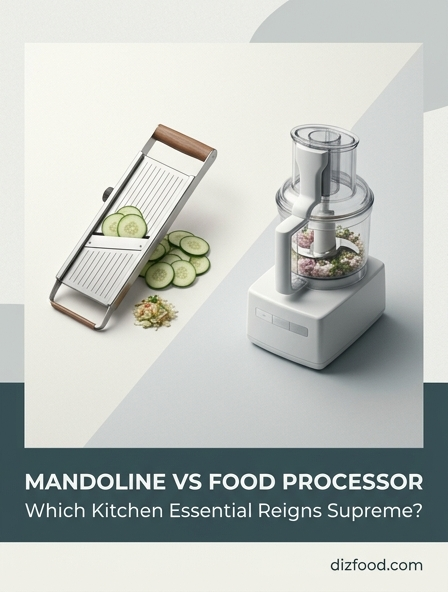
Mandoline vs Food Processor Slicing Precision and Consistency
When it comes to achieving the ultimate level of precision in the kitchen, the mandoline is often regarded as the superior tool. Its design allows the user to set a specific depth, ensuring that every single slice of a radish, potato, or apple is identical to the last. This level of uniformity is not just about aesthetics; it ensures even cooking times, which is critical for dishes like homemade potato chips or vegetable carpaccio. Because the food is moved manually across a stationary blade, the cook has tactile feedback and total control over the pressure and angle of the cut.
In contrast, a food processor relies on a spinning disc to perform its slicing duties. While modern high-end food processors offer adjustable slicing discs, they generally lack the microscopic precision of a sharp mandoline blade. The centrifugal force can occasionally cause softer vegetables to tilt or tear, leading to slices that are slightly tapered or uneven. However, for most home cooking applications, the consistency provided by a food processor is more than adequate. The choice between the two often comes down to the specific requirements of the recipe:
- Mandoline: Best for paper-thin translucent slices and professional-grade garnishes.
- Food Processor: Best for uniform slices where a slight variance in thickness is acceptable.
- Tactile Control: Mandolines offer direct contact, while food processors are automated.
Speed and Efficiency Comparison for Kitchen Prep
The debate between speed and efficiency depends largely on the volume of food being processed. A food processor is an industrial powerhouse capable of shredding a five-pound block of cheese or slicing a dozen onions in less than a minute. For bulk meal prep or large family gatherings, the electric motor does the heavy lifting, saving the cook from physical fatigue. However, the "hidden" time cost of a food processor lies in its setup and breakdown. Retrieving the heavy base, finding the correct blade, and assembling the lid can take longer than the actual chopping task.
A mandoline excels in "quick-hit" efficiency. If a chef needs to slice two cucumbers for a salad, a mandoline can be pulled from a drawer and used immediately. There is no cord to plug in and no heavy motor to lug around. While the manual motion takes more physical effort per slice than an electric tool, the lack of assembly time makes it the faster option for small to medium tasks. The following table compares the typical time spent on common prep tasks:
| Task | Mandoline Time | Food Processor Time |
|---|---|---|
| Slicing 2 Onions | 45 Seconds | 2 Minutes (with setup) |
| Slicing 10 lbs Potatoes | 15 Minutes | 3 Minutes |
| Cleaning the Tool | 1 Minute | 5 Minutes |
Safety Features and Risk Factors for Each Tool
Safety is perhaps the most significant point of divergence between these two kitchen staples. The mandoline is notoriously one of the most dangerous tools in a professional kitchen. Its blade is exceptionally sharp and often exposed, requiring the user to move their hand toward the cutting edge. Without the use of a safety guard or a cut-resistant glove, the risk of serious lacerations is high, especially as the vegetable gets smaller and the fingers get closer to the blade. Most modern mandolines include a "hand guard" or "pusher," but many users find them clunky and choose to bypass them, increasing risk.
Food processors are inherently safer because the cutting mechanism is fully enclosed within a plastic bowl. The motor will generally not engage unless the lid and the pusher are securely locked into place, creating a physical barrier between the blades and the user's hands. While the blades are still sharp during cleaning, the operational risk is nearly zero. When considering safety, users should follow these protocols:
- Always use the food guard provided with a mandoline slicer.
- Wear a chainmail or Kevlar cut-resistant glove when using manual slicers.
- Ensure the food processor is unplugged before reaching in to clear a jam.
- Store mandoline blades in their protective cases or locked positions.
Versatility in Cutting Styles and Blade Attachments
The food processor is a multi-functional workhorse that transcends simple slicing. By swapping out attachments, it can transform into a grater, a dough mixer, a blender, or a dicing machine. This versatility makes it an indispensable tool for bakers and those who make their own sauces or nut butters. It can handle textures that a mandoline cannot touch, such as emulsifying mayonnaise or pulsing cold butter into flour for pie crusts. Its utility is defined by its ability to change the state of the food entirely.
The mandoline is a specialist tool. While it cannot make dough or puree soup, it offers specialized "fancy" cuts that a food processor cannot replicate. Many mandolines come with interchangeable blades for julienne, matchsticks, crinkle cuts, and even waffle cuts (gaufrette). For a cook who prioritizes the visual presentation of vegetables, the mandoline offers a creative range that the utilitarian food processor lacks. While the food processor is a "jack of all trades," the mandoline is the master of the decorative slice. Common attachments for each include:
- Food Processor: S-blade, shredding disc, dough hook, and dicing kit.
- Mandoline: Straight blade, serrated blade, julienne teeth, and waffle-cut settings.
Ease of Cleaning and Storage Requirements
Storage and maintenance are often the deciding factors for home cooks with limited kitchen space. A mandoline is sleek, flat, and lightweight. It can easily slip into a narrow drawer or be hung on a hook. Cleaning a mandoline is usually a straightforward process: a quick rinse under hot soapy water is often enough to dislodge debris from the blade. Because it has few moving parts and no electronic components, it can be cleaned in seconds, though one must remain extremely cautious of the sharp edges during the process.
A food processor is a significant commitment in terms of real estate. The base is heavy and bulky, and the various bowls, lids, and blade attachments require substantial cabinet space. Cleaning is also a more involved affair. Food particles often get trapped in the handle of the bowl, the spindle, or the various crevices of the lid. While many parts are dishwasher safe, the sheer volume of components can quickly fill up a dishwasher rack. The choice between them often hinges on your kitchen's footprint:
| Feature | Mandoline | Food Processor |
|---|---|---|
| Storage Space | Minimal (Drawer) | Large (Counter/Cabinet) |
| Weight | 1-2 lbs | 10-20 lbs |
| Dishwasher Safe | Hand wash recommended | Mostly yes (Top rack) |
Best Use Cases for Mandoline Slicers in Cooking
The mandoline is the tool of choice when texture and presentation are the primary goals of a dish. For example, when making a traditional Gratin Dauphinois, the potatoes must be sliced thin enough to soften into the cream but thick enough to retain their shape. A mandoline allows the cook to dial in the exact millimeter required for this balance. Similarly, for salads featuring raw root vegetables like fennel or beets, the mandoline can produce shavings that are delicate and easy to chew, which would be impossible to achieve with a knife or a food processor.
Professional chefs also rely on the mandoline for garnishes that elevate a plate. Thinly julienned carrots for a slaw, perfectly round radish slices for a taco, or waffle-cut sweet potatoes for an appetizer are all hallmarks of mandoline work. Because it requires manual operation, it is best used for ingredients that are firm and can be held comfortably. It is particularly effective for:
- Cucumber Salads: Creating uniform ribbons or translucent rounds.
- Homemade Chips: Ensuring every slice fries at the exact same rate.
- Coleslaw: Shredding cabbage into fine, elegant strands.
- Truffles: Shaving expensive ingredients into paper-thin layers to maximize aroma.
When to Choose a Food Processor for Large Batches
There is a threshold where manual slicing becomes an exhausting chore rather than a culinary joy. When you are tasked with preparing food for a large party or engaging in "Sunday meal prep" for the entire week, the food processor is the logical choice. The speed at which an electric motor can process bulk produce is unmatched. If you are making a large batch of sauerkraut, for instance, a food processor with a slicing disc can shred several heads of cabbage in the time it would take to do half of one on a mandoline.
Furthermore, the food processor is the better option for tasks that require significant force or repetitive motion. Grating three pounds of carrots for a cake or shredding several blocks of mozzarella for a pizza party can be taxing on the wrists and shoulders. The food processor removes the physical strain from the equation. Consider the food processor for the following scenarios:
- Preparing bulk mirepoix (onions, carrots, celery) for soups and stews.
- Making large quantities of dip, such as hummus or pesto, where slicing is followed by pureeing.
- Processing tough ingredients that might resist a manual blade.
Maintenance and Longevity of Manual vs Electric Tools
The longevity of a kitchen tool is often inversely proportional to its complexity. A mandoline is a simple mechanical device. As long as the frame is made of high-quality stainless steel or durable BPA-free plastic, it can last for decades. The primary maintenance concern is the sharpness of the blade. While some high-end mandolines feature replaceable or sharpenable blades, many entry-level models are intended to be replaced once the blade dulls. However, because there are no motors to burn out or circuits to fail, a well-maintained mandoline is a very reliable long-term investment.
Food processors are more prone to mechanical failure over time. The motor can overheat if pushed too hard, and the plastic bowls are susceptible to cracking if dropped or exposed to high heat in a dishwasher. Furthermore, the interlocking safety mechanisms can sometimes become finicky or break, rendering the entire unit unusable. However, a high-quality food processor from a reputable brand often comes with a multi-year warranty on the motor, which is the most expensive component. To ensure longevity, users should avoid overloading the bowl and should hand-wash the blades to prevent the dulling effects of harsh dishwasher detergents.
Price Point and Value for Money Analysis
When analyzing value, the mandoline is the clear winner for those on a budget. You can purchase a professional-grade handheld mandoline for between $20 and $50. Even top-of-the-line French stainless steel models rarely exceed $150. For the home cook who only needs precision slicing occasionally, the mandoline provides high-end results with a very low barrier to entry. It is a specialized tool that does one thing exceptionally well for a relatively low cost.
A food processor is a more significant financial investment. Entry-level models start around $50, but these often lack the power and durability required for heavy tasks. A high-performance food processor typically costs between $200 and $500. However, the value lies in its multi-functionality. Because it replaces a grater, a blender, and a stand mixer for certain tasks, the high price tag can be justified as an "all-in-one" kitchen solution. The following table summarizes the general pricing tiers:
| Category | Mandoline Price | Food Processor Price |
|---|---|---|
| Budget | $15 - $30 | $40 - $80 |
| Mid-Range | $40 - $70 | $100 - $200 |
| Professional | $100 - $200 | $300 - $600+ |
Final Verdict Which Tool Should You Choose
The choice between a mandoline and a food processor ultimately depends on your cooking style and the size of your household. If you are a culinary enthusiast who values artistic presentation, enjoys making delicate salads, and often cooks for just one or two people, the mandoline is an essential tool. Its ability to produce paper-thin, uniform slices with minimal cleanup makes it the preferred choice for precision-oriented tasks. It is the surgical scalpel of the kitchen-sharp, focused, and efficient.
On the other hand, if you prioritize power, speed, and multi-functionality, the food processor is the better investment. It is the heavy machinery of the kitchen, designed to tackle high-volume prep and complex tasks like kneading dough or emulsifying sauces. For families, meal-preppers, and those who frequently host large gatherings, the time saved by a food processor far outweighs the extra effort required for cleaning and storage. To help you decide, consider these final points:
- Choose a Mandoline if: You have limited space, value precision over volume, and want specialized cuts like julienne or waffles.
- Choose a Food Processor if: You cook in large batches, need a tool that can grate and puree, and prefer a higher level of built-in safety.
- The Ideal Setup: Many serious cooks find that owning both tools provides the perfect balance of precision and power.

Comments