
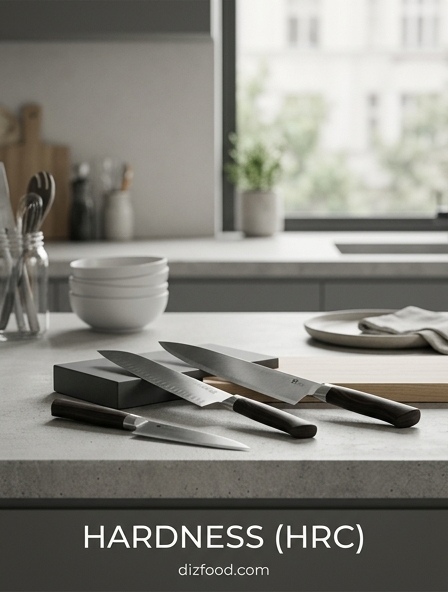
Understanding the Rockwell Scale for Kitchen Knives
The Rockwell C Scale (HRC) is a standard measure used in metallurgy to determine the indentation hardness of a material. In the context of kitchen cutlery, it identifies how resistant a blade is to permanent deformation when a specific load is applied via a diamond-tipped cone. Manufacturers typically test the core of the blade to provide a rating that usually falls between 52 and 66 for kitchen tools. A higher number indicates a harder material, which is a primary indicator of how the knife will perform under various culinary stresses.
Understanding this scale is vital for consumers because it dictates the lifespan and functionality of the tool. Most mass-produced European knives sit between 54 and 58 HRC, offering a balance of toughness. In contrast, premium Japanese knives often reach 60 to 64 HRC, prioritizing extreme sharpness. The scale is logarithmic in nature; even a difference of two points can represent a significant change in the molecular structure and mechanical properties of the steel. This metric serves as a baseline for determining whether a knife is built for heavy-duty butchery or delicate, precise slicing tasks.
HRC Impact on Blade Edge Retention
Edge retention refers to a knife's ability to remain sharp during prolonged use. The HRC rating plays a pivotal role here; harder steel possesses a tighter molecular structure that resists "rolling" or "folding" at the apex of the edge. When a blade strikes a cutting board, a softer steel with a lower HRC will microscopically deform, leading to a dull sensation. Harder steels, particularly those above 60 HRC, maintain their alignment for significantly longer periods, allowing for thousands of cuts before requiring maintenance.
This characteristic is highly sought after in environments where high-volume prep is common. However, edge retention is not solely dependent on hardness; the chemical composition of the steel, such as the presence of vanadium or tungsten carbides, also contributes. Nevertheless, HRC remains the most reliable predictor of how long a blade will stay sharp.
- 52-54 HRC: Low retention, requires frequent honing.
- 55-58 HRC: Moderate retention, standard for home use.
- 59-62 HRC: High retention, maintains edge through heavy prep.
- 63+ HRC: Extreme retention, designed for precision slicing.
Durability versus Brittleness in High HRC Steel
The relationship between hardness and durability is an inverse one in the world of metallurgy. While high HRC steel provides an incredibly keen edge, it also becomes inherently brittle. This brittleness means the steel is less capable of absorbing shocks or lateral pressure. If a high HRC blade strikes a bone, a frozen item, or even a hard plastic cutting board at an awkward angle, it is more likely to chip or crack rather than bend. This makes high-hardness knives specialized tools rather than general-purpose workhorses.
Conversely, lower HRC steels are considered "tough." They can withstand significant abuse, such as being dropped or used for prying, because the steel is malleable enough to flex without snapping. This makes them ideal for tasks like cleaving through poultry bones or heavy-duty vegetable prep. Users must choose between the durability of a soft blade that might dull quickly but rarely breaks, and the performance of a hard blade that stays sharp but requires delicate handling. This trade-off is the central conflict in knife selection, requiring the cook to match the tool to the specific technique.
The Relationship Between Steel Hardness and Sharpening Ease
There is a direct correlation between HRC ratings and the effort required to sharpen a blade. Soft steels, typically those below 56 HRC, are very forgiving. They can be easily realigned using a standard honing rod and quickly sharpened on a low-grit stone. The metal is removed easily, meaning a dull knife can be brought back to a functional edge in minutes. However, because the steel is soft, the edge will also degrade just as quickly as it was repaired, leading to a cycle of frequent maintenance.
Harder steels present a different challenge. Blades with an HRC of 61 or higher are resistant to abrasion, making the sharpening process much more time-consuming. These knives often require specialized ceramic rods or high-quality whetstones infused with synthetic diamonds or high-grade abrasives to "bite" into the steel. While the process takes longer and requires more technical skill, the result is an edge that is significantly thinner and sharper than what can be achieved on soft steel. For many, the reward of a long-lasting, surgical edge justifies the increased difficulty in the maintenance routine.
Comparing Soft Steel and Hard Steel Performance
Choosing between soft and hard steel depends largely on the intended application and the user's maintenance habits. Soft steel is often preferred in commercial butcheries and busy family kitchens where speed and durability are paramount. Hard steel is the darling of fine-dining chefs and enthusiasts who demand microscopic precision. The performance differences are best understood through their mechanical limits and intended environments.
| Feature | Soft Steel (54-56 HRC) | Hard Steel (60-64 HRC) |
|---|---|---|
| Edge Life | Short | Long |
| Toughness | High (Resistant to chips) | Low (Prone to chipping) |
| Sharpening | Fast and easy | Slow and technical |
| Common Use | Cleavers, Utility knives | Sujihiki, Gyuto, Paring |
Soft steel performance is characterized by its toughness, allowing it to roll rather than break when encountering hard surfaces. Hard steel performance is defined by stiffness, allowing the manufacturer to grind the blade to a much more acute angle. While a soft blade might be sharpened to a 20-degree angle, a hard blade can often support a 12-degree angle, resulting in drastically less resistance during a cut.
Why HRC Ratings Matter for Professional Chefs
For a professional chef, a knife is an extension of the hand, and HRC ratings are a critical specification for daily productivity. In a high-volume kitchen, stopping every twenty minutes to hone a blade is inefficient. Chefs often opt for knives with an HRC of 58 to 61 because they offer a balance: they hold an edge through a full shift of prep work but are not so brittle that they will shatter if dropped in a fast-paced environment. This reliability is essential for maintaining the flow of a service line.
Furthermore, HRC impacts the level of detail a chef can achieve. In tasks like sushi preparation or fine brunoise cutting, a high HRC blade allows for the extreme thinness necessary to prevent bruising delicate ingredients like herbs or raw fish. Professionals also understand that HRC dictates the type of cutting board they must use; hard blades require soft wood or synthetic rubber boards to prevent premature chipping. Ultimately, the HRC rating tells a professional how much they can trust their tool to perform under pressure without failing or losing its bite mid-service.
Finding the Ideal HRC for Home Cooking
For the average home cook, the quest for the highest possible HRC can actually be counterproductive. While the allure of a 64 HRC Japanese blade is strong, most home kitchens are better served by a "sweet spot" between 56 and 58 HRC. This range provides enough edge retention to last through several weeks of casual meal prep while remaining durable enough to survive the occasional accidental contact with a ceramic plate or a granite countertop. This balance reduces the anxiety of damaging an expensive tool during routine tasks.
Knives in this range are also more compatible with common home maintenance tools, such as pull-through sharpeners or basic honing steels, which might damage harder blades. A home cook who prioritizes versatility-using one knife for everything from dicing onions to cutting through a chicken joint-will find a mid-range HRC much more forgiving. It offers a balance where the knife stays sharp enough to be enjoyable but is rugged enough to not require a professional's touch for every minor repair. Finding the ideal HRC is about matching the tool to your actual habits rather than chasing professional-grade specifications.
How Heat Treatment Influences Knife Longevity
The HRC of a knife is not determined solely by the type of steel used, but by the precision of the heat treatment process. Two knives made from the same VG-10 stainless steel can have different HRC ratings based on how they were heated, quenched, and tempered. During heat treatment, the steel is brought to a critical temperature where its crystalline structure changes. It is then rapidly cooled (quenched) in oil, water, or air to "lock" that hardness in place. This process is the most delicate stage of manufacturing.
However, quenched steel is extremely brittle. To achieve a functional HRC, the blade must undergo tempering-reheating it to a lower temperature to trade some hardness for toughness. This delicate dance determines the knife's longevity and performance consistency.
- Cryogenic Treatment: Cooling the steel to sub-zero temperatures to further refine grain structure.
- Differential Tempering: Making the edge harder than the spine for a mix of sharpness and flexibility.
- Soak Time: How long the steel stays at peak temperature affects carbide distribution.
A superior heat treatment ensures the HRC is consistent across the entire edge, preventing soft spots that would dull prematurely or cause uneven wear.
Balancing Edge Sharpness and Structural Integrity
Achieving the perfect knife involves a constant struggle between edge geometry and structural integrity. A thinner edge cuts better because it encounters less friction, but a thin edge requires hard steel to prevent it from collapsing under pressure. This is why high HRC ratings are often paired with "laser" grinds. If a manufacturer tried to sharpen a soft 54 HRC knife to a 10-degree angle, the edge would fold almost instantly upon contact with a cutting board, rendering the knife useless.
Structural integrity is the blade's ability to maintain its shape under load. As HRC increases, the steel's yield strength increases, meaning it can handle more force before it deforms permanently. However, this comes at the cost of fracture toughness. A well-designed knife balances these factors by using a high HRC core for the edge, often "clad" in layers of softer stainless steel. This lamination technique provides the structural integrity of a tough blade with the razor-sharp capabilities of high-hardness steel. It allows the user to enjoy a high-performance edge without the fear of the entire knife snapping in half during a demanding task.
Maintaining High HRC Blades in a Kitchen Environment
Owning a high HRC blade requires a shift in kitchen habits to ensure the tool's longevity. Because these blades are prone to micro-chipping, they should never be used on hard surfaces like glass, marble, or bamboo. Instead, use end-grain wood or soft plastic boards that absorb the impact. Storage is equally important; high HRC knives should never be tossed in a utensil drawer where they can clatter against other metal tools. A magnetic strip or a dedicated knife block is essential to protect the delicate edge from unnecessary contact.
Maintenance also differs for hard steel. Traditional ribbed honing steels can actually cause chips in a 62 HRC blade; ceramic honing rods or leather strops are much safer alternatives for daily edge alignment. Finally, hand-washing is non-negotiable. The high heat and abrasive detergents in a dishwasher can cause thermal shock and physical damage to the refined grain structure of hard steel. By following these protocols, a high HRC knife will not only maintain its superior cutting performance but will also remain a functional heirloom for decades, proving that the extra care is a small price for surgical precision.



Comments