
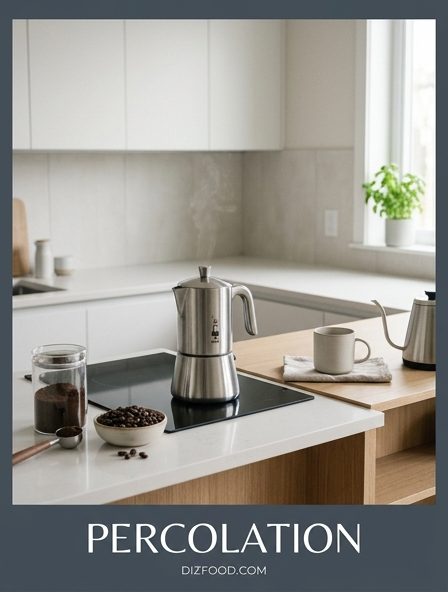
Fundamentals of Coffee Percolation Chemistry
Percolation chemistry revolves around the efficient transfer of soluble compounds from coffee grounds into a liquid solvent. This process is driven by diffusion and osmosis, where water acts as the primary medium for extracting volatile aromatics, lipids, and organic acids. During percolation, fresh water continuously interacts with the coffee bed, maintaining a steep concentration gradient that encourages the rapid movement of molecules. The chemical composition of the final brew is determined by the specific rate at which different compounds dissolve. Polar molecules, such as fruit acids and caffeine, are among the first to be extracted due to their high solubility.
- Organic Acids: Responsible for brightness and fruit-like notes.
- Maillard Products: Provide savory, toasted, and nutty flavors.
- Phenylindanes: Contribute to the perceived bitterness and body.
As the extraction progresses, heavier compounds like tannins and bitter plant fibers begin to dissolve. Achieving the perfect chemical balance requires stopping the percolation before these less desirable elements dominate the profile. The chemistry is a dynamic race between sweetness, acidity, and bitterness, dictated by the solvent's ability to navigate the complex cellular structure of the roasted coffee bean.
The Physics of Water Flow and Extraction
The physics of percolation is largely governed by fluid dynamics and Darcy's Law, which describes the flow of a fluid through a porous medium. In a kitchen setting, gravity provides the necessary force to push water through the compressed bed of coffee. The resistance encountered by the water is a function of the bed's permeability, which is influenced by the density of the pack and the particle size. If the water finds a path of least resistance, it creates "channeling," where certain areas are over-extracted while others remains dry, leading to a thin and uneven flavor profile.
Hydrostatic pressure and surface tension also play critical roles. Water must overcome the surface tension to penetrate the microscopic pores of the coffee grounds. As the liquid moves downward, it carries dissolved solids, increasing the viscosity of the solution. This change in viscosity can slightly alter the flow rate toward the end of the brew. Understanding these physical constraints allows for better control over the contact time and ensures that the water interacts uniformly with every particle in the basket.
Optimizing Grind Size for Flavor Clarity
Grind size is perhaps the most significant variable in percolation, as it determines the total available surface area for extraction. A finer grind increases the surface area, slowing down the flow of water and increasing the contact time. Conversely, a coarse grind allows water to pass through quickly, which may result in under-extraction if not managed correctly. Flavor clarity depends on a uniform particle size distribution, often referred to as a "narrow grind spectrum."
| Grind Setting | Surface Area | Flow Resistance | Flavor Impact |
|---|---|---|---|
| Fine | High | Significant | Intense, Higher Bitterness |
| Medium | Moderate | Balanced | Sweet, Balanced Acidity |
| Coarse | Low | Minimal | Bright, Potentially Sour |
In percolation, "fines"-extremely small dust-like particles-can clog the filter and cause bitterness. "Boulders"-large chunks-can lead to watery, sour notes. Achieving flavor clarity requires a high-quality burr grinder that minimizes these outliers, ensuring that the extraction proceeds at a predictable and even pace across the entire coffee bed.
Temperature Control for Vibrant Acidity
Thermal energy is the catalyst for the chemical reactions occurring during percolation. Higher temperatures increase the kinetic energy of water molecules, allowing them to break molecular bonds within the coffee grounds more effectively. For a vibrant and acidic profile, temperature stability is essential. Typically, water between 90°C and 96°C is ideal for extracting the delicate organic acids that define specialty coffee. If the temperature is too low, the acids remain trapped, resulting in a flat or metallic taste.
However, excessive heat can lead to the extraction of astringent polyphenols, which mask the pleasant acidity with a dry, mouth-puckering sensation. Different roast levels require different thermal approaches; lighter roasts benefit from higher temperatures to assist in breaking down their denser cellular structures, while darker roasts require cooler water to prevent the over-extraction of carbonaceous and bitter compounds. Maintaining a consistent temperature throughout the brewing cycle ensures that the extraction profile remains stable from the first drop to the last, preserving the nuanced brightness of the beans.
The Role of Filter Media in Crispness
The choice of filter media acts as the final gatekeeper for the sensory characteristics of the percolated beverage. Filters do more than just hold the grounds; they selectively remove specific compounds based on their material properties and pore size. Paper filters are known for producing a "crisp" and "clean" cup because they are dense enough to trap fine particles and absorb most of the coffee's insoluble oils and diterpenes like cafestol.
- Bleached Paper: Offers the highest clarity with no papery aftertaste.
- Unbleached Paper: Provides a similar texture but requires thorough rinsing to remove woody notes.
- Metal Mesh: Allows oils and micro-sediment to pass through, creating a heavy body and creamy mouthfeel.
- Cloth: A hybrid option that traps fines but allows some oils, resulting in a rich yet clean profile.
The thickness and weave of the filter also influence the flow rate. A thicker paper filter provides more resistance, increasing contact time and potentially enhancing sweetness, whereas a thinner filter facilitates a faster draw-down, highlighting top-note acidity. Matching the filter to the desired outcome is vital for achieving the specific clarity intended by the brewer.
Balancing Extraction Time for Bright Profiles
Extraction time, or "contact time," is the duration for which the water is in active contact with the coffee grounds. In percolation, this is a product of the grind size, dose, and pouring technique. Timing is the primary tool for balancing the three phases of extraction: acidity, sweetness, and bitterness. A short extraction time often highlights the "bright" notes-the fruity and floral acids that dissolve first. However, if the time is too short, the brew lacks the sugar development necessary to balance that acidity, leading to a sour result.
- Under-extracted: Fast flow, sour taste, salty notes, thin body.
- Ideally extracted: Balanced flow, sweet, transparent acidity, lingering finish.
- Over-extracted: Slow flow, bitter, astringent, dry mouthfeel.
To achieve a bright profile without sourness, brewers must find the "sweet spot" where enough sugars have been extracted to provide a foundation for the acids. This is usually managed by adjusting the pour rate or the grind size to ensure the total brew time falls within a specific window, typically three to four minutes for most pour-over methods.
Understanding the Bloom Phase Dynamics
The bloom phase is the initial wetting of the coffee grounds, usually involving a small amount of water (about twice the weight of the coffee). This step is crucial for percolation because it facilitates the release of trapped carbon dioxide (CO2) gas, a byproduct of the roasting process. If CO2 is not removed, it creates a physical barrier that repels water, preventing even saturation and leading to uneven extraction. The visible bubbling during the bloom is the "degassing" process in action.
Properly managing the bloom enhances the overall clarity of the final cup. A typical bloom lasts between 30 and 45 seconds. By allowing the gas to escape, the coffee bed becomes more permeable and receptive to the subsequent pours. This phase also warms the brewing vessel and the filter, stabilizing the temperature for the remainder of the percolation. Neglecting the bloom often results in a "trapped" flavor where the vibrant notes are muted by the interference of the gas, making the resulting brew taste underdeveloped and inconsistent.
Impact of Water Chemistry on Percolation
Water is the solvent that performs the work of extraction, and its chemical composition significantly impacts the flavor of the percolated coffee. Distilled water is an aggressive solvent but lacks the minerals necessary to pull out complex flavors, often resulting in a flat, sharp brew. Conversely, water that is too hard-containing high levels of calcium and magnesium-can lead to a chalky or dull flavor profile and may cause scale buildup in equipment.
The specific mineral content matters:
- Magnesium: Highly effective at extracting sharp, fruity flavors and acidity.
- Calcium: Enhances the extraction of heavier, creamier notes and sweetness.
- Bicarbonate: Acts as a buffer; too much will neutralize the pleasant acids, making the coffee taste bland.
The ideal water for percolation is "soft" but mineralized, with a total dissolved solids (TDS) count of approximately 150 mg/L. By controlling the alkalinity and the ratio of magnesium to calcium, brewers can fine-tune which chemical compounds are prioritized during the percolation process, effectively "sculpting" the flavor profile from the molecular level up.
Fine Tuning Agitation for Even Saturation
Agitation refers to the physical disturbance of the coffee grounds during the brewing process. In percolation, agitation is primarily introduced by the stream of water hitting the bed, but it can also be supplemented by stirring or swirling. Controlled agitation is beneficial because it ensures that all coffee particles are hydrated simultaneously, preventing dry pockets and promoting a more uniform extraction. However, excessive agitation can be detrimental; it may cause "fines" to migrate to the bottom of the filter, clogging the pores and causing the water to stall.
Techniques for managing agitation include:
- Pour Height: Higher pours increase the kinetic energy and turbulence in the bed.
- Pour Pattern: Concentric circles ensure the center and edges are equally saturated.
- Mechanical Agitation: A gentle stir with a spoon can break up clumps during the bloom.
The goal is to provide just enough movement to ensure saturation without disrupting the structural integrity of the coffee bed. Mastering agitation allows the brewer to increase extraction efficiency and achieve a higher degree of consistency across multiple brews.
Comparing Percolation and Immersion Science
While both percolation and immersion are methods of extraction, they operate on different scientific principles. In immersion brewing, such as a French Press, the coffee grounds are submerged in a fixed volume of water for the entire duration. This leads to a decreasing concentration gradient as the water becomes saturated with coffee solids, eventually reaching an equilibrium where extraction slows down significantly. This typically results in a fuller body but lower flavor clarity.
Percolation, however, is a dynamic process where fresh water is constantly introduced. This maintains a high concentration gradient throughout the brew, allowing for a more efficient and thorough extraction of soluble materials. Because the water passes through the bed and a filter, the resulting liquid is much cleaner and more nuanced.
- Percolation: Constant fresh solvent, filtered, high clarity, dynamic gradient.
- Immersion: Static solvent, unfiltered or coarsely filtered, high body, equilibrium-based.
This fundamental difference explains why percolation is often preferred for highlighting the complex, acidic, and floral notes of single-origin coffees, while immersion is favored for its simplicity and heavy, chocolatey textures.





Comments