
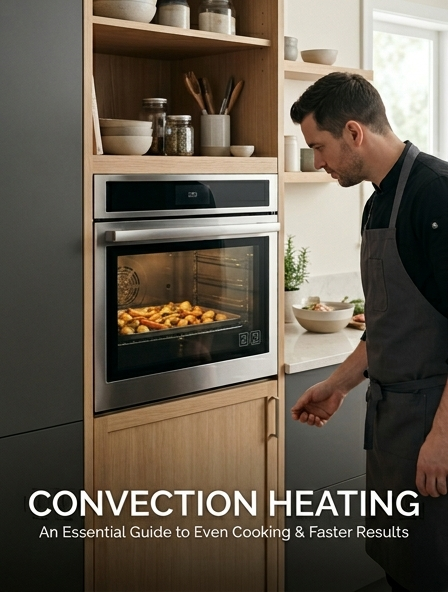
Modern kitchen results rely heavily on the magic of convection heating technology, a system that utilizes powerful internal fans to circulate hot air continuously around your food. Unlike traditional radiant heat, this constant airflow eliminates stagnant cold spots, ensuring that every dish cooks at a perfectly consistent temperature. This efficient process is the secret behind achieving professional-grade textures, such as golden-brown, crispy exteriors paired with tender, succulent interiors. By rapidly removing surface moisture, convection transforms standard roasting and baking into a superior culinary experience. To find the right fit for your countertop, it is essential to compare the mechanics of an air fryer vs convection oven for optimal crisping performance.
The Science of Airflow in Modern Ovens
The core principle behind convection heating is the active movement of air, which transforms the oven cavity from a stagnant chamber into a dynamic environment. In a standard oven, air remains relatively still, relying on natural rising and falling patterns that often lead to inconsistent heat transfer. Modern convection systems utilize high-velocity fans and strategically placed exhaust vents to circulate heated air continuously around the food. This movement strips away the "cold boundary layer"-a thin envelope of cooler air and evaporated moisture that naturally surrounds food as it cooks.
- Forced Convection: Mechanical assistance from fans increases the rate of heat energy transfer to the food's surface.
- Boundary Layer Reduction: Rapid airflow minimizes the insulation provided by moisture, allowing heat to penetrate more directly.
- Thermal Equilibrium: Constant circulation ensures that the temperature near the heating element is nearly identical to the temperature in the furthest corner.
By optimizing these aerodynamic variables, convection ovens achieve a state of thermal efficiency that traditional radiant ovens cannot match. This mechanical advantage ensures that every cubic inch of the appliance contributes to the cooking process, resulting in a more predictable and scientific approach to culinary heat application.
Convection Versus Traditional Thermal Heating
Understanding the distinction between convection and traditional thermal heating is essential for mastering different culinary techniques. Traditional ovens rely on radiant heat from stationary elements, which can create significant temperature variances between the top and bottom racks. In contrast, convection ovens emphasize the movement of heat through a fluid medium-in this case, air. This fundamental difference affects how energy interacts with the ingredients, often necessitating adjustments in both time and temperature settings.
| Feature | Traditional Thermal | Convection Heating |
|---|---|---|
| Heat Source | Static Radiant Elements | Circulated Hot Air |
| Air Movement | Passive/Natural Rise | Active/Fan-Driven |
| Cooking Speed | Standard Reference | 20-25% Faster |
| Heat Distribution | Potential Hot Spots | Highly Uniform |
While traditional heating is often preferred for slow-cooked items that require minimal surface disturbance, convection excels in scenarios where rapid heat transfer and surface dehydration are desired. The choice between these two methods depends largely on the desired texture of the final dish and the volume of food being prepared simultaneously.
Achieving the Perfect Golden Crust
The secret to a superior golden crust lies in the rapid dehydration of the food's exterior. Convection heating is uniquely suited for this task because the moving air quickly carries away the steam released by the food during the initial stages of cooking. When moisture lingers on the surface, the food effectively steams rather than roasts, resulting in a pale, soft exterior. By maintaining a dry environment directly at the surface interface, the oven allows the temperature of the outer layer to rise quickly above the boiling point of water.
- Preheat the oven thoroughly to ensure the fan is circulating air at the target temperature before the food enters.
- Avoid overcrowding the pan, as restricted airflow can trap moisture between items.
- Use low-sided roasting pans to allow the circulating air to reach the bottom and sides of the food.
This process is particularly effective for poultry, roasted vegetables, and crusty breads. The constant airflow ensures that sugars on the surface caramelize evenly, producing a uniform, mahogany finish that provides both visual appeal and a satisfying textural contrast. Without the mechanical assistance of convection, achieving this level of crispness often requires much longer cooking times, which risks drying out the interior of the dish.
Eliminating Hot Spots for Uniform Results
One of the most persistent frustrations in traditional baking is the presence of hot spots-localized areas where the temperature is significantly higher than the set point. These occur because of the proximity to heating elements and the lack of air movement, forcing bakers to rotate trays mid-cycle to prevent burning. Convection heating addresses this issue by equalizing the temperature throughout the entire oven cavity. Because the fan keeps the air in constant motion, heat energy is distributed evenly across all racks, regardless of their position.
- Multi-Rack Baking: You can bake multiple sheets of cookies simultaneously without worrying about the bottom tray burning.
- Reduced Manual Intervention: There is no longer a need to open the door to rotate pans, which helps maintain a steady internal temperature.
- Predictable Browning: Every item on a tray receives the same amount of heat, ensuring a consistent batch every time.
This uniformity is not just a convenience; it is a critical factor in professional-grade results. When every part of the oven behaves the same way, the cook can focus on the timing and quality of the ingredients rather than managing the quirks of the appliance. This reliability makes convection the preferred choice for high-volume baking and roasting.
The Role of Fans in Moisture Retention
A common misconception is that the moving air of a convection oven dries out the interior of the food. In reality, the opposite is often true, especially when roasting meats. The rapid heat transfer facilitated by the fan creates a quick "sear" on the exterior of the item. This accelerated surface cooking helps to lock in internal juices by creating a protective barrier more quickly than a traditional oven would. Because the cooking time is reduced, the food spends less total time in the heat, which preserves the moisture content of the protein fibers.
Furthermore, many modern convection ovens include "true" convection or European convection, which adds a third heating element behind the fan. This allows for even more precise control over the air temperature, ensuring that the moisture is retained through efficient energy use. The result is a roast that is significantly juicier on the inside while remaining perfectly browned on the outside. For delicate items like fish or lean cuts of meat, this balance between surface crisping and internal moisture retention is the hallmark of professional-level cooking. By mastering the airflow, home cooks can achieve succulent results that were previously difficult to replicate outside of a commercial kitchen environment.
Faster Cooking Times Without Quality Loss
Efficiency is perhaps the most celebrated benefit of convection technology. Because moving air transfers heat more effectively than still air, food cooks approximately 25% faster. This reduction in time does not come at the expense of quality; rather, it often improves the final product by minimizing the duration the food is exposed to potentially drying heat. The intensity of the convection environment means that lower temperatures can often produce the same results as higher temperatures in a conventional oven.
- Time Conversion: A recipe designed for 60 minutes may only require 45 to 50 minutes in a convection setting.
- Energy Savings: Shorter run times and lower temperature requirements lead to reduced household energy consumption.
- Improved Throughput: Faster cycles allow for more efficient meal preparation, especially during holiday cooking or large gatherings.
To prevent overcooking, it is standard practice to reduce the recommended recipe temperature by 25 degrees Fahrenheit and begin checking for doneness significantly earlier. This adjustment accounts for the increased kinetic energy of the air, ensuring that the speed of the process does not compromise the texture or flavor of the dish.
Enhancing Maillard Reaction for Richer Flavors
The Maillard reaction is a chemical process between amino acids and reducing sugars that gives browned food its distinctive, savory flavor. Convection heating is a catalyst for this reaction because it optimizes the conditions under which these chemical changes occur. The reaction requires heat and the removal of surface moisture, both of which are accelerated by the fan-driven airflow of a convection oven. As the air circulates, it breaks down the moisture barrier faster than radiant heat alone, allowing the surface temperature to reach the 285°F to 330°F range where the Maillard reaction thrives.
- The fan removes steam, preventing the food from hovering at the 212°F boiling point.
- Surface proteins and sugars begin to restructure, creating hundreds of new flavor compounds.
- The uniform airflow ensures this reaction happens evenly across the entire surface area of the food.
This is why roasted vegetables from a convection oven taste sweeter and more complex, and why meats develop a deeper, more savory profile. By enhancing the efficiency of this reaction, convection heating doesn't just cook food faster; it fundamentally improves the depth of flavor by maximizing the chemical potential of the ingredients.
Optimizing Heat Circulation for Delicate Pastries
When it comes to delicate pastries like cream puffs, croissants, and puff pastry, convection heating is a game-changer. These items rely on the rapid expansion of steam within their layers to achieve "lift" and a light, airy texture. The consistent and intense heat of a convection oven provides the necessary energy to turn internal moisture into steam almost instantly as the pastry enters the oven. This quick burst of heat ensures that the structure sets while the pastry is at its maximum height, preventing the dreaded collapse that can occur with uneven heating.
Additionally, the uniform air circulation prevents the bottoms of the pastries from burning before the centers are fully cooked. In a traditional oven, the bottom heat can often be too aggressive for delicate butter-based doughs. Convection mitigates this by surrounding the pastry with tempered air, cooking it from all angles simultaneously. This results in a superior flake and a professional-grade honeycomb structure inside the pastry. For the best results, bakers often use perforated baking mats or mesh trays to allow the air to circulate even more freely around the base of the delicate items, ensuring every layer is perfectly toasted and crisp.
Professional Textures in the Home Kitchen
The leap from home-cooked to professional-quality food often boils down to texture. Professional chefs rely on high-end equipment to achieve specific textural benchmarks-silky interiors, shatteringly crisp crusts, and uniform browning. Convection technology brings this capability into the domestic sphere by providing the control and consistency required for these results. By mimicking the airflow patterns found in commercial combi-ovens, home convection units allow for a level of precision that makes complex recipes more accessible and successful.
- Shatter-Crisp Skin: Ideal for roast chicken or duck where a parchment-thin, crunchy skin is the goal.
- Tender Crumb: Ensures cakes and muffins rise evenly and maintain a soft, consistent internal structure.
- Caramelized Edges: Perfect for roasted root vegetables, providing a sweet, slightly charred exterior without mushiness.
Achieving these textures requires an understanding of how air moves within the specific oven model. Once a cook masters the interplay between airflow and temperature, the kitchen becomes a laboratory for high-end culinary execution. The ability to reliably produce these textures transforms simple meals into gourmet experiences, proving that the right application of physics is just as important as the recipe itself.
Mastering Temperature Control for Consistent Outcomes
Consistency is the hallmark of a master cook, and convection heating is the ultimate tool for achieving it. Traditional ovens fluctuate in temperature as the heating elements cycle on and off, creating a "sine wave" of heat that can be unpredictable. Convection ovens, particularly those with sophisticated sensors, maintain a much tighter temperature range. This stability is vital for precision tasks such as roasting large cuts of meat to a specific internal temperature or baking delicate soufflés that require a steady environment.
| Technique | Temperature Adjustment | Primary Benefit |
|---|---|---|
| Roasting Meat | Lower by 25°F | Even doneness from edge to center |
| Baking Cookies | Reduce time by 20% | Uniform color across multiple trays |
| Dehydrating | Lowest setting + Fan | Rapid moisture removal without cooking |
To master this control, it is recommended to use an internal oven thermometer to verify the accuracy of the appliance's settings. Since the fan increases the "perceived heat" by the food, the numerical setting on the dial is only part of the equation. By combining precise temperature settings with the mechanical advantage of forced air, you create a controlled culinary environment that yields identical, high-quality results every time the oven is turned on.


Comments