
When it comes to mastering the art of low-and-slow cooking, choosing between a Dutch oven and a braiser is all about matching your kitchen tool to your culinary goals. The Dutch oven is the ultimate deep-vessel workhorse, featuring tall sides that minimize evaporation-perfect for hearty stews, baking crusty bread, or submerging a whole pot roast. Conversely, the braiser is designed with a wide base and sloped sides to maximize surface area, making it the champion of searing meats and reducing savory sauces with precision. While both offer the incredible heat retention of enameled cast iron, the Dutch oven excels in volume-heavy liquid recipes, while the braiser thrives in shallow-liquid environments where browning and texture take center stage.
| Feature | Dutch Oven | Braiser |
|---|---|---|
| Shape & Depth | Tall, vertical walls; deep interior. | Wide base; short, sloped sides. |
| Primary Use | Deep simmering, boiling, & baking. | Searing, shallow frying, & reduction. |
| Surface Area | Moderate; optimized for volume. | Expansive; optimized for browning. |
| Liquid Capacity | High (typically 4-9+ quarts). | Low to Medium (typically 2-5 quarts). |
| Best Recipes | Soups, stews, chili, & sourdough. | Chicken thighs, meatballs, & short ribs. |
| Moisture Control | Heavy lid locks in max steam. | Encourages controlled evaporation. |
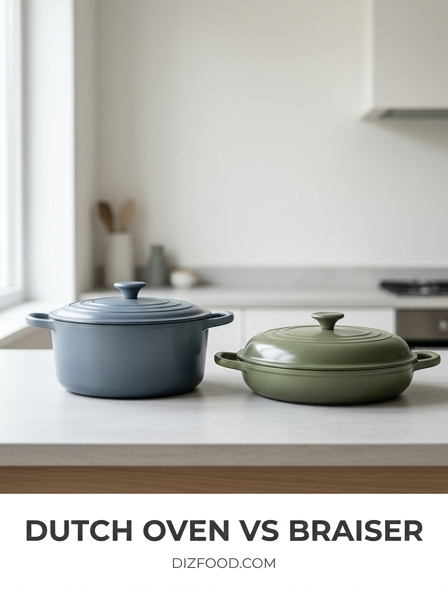
Dutch Oven vs Braiser Key Differences
The primary distinction between a Dutch oven and a braiser lies in their geometric proportions and intended culinary utility. A Dutch oven is characterized by its high, vertical walls and a relatively narrow base compared to its height. This design is optimized for volume-heavy tasks, such as simmering large batches of soup or boiling pasta. In contrast, a braiser features shorter, often sloped sides and a significantly wider base. While both vessels are frequently made from enameled cast iron, their silhouettes dictate how heat and moisture interact with the ingredients inside.
Functionally, the Dutch oven acts as a versatile "pot," whereas the braiser acts more like a hybrid between a skillet and a pot. Because the Dutch oven is deeper, it is better suited for deep-frying or baking tall loaves of sourdough bread. The braiser, however, excels at shallow-frying and reducing sauces due to its increased surface area. When choosing between the two, home cooks must consider the following fundamental attributes:
- Wall Height: Dutch ovens typically range from 5 to 7 inches deep, while braisers usually stay under 3 inches.
- Lid Shape: Braisers often feature domed lids to accommodate larger cuts of meat that might peak above the rim, whereas Dutch oven lids are usually flatter.
- Moisture Retention: Dutch ovens excel at trapping steam for long, wet cooks; braisers allow for slightly more evaporation, which is ideal for thickening sauces.
Ultimately, while they can often be used interchangeably in a pinch, the Dutch oven is the heavy-duty workhorse for bulk cooking, while the braiser is the refined tool for precision searing and simmering.
Understanding Design and Shape Variations
The design of a Dutch oven is rooted in the "cocotte" tradition, emphasizing verticality. The high walls serve a dual purpose: they prevent liquids from splashing out during a vigorous boil and they create a massive thermal environment that surrounds food with consistent heat. This shape is essential for recipes that require total immersion, such as a traditional beef bourguignon or a slow-simmered marinara sauce. The weight of the vessel is usually concentrated in the thick bottom and the heavy, tight-fitting lid, which ensures that pressure remains constant during oven roasting.
The braiser, sometimes referred to as a "buffet casserole" or "everyday pan," prioritizes width over depth. The wide, flat bottom allows for more ingredients to make direct contact with the heat source simultaneously. This is a critical design variation because it prevents "crowding the pan," a common mistake that leads to steaming rather than browning. The sloped sides of the braiser are also designed for easy access with a spatula or tongs, making it much easier to flip delicate proteins like fish fillets or chicken thighs without the awkward maneuvering required in a deep-walled Dutch oven.
Furthermore, the handles on these vessels often differ to reflect their weight distribution. Dutch ovens typically have smaller, more compact loop handles to fit easily inside a crowded oven. Braisers often feature wider, more ergonomic handles, as they are frequently moved from the stovetop directly to the dining table for serving. The aesthetic of the braiser is intentionally designed for presentation, bridging the gap between high-performance cookware and elegant serveware.
Cooking Depth vs Surface Area Benefits
Choosing between depth and surface area is perhaps the most important decision a cook makes when selecting their vessel. Depth is the ally of the "low and slow" method. In a Dutch oven, the depth allows for a high liquid-to-solid ratio, which is vital for breaking down tough connective tissues in large roasts or shanks. The deep environment also facilitates better heat convection; as the liquid at the bottom heats up, it rises, circulates around the food, and falls back down, creating a self-basting cycle that keeps meats incredibly tender over several hours.
Surface area, the hallmark of the braiser, provides the mechanical advantage for Maillard reaction-the chemical process that creates the flavorful brown crust on meats. When you have more floor space, you can sear eight chicken thighs at once rather than doing them in three separate batches. Additionally, a larger surface area facilitates faster reduction. If you are finishing a dish with a wine or cream sauce, the wide opening of a braiser allows moisture to escape more quickly, resulting in a thick, velvety glaze rather than a thin, watery broth.
| Feature | Dutch Oven (Deep) | Braiser (Wide) |
|---|---|---|
| Primary Benefit | Total Immersion & Convection | Maximum Searing & Reduction |
| Evaporation Rate | Low (keeps liquids stable) | High (thickens sauces) |
| Ingredient Capacity | High (perfect for soups) | Moderate (best for single layers) |
| Heat Distribution | Uniform surrounding heat | Direct bottom-up heat |
The Best Recipes for Dutch Ovens
The Dutch oven is the undisputed king of one-pot meals that require significant volume. Because of its height and capacity, it is the ideal vessel for making stocks and broths. When simmering bones and aromatics for eight to twelve hours, the high walls minimize evaporation, ensuring you don't end up with a scorched pot by morning. It is also the preferred tool for deep-frying at home; the high sides act as a safety barrier against oil splatters and help maintain a consistent oil temperature even when cold foods are submerged.
Beyond liquid-based dishes, the Dutch oven has gained modern fame as the ultimate bread-baking tool. When preheated, the thick cast iron walls radiate intense heat, mimicking a professional stone hearth. The tight lid traps the moisture escaping from the dough, creating a localized steam chamber that allows the bread to expand fully before the crust sets. This results in the "oven spring" and crackling crust that artisanal bakers strive for. The following list highlights the most effective uses for this vessel:
- Artisan Sourdough: Utilizing the steam-trap effect for a crispy crust.
- Chili and Stews: Managing large volumes of beans, meat, and vegetables.
- Deep Frying: Safe containment of hot oil for donuts or fried chicken.
- Boiling Pasta: Its thermal mass keeps water boiling even after adding noodles.
- Whole Poultry: Roasting a whole chicken with vegetables in its own juices.
When to Reach for a Braiser
A braiser is the tool of choice when the dish requires a "sear-then-simmer" technique. This method is common in Mediterranean and French country cooking. For example, when making meatballs in tomato sauce, you want to brown the exterior of the meat to develop flavor and then simmer them in a shallow layer of sauce to finish cooking. A Dutch oven's high walls would make it difficult to turn the meatballs without breaking them, and the lack of surface area would force you to work in many small batches.
The braiser is also superior for "wet-roasting" vegetables or cooking grains like paella or risotto. Because the liquid level remains shallow, the tops of the ingredients stay exposed to the hot air of the oven, allowing them to crisp up while the bottoms remain tender and soaked in flavorful liquid. This contrast in textures is difficult to achieve in a deep Dutch oven. To achieve the best results with a braiser, follow these steps:
- Sear: Use the wide base to brown proteins in a single layer over medium-high heat.
- Deglaze: Add a small amount of wine or stock to scrape up the browned bits (fond).
- Liquid Addition: Add just enough liquid to come halfway up the sides of the meat.
- Low Simmer: Cover with the domed lid and move to a low-heat oven or stovetop.
- Serve: Bring the attractive pan directly to the table to maintain heat.
Liquid Capacity and Volume Comparisons
Capacity is often the deciding factor for many home cooks. Dutch ovens are sold in a wide variety of sizes, typically ranging from 2 quarts to a massive 13 quarts. The "Goldilocks" size for a standard family of four is generally considered to be the 5.5-quart or 6-quart model. This size provides enough room for a standard batch of soup while still being light enough to lift when full. Because of their verticality, Dutch ovens utilize vertical space, allowing them to hold a large amount of liquid without taking up more than one burner on the stovetop.
Braisers are measured differently because their utility is tied to their diameter as much as their volume. A 3.5-quart braiser is the industry standard and is surprisingly spacious due to its wide footprint. However, because it is shallow, you cannot fill it to the brim like a Dutch oven. You must leave "headspace" to prevent boiling over and to allow the lid to fit properly over the food. When comparing volumes, remember that a 5-quart Dutch oven and a 5-quart braiser are not equal in practice; the Dutch oven will always be better for liquids, while the braiser will always be better for solid ingredients laid flat.
| Standard Size | Best Use Case | Liquid Capacity Utility |
|---|---|---|
| 1.5 - 2.5 Quarts | Side dishes or sauces | Very limited for main courses |
| 3.5 - 4.5 Quarts | Average Braiser size | Good for 3-4 servings of meat |
| 5.5 - 7.5 Quarts | Standard Dutch Oven | Ideal for soups and family roasts |
| 9+ Quarts | Large gatherings | Extremely heavy; requires two people |
Stovetop to Oven Cooking Performance
Both Dutch ovens and braisers are celebrated for their ability to transition seamlessly from the stovetop to the oven. This "one-pot" capability is not just about convenience; it is a fundamental culinary technique. On the stovetop, the thick cast iron base provides even heat distribution, which is essential for searing meat at high temperatures without creating hot spots that could scorch the enamel. Once the initial browning and deglazing are complete, the vessel is moved to the oven, where the ambient heat takes over.
In the oven, the Dutch oven acts as a small, secondary oven within the larger one. Its thick walls absorb the oven's heat and radiate it back into the food from all sides. This environment is very stable, which is why it is so effective for "set it and forget it" recipes like pot roast. The braiser performs similarly, but because it is shallower, the food is physically closer to the top heating elements of the oven. This makes the braiser slightly better for dishes that benefit from a bit of browning on the top, such as a gratin or a cobbler, where the lid might be removed for the final fifteen minutes of cooking.
The transition between heat sources also allows for better temperature control. You can start with an aggressive sear on the burner and then drop the temperature significantly by moving the pot to a 275-degree oven. This gentle heat prevents the meat from toughening, a risk that is much higher if you try to finish a braise on a stovetop burner where the heat is concentrated only at the bottom.
Heat Retention and Material Comparison
The performance of these vessels is largely dictated by their material, with enameled cast iron being the gold standard for both. Cast iron is prized for its high thermal mass, meaning it takes a long time to heat up but stays hot for a very long duration. This heat retention is vital when you add a cold piece of meat to the pan; a thinner pan would see a massive drop in temperature, resulting in grey, steamed meat. Cast iron maintains its energy, allowing for an immediate and consistent sear.
The enamel coating serves as a non-reactive barrier, which is a major advantage over raw cast iron. You can cook highly acidic foods, like tomato-based sauces or dishes with heavy vinegar and wine, without the metal leaching a metallic taste into your food or stripping the seasoning off the pan. While some manufacturers offer stainless steel or hard-anodized aluminum versions of Dutch ovens and braisers, these materials lack the same level of heat retention. Stainless steel is lighter and heats up faster, making it better for quick sautés, but it cannot compete with the "low and slow" consistency of cast iron. When evaluating materials, consider these points:
Enameled cast iron provides a smooth surface that is easier to clean and requires no seasoning. However, it is prone to chipping if handled roughly. Raw cast iron is indestructible and develops a natural non-stick surface over time but requires careful maintenance. For most modern kitchens, the versatility and ease of the enameled version make it the superior choice for both Dutch ovens and braisers.
Size and Weight for Easy Handling
Before purchasing either vessel, one must consider the physical demands of working with cast iron. A 7-quart Dutch oven can easily weigh 15 to 20 pounds when empty. Once filled with a gallon of water, meat, and vegetables, the total weight can exceed 30 pounds. This can be a significant challenge when trying to move the pot from a low oven rack to the stovetop. If you have mobility issues or limited strength, a smaller Dutch oven or a braiser might be a more practical choice.
Braisers are generally easier to handle because they are smaller in volume and have a lower center of gravity. Their wider, often more ornate handles provide a more secure grip, which is helpful when wearing bulky oven mitts. Storage is another consideration; the Dutch oven's height makes it difficult to fit on some pantry shelves, while the braiser's wide diameter might interfere with other pots on the stovetop. When evaluating your kitchen space, keep the following in mind:
- Weight: Dutch ovens are significantly heavier due to their higher walls.
- Diameter: Braisers require a larger footprint (usually 11 to 12 inches).
- Storage: Dutch ovens may require adjustable shelving to accommodate their height.
- Oven Clearance: Ensure your oven racks have enough vertical space for a Dutch oven with its lid on.
Final Verdict Which Pot Should You Buy
The decision between a Dutch oven and a braiser ultimately depends on your cooking habits and the current state of your cookware collection. If you do not currently own either, the Dutch oven should be your first purchase. Its versatility is unmatched; it can do almost everything a braiser can do, even if it is slightly less convenient for searing. You can make soup in a Dutch oven, but you cannot realistically make a large batch of soup in a shallow braiser. The Dutch oven is the essential foundation of a high-performance kitchen.
However, if you already own a large stockpot or a standard Dutch oven, the braiser is an incredible secondary tool that will elevate your daily cooking. It is the perfect "weeknight" pan because it excels at smaller, faster meals like chicken thighs, pork chops, or sautéed vegetables. It also serves as a beautiful piece of tabletop decor. Many cooks find that while they pull out the heavy Dutch oven for weekend projects, the braiser stays on the stove because it is the most used pan in the house. If you value presentation and frequently cook proteins in sauces, the braiser is a luxury that quickly becomes a necessity.
In summary, buy the Dutch oven for volume, bread, and deep-frying. Buy the braiser for searing, reduction, and serving. If your budget and cabinet space allow, owning one of each will cover every possible slow-cooking scenario in the culinary world.

Comments