
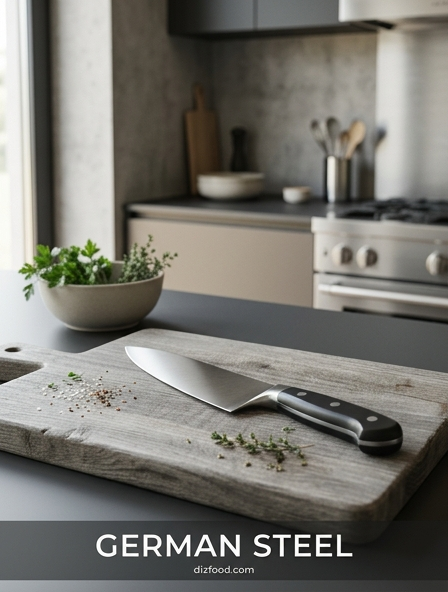
The Science Behind German Knife Steel
The composition of German knife steel is a masterclass in metallurgical balance, specifically designed for the high-intensity environment of a modern kitchen. Most German blades are crafted from alloys that prioritize a specific equilibrium between hardness and "toughness"-the ability of the metal to resist fracturing under stress. Unlike high-carbon steels that focus purely on edge retention at the cost of fragility, German steel utilizes a precise blend of elements to ensure the blade remains functional through years of abuse. The science involves manipulating the molecular lattice of the iron during the heat treatment process to achieve a Rockwell Hardness Scale (HRC) rating typically between 54 and 58. This range is considered the "sweet spot" for kitchen utility.
- Carbon: Provides the necessary hardness for sharpening.
- Molybdenum: Increases the tensile strength of the blade.
- Vanadium: Refines the grain structure for better wear resistance.
- Iron: The base metal providing the structural foundation.
By controlling the cooling rates during quenching, manufacturers can ensure that the steel does not become too brittle. This allows the blade to absorb the kinetic energy produced during heavy chopping tasks, preventing the microscopic cracks that lead to total blade failure in harder, more delicate steels.
Durability of ThyssenKrupp X50CrMoV15
ThyssenKrupp X50CrMoV15 is the undisputed gold standard for professional-grade German cutlery. This specific alloy name serves as a chemical blueprint: it contains 0.5% carbon (X50), 15% chromium (Cr), and measured amounts of Molybdenum (Mo) and Vanadium (V). This combination is engineered specifically for durability in commercial settings where knives are used for hours on end. The 15% chromium content is particularly significant, as it ensures the metal is officially classified as stainless steel, providing a robust defense against the corrosive environment of a kitchen. The following table illustrates the elemental contributions to this alloy's legendary durability:
| Element | Percentage | Primary Benefit |
|---|---|---|
| Carbon | 0.5% | Edge sharpness and retention |
| Chromium | 14-15% | Stain and rust resistance |
| Molybdenum | 0.5-0.8% | Resistance to pitting |
| Vanadium | 0.1-0.2% | Increases toughness |
This alloy's durability is further enhanced by its ability to resist "work hardening," meaning it maintains its structural integrity even after repeated impacts against wooden or synthetic cutting boards. It is the workhorse of the culinary world, capable of performing heavy-duty tasks that would ruin more sensitive metals.
German vs Japanese Steel Comparison
The debate between German and Japanese steel centers on two distinct philosophies of knife making. German steel is characterized by its relative softness and incredible resilience, whereas Japanese steel is known for its extreme hardness and surgical precision. Because German steel is tougher, it can be ground to a wider edge angle, typically around 20 degrees, which supports the blade during heavy-duty tasks like cutting through bone or thick-skinned vegetables. In contrast, Japanese steel is often ground to a much finer 12 to 15-degree angle, allowing for cleaner cuts but making the edge susceptible to chipping.
- German Steel: Higher durability, easier to sharpen, resists chipping, lower HRC.
- Japanese Steel: Superior sharpness, holds edge longer, prone to brittleness, higher HRC.
- Maintenance: German knives require frequent honing; Japanese knives require careful whetstone work.
- Usage: German knives are versatile "all-rounders"; Japanese knives are specialized precision tools.
While Japanese steel excels in delicate tasks like slicing sashimi, German steel is the preferred choice for those who want a single knife that can handle everything from mincing garlic to dejointing a chicken without fear of damaging the edge.
Exceptional Corrosion Resistance Features
Kitchen environments are inherently hostile to metal, characterized by constant exposure to moisture, salt, and acidic organic compounds. German steel is specifically engineered to survive these conditions through its high chromium content. When the chromium in the steel reacts with oxygen in the air, it forms a microscopic, passive layer of chromium oxide on the surface of the blade. This layer is impervious to water and protects the underlying iron from oxidation, which would otherwise manifest as rust. To maintain this exceptional resistance, manufacturers recommend a simple care regimen:
- Hand wash the blade immediately after contact with acidic foods like citrus or onions.
- Avoid the dishwasher, as high heat and harsh detergents can degrade the protective layer.
- Dry the knife thoroughly with a soft cloth before storage to prevent water spotting.
- Store in a dry environment, such as a magnetic strip or knife block.
Unlike carbon steel knives that require constant oiling and develop a patina over time, German stainless steel remains bright and clean. This makes it not only more aesthetically consistent but also more hygienic, as there is no porous rust or oxidation to harbor food particles or bacteria.
The Role of Chromium in Blade Strength
Chromium is often associated exclusively with rust prevention, but its role in the structural strength of German steel is equally vital. In the metallurgical process, chromium acts as a carbide former. When the steel is heated and cooled, chromium atoms bond with carbon atoms to create chromium carbides. These carbides are significantly harder than the surrounding iron matrix and are dispersed throughout the blade. This dispersion strengthens the overall steel structure, increasing its resistance to wear and abrasion. Without chromium, the blade would not only rust but would also be too soft to withstand the friction of cutting through dense materials.
- Structural Reinforcement: Chromium carbides provide a skeletal strength to the metal.
- Tensile Strength: Increases the amount of force the blade can take before bending.
- Hardness Uniformity: Ensures that the blade is consistently strong from the bolster to the tip.
Furthermore, the high chromium content allows for a more stable heat treatment. This stability ensures that the knife does not develop "soft spots" or internal stress fractures during the manufacturing process, resulting in a finished tool that is dependable throughout its entire length.
Flexible Blades for Versatile Kitchen Tasks
The inherent elasticity of German steel is one of its most valuable traits, particularly for tasks that require a degree of finesse. Because German steel is not pushed to the extreme limits of hardness, it retains a level of flexibility that is absent in more brittle alloys. This "spring" in the metal allows for the creation of specialized blades, such as filleting and boning knives, which must bend to follow the contours of bones and skin. A knife that is too rigid would snap under this lateral pressure or get stuck in the joint, whereas a German steel blade will curve and then return perfectly to its original straight alignment.
- Filleting: Allows the blade to move smoothly along the backbone of a fish.
- Boning: Enables the user to navigate tight spaces around poultry or beef joints.
- Safety: A flexible blade is less likely to snap and cause injury during high-pressure tasks.
This versatility extends to the standard chef's knife as well. The slight give in the metal makes the rocking motion of mincing much smoother, as the blade can absorb the micro-vibrations of hitting the cutting board, reducing fatigue in the chef's wrist and hand over long periods of use.
Why German Steel Resists Chipping
Chipping is a common failure where small pieces of the blade edge break off, usually caused by hitting a hard object like a bone or a ceramic plate. German steel resists this through high ductility. In metallurgy, ductility is the ability of a material to deform under tensile stress rather than fracturing. When a German blade hits something too hard, the edge is more likely to "roll" or slightly indent rather than chip. A rolled edge is a minor issue that can be fixed in seconds with a honing steel, while a chip requires professional grinding to remove metal and restore the edge. The following comparison highlights how German steel manages impact:
| Scenario | German Steel Reaction | Resulting Action |
|---|---|---|
| Hitting a bone | Microscopic edge rolling | Hone with steel rod |
| Dropping on floor | Tip may bend slightly | Can be straightened |
| Cutting frozen food | Elastic deformation | No permanent damage |
This "forgiving" nature makes German steel the preferred option for novice cooks and busy professional kitchens alike. It provides a level of insurance against the inevitable accidents that occur in a fast-paced cooking environment, ensuring the tool remains in service rather than being sent for repair.
Traditional Solingen Forging Methods
The city of Solingen, Germany, has been a protected name in cutlery for generations, representing a tradition of quality and precision. The "Solingen Method" typically involves drop-forging, where a single piece of steel is heated to an orange glow and hammered into shape using a massive press. This process is superior to stamping because it aligns the internal grain of the steel with the shape of the knife, creating a significantly stronger tool. The traditional forging process follows a strict sequence of events to ensure quality:
- Heating: The raw steel billet is heated to approximately 1050°C.
- Forging: The red-hot steel is hammered into a die to create the blade, bolster, and tang.
- Hardening: The blade is heated again and quickly quenched in oil to lock the molecular structure.
- Tempering: The steel is reheated at a lower temperature to remove brittleness and add toughness.
- Grinding: Master craftsmen grind the taper and the edge to exact specifications.
By forging the blade, bolster, and tang from a single piece of steel, Solingen makers create a perfectly balanced knife. The bolster-the thick junction between the blade and handle-acts as a finger guard and adds weight, providing the classic "heft" that German knives are famous for.
Maintaining a Sharp Edge with German Steel
One of the most misunderstood aspects of German steel is its edge maintenance. While it does not hold an edge as long as ultra-hard Japanese steel, it is significantly easier to maintain and sharpen. Because the metal is relatively ductile, the edge "rolls" over time with use. Regular maintenance does not necessarily require removing metal on a stone; instead, it requires "honing." A honing steel realigns the microscopic edge of the blade, pushing it back into a straight line. This process can be done daily and keeps the knife performing at its peak. When the knife eventually becomes truly dull, it responds quickly to sharpening tools.
- Honing: Use a ceramic or steel rod at a 20-degree angle to realign the edge.
- Sharpening: Use a medium-grit whetstone once or twice a year for home users.
- Cleaning: Keep the blade clean to ensure no debris interferes with the honing process.
For the average user, the ability to restore a razor-sharp edge in minutes using basic tools is a major advantage. You do not need expensive diamond hones or specialized water stones to keep a German blade in top condition, making it a practical choice for everyday home cooking.
Long Term Value of German Cutlery
Purchasing a high-quality German steel knife is widely considered a lifetime investment. While the upfront cost of a forged Solingen blade is higher than mass-produced stamped knives, the long-term value is unmatched. These knives are built to withstand decades of daily use without losing their structural integrity. The combination of rust resistance and impact toughness means that, with proper care, a German knife can be passed down through generations. The full-tang construction-where the steel extends to the very end of the handle-ensures that the handle will never snap off, a common failure point in cheaper cutlery.
| Feature | Impact on Value |
|---|---|
| Corrosion Resistance | Prevents aesthetic and structural decay over decades. |
| Ease of Sharpening | Reduces the need for professional sharpening services. |
| Forged Construction | Ensures the knife remains balanced and intact for a lifetime. |
Because these knives can be sharpened hundreds of times before the blade profile is significantly altered, the cost-per-use becomes negligible over time. In a world of "disposable" kitchen gadgets, German steel remains a testament to the value of buying high-quality tools once rather than low-quality tools repeatedly.

Comments