
Achieving professional consistency in your kitchen or home brewery often hinges on how accurately you measure liquid density and sugar concentration. Whether you are tracking the fermentation of a craft cider or calibrating the sweetness of a gourmet fruit reduction, choosing between a hydrometer and a refractometer is vital for culinary precision. While both instruments help you determine specific gravity and Brix levels, they utilize vastly different methods: the hydrometer relies on physical buoyancy in a large liquid sample, whereas the refractometer measures how light bends through just a few drops. Selecting the right tool depends on your need for speed, the size of your batch, and whether you are measuring pre-fermented wort or a finished alcoholic beverage.
| Feature | Hydrometer | Refractometer |
|---|---|---|
| Operating Principle | Buoyancy / Displacement | Light Refraction (Bending) |
| Sample Volume | Large (approx. 100ml - 250ml) | Minimal (2 - 3 drops) |
| Best For | Monitoring active fermentation | Instant sugar checks (Brix) |
| Alcohol Interference | Unaffected by ethanol | Requires complex correction math |
| Durability | Fragile (Glass/Thin) | Robust (Metal/Plastic) |
| Temperature | Calibrated to 60°F/68°F | Auto Temp. Compensation (ATC) |
Defining Density Measurement Tools
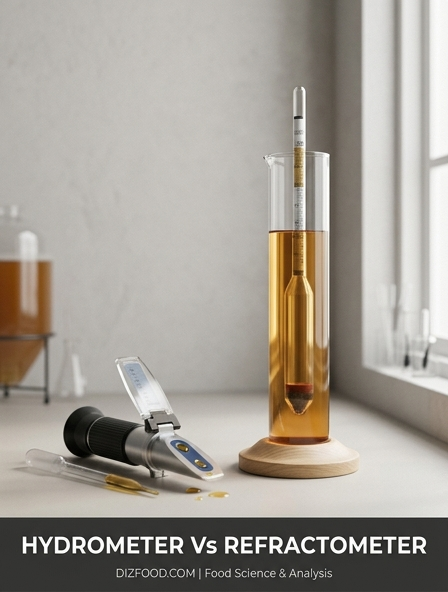
In the world of culinary science and home fermentation, density measurement tools are essential for monitoring the concentration of dissolved solids, primarily sugars, within a liquid. The two primary instruments used for this purpose are the hydrometer and the refractometer. While both devices aim to provide the user with a specific gravity or Brix reading, they utilize vastly different physical properties to arrive at their results. A hydrometer is a weighted glass instrument that measures the buoyancy of a liquid, whereas a refractometer is an optical device that measures how light bends as it passes through a sample.
Understanding these tools is vital for brewers, winemakers, and even confectioners who need to ensure consistency in their products. By measuring density, a kitchen enthusiast can determine the potential alcohol content of a fermenting wash, the sugar concentration of a fruit preserve, or the progress of a reducing syrup. These measurements are typically expressed in two common scales:
- Specific Gravity (SG): The ratio of the density of the liquid to the density of pure water.
- Brix: A scale representing the percentage of sugar by weight in a solution.
- Plato: A scale similar to Brix, primarily used in professional brewing to measure wort concentration.
While the goal of identifying the "thickness" or "strength" of a liquid is shared, the choice between these tools often depends on the specific stage of the cooking or brewing process and the level of precision required by the user. Both instruments have become staples in modern kitchens where precision outweighs guesswork.
How Hydrometers Work via Buoyancy
The hydrometer operates based on Archimedes' principle, which states that a solid body displaced in a liquid will be buoyed up by a force equal to the weight of the liquid displaced. Physically, a hydrometer consists of a sealed glass tube with a narrow stem and a weighted bulb at the bottom, usually containing lead shot or steel pellets to keep it upright. When placed in a testing jar filled with liquid, the device floats. The depth at which it floats is directly proportional to the density of the fluid.
In a high-density liquid, such as a heavy sugar syrup or unfermented beer wort, the hydrometer will float high, exposing more of the graduated scale on the stem. In a low-density liquid, such as finished dry wine or pure water, the instrument sinks deeper. To get an accurate reading, the user must observe the point where the surface of the liquid crosses the scale on the stem. This requires careful attention to the meniscus, the slight curve of the liquid against the glass. Most kitchen-grade hydrometers are calibrated to be read at the bottom of this curve.
The simplicity of this design makes it highly reliable because it does not rely on complex electronics or optical components. However, it does require a significant volume of liquid to function, as the hydrometer must be able to float freely without touching the bottom or sides of the container. This mechanical approach remains the gold standard for final density readings in fermentation because it is not easily fooled by the chemical complexities of the liquid.
Principles of Light Refraction Technology
Refractometers utilize the physics of light to determine the concentration of solutes in a liquid. When light enters a liquid, it slows down and changes direction; this phenomenon is known as refraction. The degree to which the light bends depends on the amount of dissolved material, such as sugar, in the water. A handheld refractometer captures this change by passing light through a thin film of the sample placed on a prism. The user then looks through an eyepiece to see where the light and dark boundaries fall on a graduated scale, usually measured in Brix.
The internal mechanism of a refractometer involves a prism and a secondary lens that projects the refracted light onto a shadow line. This boundary is highly sensitive to the refractive index of the solution. Because sugar molecules are large and impact the speed of light significantly, even a tiny amount of sugar will cause a noticeable shift in the reading. This makes the refractometer an incredibly powerful tool for quick assessments during the preparation phases of cooking or brewing.
One of the most significant advantages of this technology is that it requires only a few drops of liquid. This is particularly useful in a kitchen setting when checking the ripeness of fruit or the concentration of a boiling sauce, where taking a large sample would be wasteful or dangerous. Despite its technical sophistication, the device is purely analog in most cases, using ambient light to illuminate the scale, though digital versions exist that use internal LEDs and sensors to provide a numeric readout.
Comparing Accuracy and Precision Levels
When comparing the accuracy and precision of hydrometers and refractometers, it is important to distinguish between "theoretical accuracy" and "user-driven precision." Hydrometers are generally considered more accurate for finished products, especially those containing alcohol, because their physical measurement of density is straightforward. However, they are prone to human error, such as misreading the meniscus or failing to account for carbonation bubbles that cling to the glass and lift the device, giving a false high reading.
Refractometers provide high precision for initial sugar concentrations, but their accuracy can be compromised by the presence of non-sugar solids or alcohol. Because they measure the refractive index rather than physical weight, any substance that bends light will affect the result. For instance, hop oils in beer or acids in fruit juice can slightly skew a refractometer reading. To visualize the differences in their performance profiles, consider the following comparison:
| Feature | Hydrometer | Refractometer |
|---|---|---|
| Primary Accuracy | High (Final Gravity) | High (Initial Gravity) |
| Precision | Lower (Harder to read) | Higher (Clearer scale) |
| Susceptibility to Bubbles | High | None |
| Alcohol Interference | Minimal | Significant |
Ultimately, while a refractometer offers a more precise visual scale that is easier to read consistently, the hydrometer's fundamental reliance on gravity makes it the more "honest" instrument for complex, multi-component liquids. Professional kitchen environments often use both to verify results against one another.
Temperature Correction and Calibration Needs
Both hydrometers and refractometers are highly sensitive to temperature, though they handle this variable differently. The density of a liquid changes as its temperature fluctuates; warmer liquids are less dense, causing a hydrometer to sink deeper and provide a false low reading. Most kitchen hydrometers are calibrated to a specific reference temperature, usually 60°F (15.5°C) or 68°F (20°C). If the sample is hotter or colder than this standard, the user must apply a mathematical correction formula or refer to a conversion chart to find the true gravity.
Refractometers face a similar challenge because the refractive index of a liquid also shifts with temperature. However, many modern handheld refractometers feature Automatic Temperature Compensation (ATC). This mechanism utilizes a small bimetallic strip inside the device that shifts the internal scale or lens to compensate for temperature changes within a specific range, typically 50°F to 86°F. This makes the refractometer much more convenient for testing hot wort or simmering syrups directly from the stove.
Calibration is a shared requirement for maintaining reliability. To calibrate these tools, the following steps are generally followed:
- Clean the sensing surface or glass tube with distilled water.
- Hydrometer Maintenance: Requires thorough rinsing to remove sticky residues. It must be stored in a plastic tube to prevent breakage.
- Refractometer Maintenance: The prism must be cleaned with a soft, lint-free cloth and distilled water after every use. It must be kept dry to prevent moisture from entering the internal housing.
- Storage: Refractometers should be stored in a temperature-stable environment to protect the ATC mechanism.
Regular calibration is essential, especially for refractometers, as the internal alignment can shift if the tool is dropped or exposed to extreme temperature swings during storage.
Sample Volume and Ease of Use
One of the most practical differences between these two tools in a kitchen or brewing environment is the volume of liquid required for a successful test. The hydrometer is a "bulk" measurement tool. To use it, you must fill a testing cylinder (usually 250ml to 500ml) with enough liquid to allow the hydrometer to float freely. For a homebrewer making a small 1-gallon batch, losing 10% of the product to every gravity check is often unacceptable. Furthermore, the sample must be cooled down significantly before testing to avoid cracking the glass hydrometer or requiring massive temperature corrections.
The refractometer, by contrast, is the king of efficiency. It requires only two or three drops of liquid. This small sample size also means that the liquid reaches ambient temperature almost instantly when it touches the prism, allowing for rapid-fire testing during a cook or a brew day. This ease of use encourages more frequent monitoring, which can lead to better quality control in the final product. A chef can check the sugar concentration of a reduction multiple times in a few minutes without depleting the sauce.
In terms of workflow, the refractometer is significantly faster to clean and deploy. You simply wipe the prism, add the drops, and look. The hydrometer involves filling a jar, waiting for foam or bubbles to dissipate, taking the reading, and then either discarding the sample or sanitizing everything to return the sample to the vessel. For those who prioritize speed and minimal waste, the refractometer is the clear winner in daily kitchen operations.
Impact of Alcohol on Reading Results
The presence of alcohol introduces a significant complication for density measurement, particularly for the refractometer. Alcohol has a different refractive index than water and sugar. Once yeast begins converting sugar into ethanol and carbon dioxide, the optical properties of the liquid change in a way that the refractometer cannot distinguish from sugar content. Specifically, alcohol causes the light to bend differently, leading to a much higher Brix reading than what is actually present. This means a refractometer cannot be used to measure "Final Gravity" directly without using complex software or correction calculators.
The hydrometer is also affected by alcohol, but in the opposite direction and to a lesser extent. Since ethanol is less dense than water (with a specific gravity of approximately 0.789), its presence in a finished wine or beer will pull the overall density down. This is why a very dry wine can have a specific gravity lower than 1.000. While the hydrometer reading is technically "distorted" by the alcohol, it is the standard method for determining fermentation completion because when the reading stops moving for several days, you know the density is stable.
For those using a refractometer during fermentation, a "Wort Correction Factor" and an alcohol correction equation must be applied. This requires knowing the original gravity (starting sugar) and the current refractometer reading. Without these calculations, the refractometer is effectively useless once fermentation has moved past the initial stages. The hydrometer remains the most foolproof way to determine if a fermentation has "stuck" or finished completely.
Durability and Maintenance Requirements
The physical resilience of these tools is a major consideration in a busy kitchen. Hydrometers are almost exclusively made of thin glass. They are notoriously fragile; a short roll off a counter or a slight tap against a sink usually results in a shattered instrument. Because they are weighted with lead or steel shot, they are also top-heavy, making them prone to tipping. Most experienced brewers and cooks keep a spare hydrometer on hand because breakage is considered a matter of "when," not "if."
Refractometers are generally more robust, constructed from a combination of chrome-plated brass, aluminum, and high-quality glass for the prism. They are designed to be handheld and often come with padded carrying cases. However, they are not indestructible. The prism is susceptible to scratching if wiped with abrasive materials, and the internal calibration can be knocked out of alignment by heavy impacts. Maintenance is relatively simple but must be performed diligently to ensure longevity.
While the refractometer has a higher initial build quality, the hydrometer's lack of moving parts or internal optics means that as long as it isn't broken, it will function perfectly for decades without needing anything more than a rinse.
Cost and Value Comparison
There is a clear divide in the cost of entry for these two instruments. Hydrometers are remarkably affordable, making them accessible for beginners or hobbyists on a budget. A standard triple-scale hydrometer typically costs between $10 and $20. Even when you include the cost of a plastic or glass testing cylinder, the total investment is usually under $30. Because they are so inexpensive, the "value" lies in their disposability; if you break one, it is not a significant financial setback.
Refractometers represent a higher initial investment. A decent manual handheld refractometer with ATC typically ranges from $30 to $60. High-end digital versions, which remove the subjectivity of reading a scale by eye, can cost anywhere from $100 to $500. While the price is higher, the value is found in the savings of time and product. By using only drops rather than cups of liquid, a refractometer can "pay for itself" over time, especially if you are working with expensive ingredients like honey, rare fruit juices, or high-gravity wort.
| Tool | Price Range | Primary Value Driver |
|---|---|---|
| Standard Hydrometer | $10 - $20 | Low entry cost; high accuracy. |
| ATC Refractometer | $30 - $70 | Speed; minimal sample waste. |
| Digital Refractometer | $100 - $300 | Laboratory precision; data logging. |
For a casual cook who only needs to check a syrup once a month, the hydrometer is the better value. For a frequent brewer or a professional chef, the refractometer's efficiency offers a better return on investment.
Selecting the Best Tool for You
Choosing between a hydrometer and a refractometer depends on your specific kitchen activities and your tolerance for complexity. If you are primarily focused on fermentation-such as brewing beer, making cider, or fermenting kombucha-the hydrometer is arguably the more important tool. Its ability to provide an accurate final gravity reading without the need for complex alcohol correction math makes it indispensable for verifying that your ferment is safe to bottle. It is the "truth teller" of the fermentation world.
On the other hand, if your work involves hot processes, such as jam making, candy crafting, or checking the sugar content of fruit before harvest, the refractometer is the superior choice. Its ability to handle hot samples with ATC and its requirement of only a few drops make it a much more versatile "on-the-fly" instrument. In a fast-paced kitchen, you do not want to wait for a 10-ounce sample to cool down just to see if your marmalade has reached the proper set point.
Ultimately, many serious enthusiasts find that owning both tools is the best approach. You can use the refractometer for quick checks during the boil or the early stages of fermentation and then switch to the hydrometer for the final, definitive reading. This "hybrid" workflow gives you the best of both worlds: the speed and convenience of optical technology combined with the reliable, gravity-based physics of the traditional floating hydrometer. Assess your budget, the volume of your batches, and your need for speed to decide which tool should take priority on your kitchen counter.


Comments