
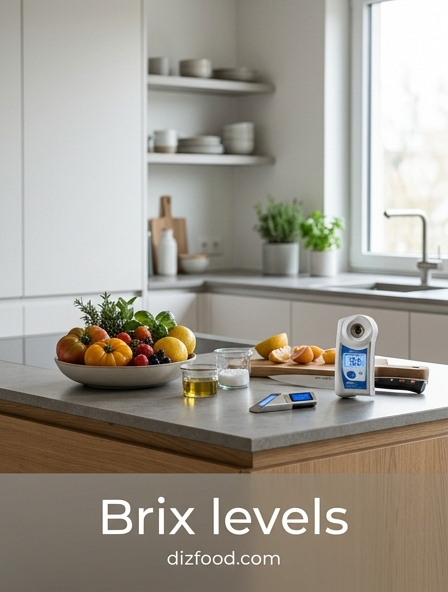
Understanding Brix in Culinary Arts and Brewing
The Brix scale is a fundamental measurement used throughout the culinary and beverage industries to quantify the concentration of dissolved solids, primarily sucrose, in a liquid solution. One degree Brix is equivalent to one gram of sucrose in one hundred grams of solution. While it originated in the wine industry to determine the ripeness of grapes and potential alcohol content, its application has expanded significantly into the professional kitchen. Chefs use Brix to ensure the consistency of sorbet bases, the concentration of savory reductions, and the sweetness of seasonal fruit purées.
In brewing, Brix levels provide a snapshot of the extract potential of the wort before fermentation begins. Understanding these levels allows for precise control over the final flavor profile, body, and alcohol by volume (ABV) of the finished product. Because sugar affects the freezing point and boiling point of liquids, Brix is also an essential metric for pastry chefs managing the texture of frozen desserts. By mastering the science of Brix, culinary professionals transition from subjective "seasoning to taste" to objective, data-driven quality control, ensuring that every batch meets a standardized level of excellence.
Essential Tools for Measuring Sugar Concentration
To accurately monitor sugar levels, professionals rely on several specialized instruments, each suited for different environments and liquid types. The most common tool in a modern kitchen is the handheld refractometer. These come in two primary forms: analog optical models and digital versions. Analog refractometers require the user to look through an eyepiece at a light source, while digital models provide a numerical readout on an LED screen, reducing human error. Another traditional tool is the hydrometer, which measures specific gravity by floating in a tall cylinder of liquid.
For a complete testing kit, the following items are considered essential:
- Optical Refractometer: Best for quick, portable checks of fruit juice or syrups.
- Digital Refractometer: Offers high precision and easy reading in low-light kitchen environments.
- Triple Scale Hydrometer: Primarily used in brewing to track density changes over time.
- Transfer Pipettes: Used to place small, uncontaminated samples onto the testing prism.
- Distilled Water: Necessary for the frequent zeroing and calibration of the devices.
- Microfiber Cloths: Essential for cleaning the prism without scratching the sensitive glass surface.
How to Calibrate Your Refractometer Properly
Calibration is the most critical step in ensuring that your Brix readings are accurate. Over time, temperature fluctuations and physical handling can cause an instrument to drift, leading to false data. For an optical refractometer, calibration should ideally occur at the start of every shift or when moving between environments with significant temperature differences. Most devices are calibrated to a standard temperature of 20°C (68°F). If the room is significantly warmer or cooler, the refraction of light through the sample will change, skewing the result.
To calibrate, place a few drops of distilled water on the prism and close the daylight plate. Looking through the eyepiece, the boundary between the blue and white fields should sit exactly at the 0% mark. If it does not, use the small adjustment screw to move the line. Digital models often feature a "Zero" button that automates this process. Using tap water for calibration is discouraged because dissolved minerals can interfere with the zero-point setting. Regular calibration ensures that a reading of 15 Brix is actually 15 Brix, maintaining the integrity of your recipes.
Step by Step Guide to Measuring Brix
Obtaining an accurate Brix reading requires a clean environment and a standardized technique. Even a tiny amount of residue from a previous test can significantly alter the results of the current sample. Follow these steps for a professional measurement:
- Clean the Prism: Wipe the glass prism and the cover plate with a soft cloth and a drop of distilled water to ensure no films or solids remain.
- Apply the Sample: Use a clean pipette to place two or three drops of the room-temperature liquid onto the prism. Avoid creating air bubbles, as they distort light.
- Close the Plate: Gently lower the daylight plate so the liquid spreads evenly across the entire surface of the glass.
- Read the Scale: Hold the refractometer toward a natural light source. Look through the eyepiece and identify the horizontal line where the color changes.
- Record and Clean: Note the value immediately. Wipe the prism clean with a damp cloth followed by a dry cloth to prevent sugary buildup or corrosion.
Always ensure the sample is representative of the whole batch by stirring the liquid thoroughly before taking a sample from the center of the container.
Monitoring Fermentation Progress in Home Brewing
In home brewing, Brix is used to track the "attenuation" of the brew, which refers to the percentage of sugars converted into alcohol and carbon dioxide by yeast. At the start of the process, the "Original Gravity" or initial Brix reading tells the brewer how much fermentable material is present. As the yeast consumes the sugar, the density of the liquid drops. By taking daily readings, a brewer can visualize the fermentation curve. A plateau in Brix readings over two or three consecutive days typically indicates that fermentation is complete.
However, brewers must be aware of the "alcohol correction" factor. Once ethanol is produced, it changes the refractive index of the liquid, making a standard refractometer reading appear higher than the actual sugar content. To get an accurate measurement during active fermentation, brewers apply a mathematical formula to correct for the presence of alcohol. This monitoring is vital for safety; bottling beer before it has fully fermented can lead to "bottle bombs" caused by excessive pressure. Consistent tracking allows the brewer to troubleshoot stalls and ensure the flavor profile remains crisp and well-balanced.
The Importance of Brix in Professional Jam Making
In professional preserves and jam production, the Brix level determines the "gel point" and the shelf stability of the product. Most commercial jams are required to have a soluble solids content of at least 65%. This high sugar concentration is not just for flavor; it serves a preservative function by lowering water activity, which inhibits the growth of mold and bacteria. If the Brix level is too low, the jam will be runny and prone to spoilage; if it is too high, the sugar may crystallize, resulting in a gritty, unpleasant texture.
Artisan producers use refractometers to account for the natural variation in fruit harvests. A batch of strawberries in June may have a lower natural sugar content than those harvested in July. By measuring the Brix of the raw fruit pulp, the maker can adjust the amount of added sugar and the duration of the boiling process to reach the exact target every time. This precision ensures that the pectin sets correctly, creating that signature spreadable consistency that distinguishes professional-grade preserves from amateur attempts. Monitoring Brix during the reduction phase allows the chef to stop the cooking process at the precise moment the target density is achieved.
Controlling Sauce Consistency Through Sugar Monitoring
Savory sauces, particularly balsamic glazes, demi-glaces, and gastriques, rely on the concentration of sugars and proteins to achieve the desired "nappe" consistency-the ability of a sauce to coat the back of a spoon. Using a refractometer in a savory context allows a chef to standardize the reduction process. For example, a balsamic reduction might be considered perfect at 60 Brix. By using data rather than visual estimation, a kitchen can ensure that the sauce served on Tuesday is identical to the one served on Saturday, regardless of which line cook was managing the reduction.
Furthermore, Brix monitoring helps in balancing the flavor profile of complex sauces. If a barbecue sauce or a teriyaki glaze is too high in sugar, it may burn quickly on the grill. By maintaining a specific Brix range, the chef can guarantee both the flavor balance and the thermal stability of the sauce. This is especially useful in high-volume catering where large batches of sauces are prepared in advance. Precise measurements prevent over-reduction, which saves on food costs by maximizing yield while maintaining the highest possible quality standards for the guest's experience.
Calculating Specific Gravity from Brix Readings
While chefs typically stick to the Brix scale, brewers often work with Specific Gravity (SG). Specific Gravity measures the density of a liquid relative to the density of pure water. Because many brewing recipes and hydrometers are calibrated in SG, it is essential to know how to convert between the two. The conversion is roughly a 1:4 ratio, but for professional accuracy, more complex polynomial equations are used. Understanding this relationship allows for seamless communication between different departments in a production facility.
The table below provides a quick reference for common conversions used in the kitchen and brewery:
| Brix Value (%) | Specific Gravity (SG) | Typical Application |
|---|---|---|
| 5.0 | 1.020 | Light broths / Weak wort |
| 10.0 | 1.040 | Fruit juices / Standard ale wort |
| 15.0 | 1.061 | Dessert sauces / High gravity beer |
| 20.0 | 1.083 | Sorbet bases / Wine must |
| 65.0 | 1.318 | Jams and Preserves |
Temperature Correction Factors for Accurate Measurements
Liquid density changes with temperature; as a liquid warms, it expands and becomes less dense. Since refractometers and hydrometers are calibrated to a specific "standard" temperature (usually 20°C or 68°F), measuring a hot liquid straight from a boiling pot will result in an inaccurate reading. An uncorrected reading of a hot syrup will show a lower Brix level than is actually present. Many modern digital refractometers include Automatic Temperature Compensation (ATC), which uses an internal thermistor to adjust the reading automatically. However, even with ATC, extreme temperatures can cause errors.
For the highest level of accuracy, it is best to cool the sample to room temperature before testing. This can be done quickly by placing a small amount of the liquid in a shallow metal dish or by using a "cooling coil." If using an analog device without ATC, you must consult a temperature correction chart. Generally, for every degree Celsius above the calibration temperature, you add approximately 0.06 to 0.08 to the Brix reading. Understanding these physical properties prevents the common mistake of over-concentrating a sauce because the initial "hot" reading appeared too low.
Achieving Batch Consistency with Sugar Data Tracking
Data tracking is the bridge between a good recipe and a successful product line. By recording the Brix levels of every batch, a culinary business can identify trends, troubleshoot failures, and ensure brand loyalty through consistency. If a customer buys a bottle of hot sauce or a jar of marmalade, they expect the same sweetness and viscosity every time. Tracking these metrics allows a producer to account for seasonal changes in ingredients, such as the varying sugar content in tomatoes or peppers throughout the year.
Effective data tracking systems should include the following parameters:
- Date and Batch Number: For traceability and inventory management.
- Raw Material Brix: The sugar level of the ingredients before processing.
- Target Brix: The desired final measurement for the finished product.
- Actual Brix: The recorded measurement at the end of production.
- Temperature: The temperature at which the sample was measured to ensure correction accuracy.
- Adjustments Made: Any additions of water or sugar used to reach the target.
Over time, this log becomes a valuable asset for scaling recipes and training new staff, ensuring the kitchen operates with scientific precision.




Comments