
Choosing between a burr grinder and a blade grinder is the most critical decision you will make for your home brewing setup, as the consistency of your grind directly dictates the depth of flavor extracted from your coffee beans. While blade grinders function like high-speed blenders that haphazardly "chop" beans into uneven fragments, burr grinders utilize two revolving abrasive surfaces to "crush" coffee into a perfectly uniform particle size. This precision is vital; a uniform grind ensures balanced extraction, preventing the muddy bitterness or sour weakness caused by inconsistent grounds. If you are looking to unlock the delicate floral notes or rich chocolate undertones of specialty roasts, transitioning to a burr mill is the definitive upgrade to elevate your daily ritual from a simple caffeine fix to a true gourmet experience.
| Feature | Blade Grinder | Burr Grinder |
|---|---|---|
| Grinding Mechanism | High-speed spinning metal blades (Chopping) | Two revolving abrasive plates (Crushing) |
| Particle Consistency | Inefficient; mix of "fines" and large chunks | Highly uniform; precise size distribution |
| Heat Friction | High; can scorch beans and degrade oils | Low; preserves delicate aromatic compounds |
| Adjustability | Manual timing; based on guesswork | Precise stepped or stepless micro-adjustments |
| Price Point | Budget-friendly ($15 - $30) | Investment ($50 - $500+) |
| Best For | Basic drip coffee or grinding spices | Espresso, Pour-over, and French Press |
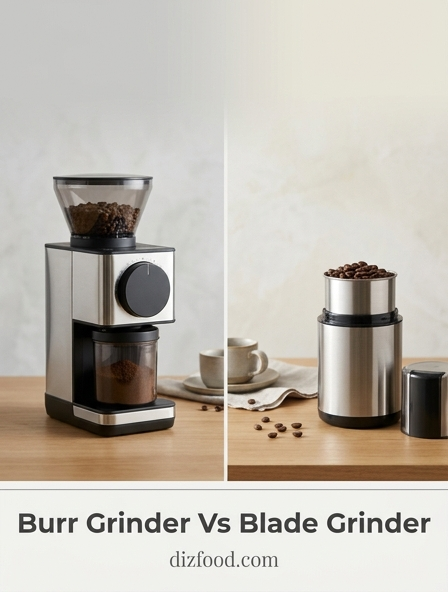
Understanding the Core Differences
The debate between burr grinders and blade grinders is more than a simple matter of kitchen preference; it represents a fundamental divide in coffee philosophy and mechanical engineering. At its most basic level, the difference lies in how each machine breaks down the whole coffee bean into the grounds used for brewing. One relies on high-speed impact, while the other utilizes controlled crushing and shearing forces. This distinction significantly impacts the final quality of the beverage in the cup, affecting everything from clarity of flavor to the body of the coffee.
Blade grinders are often the entry point for home enthusiasts due to their accessibility and low cost. They function similarly to a food processor or a blender, using a metal blade to chop beans into smaller fragments. Conversely, burr grinders are considered the standard for quality coffee preparation. They use two abrasive surfaces, known as burrs, between which the beans are passed. The distance between these burrs determines the size of the ground coffee, providing a level of control that a blade simply cannot replicate. Understanding these differences is the first step toward mastering the art of home brewing and moving away from the inconsistencies of pre-ground coffee or basic grinding methods.
- Mechanism: Impact chopping versus uniform crushing.
- Control: Time-based estimation versus physical distance adjustment.
- Consistency: High variance in particle size versus high uniformity.
- Intended Use: General spice or budget grinding versus specialty coffee extraction.
How Blade Grinders Work
Blade grinders operate on a relatively simple mechanical premise. Inside a small chamber, a double-sided metal blade is connected to a high-speed motor. When the power is engaged, the blade spins rapidly, striking the coffee beans and shattering them into smaller pieces through sheer force. Because the blades are fixed at the bottom of the chamber, the beans must constantly bounce off the walls and return to the blade to be broken down further. This creates a chaotic environment where some particles are struck multiple times, while others may escape the blade for several seconds.
The primary challenge with this mechanism is that the user has very little control over the actual size of the grounds. Instead of setting a specific measurement, the user must pulse the motor and estimate the grind size based on visual feedback or the duration of the grind. The longer the motor runs, the finer the coffee becomes. However, this inevitably leads to a mixture of "boulders," which are large chunks of beans, and "fines," which are microscopic dust particles. This unevenness makes it nearly impossible to achieve a balanced extraction, as the different sizes will brew at different rates. Despite these flaws, blade grinders remain popular for their compact footprint and their ability to handle other dry kitchen tasks, such as pulverizing spices or seeds, making them a versatile, if imperfect, tool for the casual cook.
The Precision of Burr Mechanisms
The burr grinder is a precision instrument designed specifically for the physics of coffee extraction. Unlike the blade grinder's random impact, a burr grinder uses two revolving abrasive surfaces-often shaped as cones (conical) or flat discs (flat)-to crush the beans. One burr remains stationary while the other is rotated by a motor or a hand crank. The beans are fed through the center and are forced through the gap between the two surfaces. This gap is adjustable to a fraction of a millimeter, ensuring that no bean fragment can exit the grinding chamber until it has been reduced to the exact size specified by the user.
This mechanical precision is what allows for different brewing styles, from the powdery fine requirements of espresso to the coarse, sea-salt texture needed for a French Press. High-quality burrs are typically made from stainless steel or ceramic, materials chosen for their durability and ability to maintain sharp cutting edges over thousands of cycles. Ceramic burrs are often preferred for manual grinders because they do not conduct heat as easily, whereas steel burrs are prized in electric models for their sharpness and ability to produce extremely uniform particles. By controlling the physical space through which the coffee must pass, the burr mechanism eliminates the guesswork and produces a consistent product every time the machine is turned on.
Grind Consistency and Particle Size
Consistency is the single most important variable in coffee brewing, and this is where the burr grinder truly excels over the blade grinder. When hot water interacts with coffee grounds, it dissolves the soluble compounds that create flavor. If the grounds are uniform in size, the water extracts these flavors evenly from every particle. However, if the grind is inconsistent-containing a mix of large chunks and fine powder-the water will over-extract the small particles, creating bitterness, and under-extract the large ones, resulting in a sour or weak taste. This leads to a "muddled" flavor profile that lacks clarity.
A blade grinder's output is inherently inconsistent because it relies on randomized impacts. Even with careful pulsing and shaking of the device, the result is always a wide distribution of particle sizes. In contrast, a burr grinder creates a "unimodal" or highly focused particle size distribution. This means that the vast majority of the grounds fall within a very narrow range of the desired size. This uniformity allows the brewer to accurately predict how the coffee will react to water and temperature. When you can rely on the size of your coffee grounds, you gain the ability to troubleshoot your brew and make incremental improvements to the taste, a process that is virtually impossible when using the erratic results of a blade-based system.
Heat Friction and Flavor Retention
A frequently overlooked aspect of coffee grinding is the role of thermodynamics. Coffee beans contain delicate volatile oils and aromatic compounds that are highly sensitive to heat. When these oils are exposed to high temperatures during the grinding process, they can begin to dissipate or even oxidize before the water ever touches the grounds. This results in a loss of the complex floral, fruity, or nutty notes that define high-quality coffee. Blade grinders are particularly prone to this issue because their motors must spin at extremely high Revolutions Per Minute (RPM) to effectively shatter the beans, and the friction of the blades hitting the beans generates significant heat.
Burr grinders, especially high-end electric and manual versions, are designed to minimize heat transfer. Many electric burr grinders use gear reduction to allow the motor to spin the burrs at a lower RPM while still maintaining enough torque to crush the beans. This "slow and steady" approach keeps the coffee cool throughout the process. Manual burr grinders are even better in this regard, as the human arm cannot reach the speeds necessary to generate meaningful friction heat. By preserving the integrity of the bean's temperature during the grind, burr mechanisms ensure that the full spectrum of flavor is retained for the brewing stage, leading to a much more aromatic and vibrant cup of coffee compared to the scorched results often produced by high-speed blades.
Price Points and Value Comparison
When comparing blade and burr grinders, the price is often the most significant factor for consumers. Blade grinders are mass-produced and utilize simple components, making them extremely affordable. On the other hand, burr grinders involve complex machining and higher-quality materials, leading to a wider range of price points. While a blade grinder can be purchased for the price of a few bags of coffee, a high-quality burr grinder is an investment in the kitchen's long-term utility. The value, however, is found in the longevity and the quality of the result.
| Feature | Blade Grinder | Entry Burr Grinder | Prosumer Burr Grinder |
|---|---|---|---|
| Price Range | $15 - $30 | $50 - $120 | $200 - $600+ |
| Material | Plastic/Stainless Steel | Plastic/Ceramic | All-Metal/Hardened Steel |
| Adjustability | None (Time-based) | Stepped Settings | Stepless/Micro-adjust |
| Consistency | Low | Medium-High | Very High |
While the initial cost of a burr grinder is higher, it often pays for itself by reducing wasted coffee. Because the extraction is more efficient and consistent, users often find they need fewer beans to achieve the desired strength and flavor profile compared to the hit-or-miss nature of blade grinding.
Best Grinder for Espresso Brewing
Espresso is perhaps the most demanding brewing method when it comes to grind quality. It requires a very fine, highly uniform grind that can create enough resistance to the nine bars of pressure exerted by an espresso machine. If the grind is even slightly too coarse, the water will rush through, resulting in a sour, thin liquid. If it is too fine or contains too many "fines," the machine will choke. Because of this, blade grinders are completely unsuitable for espresso. They cannot reach the necessary level of fineness without overheating the beans, and their lack of consistency ensures that the pressurized water will always find "channels" or paths of least resistance through the uneven grounds.
For espresso, a dedicated burr grinder is essential. Specifically, many espresso enthusiasts look for "stepless" burr grinders. Unlike "stepped" grinders that click into pre-set notches, stepless grinders allow for infinite adjustments, enabling the user to "dial in" the grind size to the exact micro-millimeter needed for a perfect 25-30 second extraction. This level of precision is the difference between a bitter, undrinkable shot and a sweet, syrupy espresso with a rich layer of crema. When brewing under pressure, the mechanical advantage of the burr system becomes a non-negotiable requirement for success.
Suitability for Manual Brew Methods
Manual brewing methods, such as the French Press, Chemex, and V60, each have specific requirements for particle size that highlight the versatility of the burr grinder. The French Press, for example, requires a very coarse grind. When a blade grinder is used for a coarse setting, it produces large chunks mixed with dust; the dust passes through the metal mesh filter, creating a silty, muddy cup. A burr grinder, however, can be opened up to produce large, uniform particles that are easily filtered out, resulting in a clean yet full-bodied coffee. This ability to shift between different textures is what makes the burr grinder the preferred tool for those who enjoy experimenting with various brewers.
Pour-over methods like the Hario V60 or the Chemex rely on a medium-fine to medium-coarse grind. In these methods, the grind size actually dictates the flow rate of the water. If the grind is inconsistent, the water will drain at unpredictable speeds, leading to uneven extraction. A burr grinder allows the user to repeat the same grind size every morning, ensuring that their pour-over technique remains consistent. While a blade grinder can technically be used for these methods in a pinch, the lack of repeatability makes it difficult to refine one's technique or appreciate the subtle differences between different coffee origins and roast levels.
Durability and Long-Term Maintenance
The lifespan of a grinder is a key consideration for any kitchen. Blade grinders are generally considered "disposable" appliances. Because the blades are permanently fixed to the motor shaft, they cannot be easily sharpened or replaced once they become dull. Furthermore, the high-speed motors in inexpensive blade grinders are prone to burning out if used for extended periods. Once a blade grinder fails or the blades dull, the entire unit usually needs to be replaced, contributing to electronic waste and long-term costs.
Burr grinders are built with a focus on maintenance and longevity. Most high-quality burr grinders are designed to be disassembled for regular cleaning. This is crucial because coffee oils can build up over time, turning rancid and affecting the flavor of fresh beans. Furthermore, the burrs themselves are replaceable components. If a set of steel burrs becomes dull after several years of heavy use, a new set can be installed without needing to buy a whole new machine. This modularity, combined with more robust motors designed for lower-speed operation, makes the burr grinder a far more sustainable and durable choice for the home. Regular maintenance involves:
- Using a dedicated brush to remove old grounds from the burrs.
- Running specialized cleaning pellets through the machine to absorb oils.
- Periodically checking the alignment of the burrs for maximum precision.
- Inspecting the motor and gears for any signs of wear.
Choosing the Right Grinder for You
Ultimately, the choice between a burr and a blade grinder depends on your goals as a coffee drinker and your budget. If you view coffee as a quick caffeine delivery system and are not particularly concerned with flavor nuances or brewing techniques, a blade grinder offers an affordable and compact solution. It is also a great choice if you need a multi-purpose tool that can grind spices and seeds for cooking. However, for anyone looking to explore the rich world of specialty coffee, the investment in a burr grinder is almost always worth it. The improvement in cup quality is immediate and dramatic, providing a level of clarity and balance that a blade grinder simply cannot achieve.
When making your decision, consider the types of coffee you enjoy most. If you are an espresso lover, a high-quality electric burr grinder is a necessity. If you prefer manual methods like pour-over or French Press, a high-quality manual burr grinder can provide professional-grade results at a fraction of the cost of an electric model. By prioritizing grind consistency, heat management, and durability, you are not just buying a kitchen appliance; you are securing the foundation of a better daily coffee ritual. Whether you choose the simplicity of the blade or the precision of the burr, understanding how these tools work will help you get the most out of every bean you buy.




Comments