
The Science of Coffee Extraction and Surface Area
The fundamental principle of coffee brewing lies in the relationship between water and the exposed surface area of the bean. When coffee beans are ground, their internal structure is fractured, exponentially increasing the surface area available for chemical interaction. This process allows water to act as a solvent, pulling out soluble compounds such as caffeine, lipids, and acids. The rate of extraction is directly proportional to the total surface area; smaller particles extract much faster than larger ones because the distance water must travel to reach the center of the particle is significantly reduced.
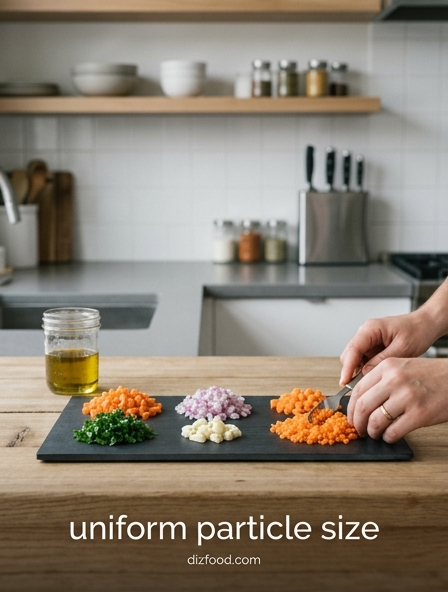
Uniformity in particle size is critical because it ensures that every individual grain of coffee reacts with water at the same rate. If the particles are inconsistent, the water will extract the desirable flavors from smaller particles while leaving larger particles under-extracted. This leads to a chemical imbalance where the final cup contains both the bitter notes of over-extraction and the sour, thin notes of under-extraction simultaneously, muddying the clarity of the roast profile.
Choosing Between Blade and Burr Grinders
Achieving a uniform particle size starts with the mechanical design of the grinding equipment. For many home cooks, the choice falls between blade grinders and burr grinders, each utilizing a different physical mechanism to break down the beans. Blade grinders function like a blender, using high-speed rotation to chop beans into random fragments. This method inherently produces an inconsistent mix of dust-like fines and large chunks, making precise extraction impossible.
In contrast, burr grinders utilize two oscillating plates to crush the beans to a specific, measurable gap. This design offers several advantages for those seeking consistency:
- Adjustability: Users can precisely control the distance between burrs to match the brewing method.
- Friction Control: High-quality burrs generate less heat, preserving volatile aromatic oils.
- Uniformity: The crushing action ensures that most particles pass through the gap only when they reach the desired size.
- Repeatability: Digital or stepped settings allow users to return to the exact same grind size daily.
Impact of Particle Size on Flavor Profiles
The sensory experience of a cup of coffee is a direct reflection of the grind size utilized during the brewing process. Particle size dictates the resistance the coffee bed provides to water flow and the speed at which soluble solids enter the liquid. When the grind is too fine for the chosen method, the water encounters significant resistance, leading to prolonged contact time. This over-extraction typically results in a dry, astringent, and unpleasantly bitter flavor profile, as the water begins to pull out heavier organic compounds that are better left in the grounds.
Conversely, a grind that is too coarse offers very little resistance, allowing water to pass through the bed rapidly. This results in under-extraction, where the acids are the only components dissolved, leaving the coffee tasting sour, salty, or watery. A uniform grind allows the brewer to target a specific "sweet spot" where the acidity, sweetness, and bitterness are perfectly balanced. Without uniformity, the palate is overwhelmed by conflicting signals, preventing the taster from identifying the unique terroir and processing notes of the specific coffee variety.
The Role of Fines and Boulders in Extraction
Even the highest quality grinders produce a distribution of sizes rather than a single perfect dimension. Within this distribution, the two most problematic elements are "fines" and "boulders." Fines are microscopic dust particles that extract almost instantly, often clogging filters and introducing bitterness. Boulders are oversized fragments that remain largely dry in the center, contributing nothing but acidity. The goal of a professional-grade grinder is to tighten the bell curve of particle distribution, minimizing these outliers.
| Particle Type | Definition | Impact on Flavor |
|---|---|---|
| Fines | Particles <100 microns | Bitterness, astringency, clogged filters |
| Target Size | Desired micron range | Balanced sweetness and clarity |
| Boulders | Significantly oversized fragments | Sourness, thin body, under-extraction |
Calibrating Your Grinder for Different Brew Methods
Calibration is the process of aligning your grinder's physical settings with the requirements of specific extraction times and pressures. Every brewing device requires a different particle size to optimize the contact time between water and coffee. For example, espresso requires an extremely fine, flour-like grind to create enough back-pressure for the machine's pump, while a French Press requires a coarse, sea-salt texture to prevent the mesh filter from clogging and to account for the long immersion time.
To calibrate effectively, follow these steps:
- Identify the manufacturer's recommended starting point for your specific brew method.
- Perform a test brew and record the total extraction time and flavor notes.
- Adjust the grind size in small increments-finer if the coffee is sour, coarser if it is bitter.
- Purge the grinder between adjustments to ensure no old grounds contaminate the new setting.
- Evaluate the "mouthfeel"; a sandy texture often indicates the grind is too coarse for the filter.
Achieving Distribution Consistency Across Various Roasts
Coffee beans undergo significant physical changes during the roasting process, which directly affects how they shatter during grinding. Lightly roasted beans are dense, hard, and retain more moisture, making them more difficult to grind uniformly. They often require a more powerful motor and sharper burrs to prevent the creation of excessive fines. Because they are less porous, light roasts generally require a finer grind to facilitate efficient extraction of their complex acids and sugars.
Darker roasts, however, have been subjected to more heat, making them brittle and highly porous. These beans shatter easily, often producing more fines than light roasts even on the same setting. They are also prone to generating static electricity due to their low moisture content, which can cause grounds to clump together. Achieving consistency across these variations requires the user to adjust the grinder speed or utilize techniques like the "Ross Droplet Technique" (adding a tiny drop of water to the beans) to reduce static and ensure a smooth, even flow of particles into the basket.
Tools for Measuring and Sifting Coffee Grounds
To move beyond guesswork, many enthusiasts and professionals use specialized tools to measure and refine their grind consistency. While visual inspection is a start, it is often inaccurate due to the microscopic nature of coffee particles. Precision sieving is one of the most effective ways to ensure uniformity by physically removing the outliers from a dose of coffee. This process involves passing the grounds through a series of screens with specific micron ratings.
- Sifting Trays: Multi-layered sieves that separate fines and boulders from the target range.
- Digital Calipers: Used to measure the physical distance between burrs for mechanical alignment.
- Optical Scanners: High-end software that analyzes a photograph of coffee grounds to map the size distribution.
- Microscopic Analysis: Used in laboratory settings to study the cellular structure of ground coffee.
By using these tools, a brewer can remove the "noise" from the extraction process, ensuring that only the most uniform particles contribute to the final beverage, resulting in unparalleled clarity and flavor definition.
How Grind Uniformity Prevents Over-Extraction
Over-extraction occurs when water pulls too much organic material from the coffee grounds, specifically the heavy tannins and bitter alkaloids. In a non-uniform grind, the fines (micro-particles) are the primary culprits of this issue. Because they have an immense surface-area-to-volume ratio, they over-extract almost immediately upon contact with hot water. Even if the majority of your grounds are at the correct size, a small percentage of fines can dominate the flavor profile with an unpleasant burnt or ashy taste.
Uniformity also prevents "channeling," a phenomenon where water finds the path of least resistance through the coffee bed. In an inconsistent grind, water will rush through areas with larger chunks and avoid areas where fines have clumped together. This creates localized pockets of over-extracted and under-extracted coffee. A uniform grind ensures an even resistance across the entire coffee bed, forcing the water to move through the grounds at a consistent velocity and extracting the flavor compounds evenly from every grain, resulting in a balanced and sweet cup.
Maintenance Tips for Long-Term Grind Precision
A grinder's ability to produce uniform particles degrades over time due to mechanical wear and the buildup of coffee oils. These oils can go rancid and act as a glue, trapping fines within the burr chamber and causing the grinder to produce inconsistent sizes. To maintain precision, a regular cleaning and maintenance schedule is essential. If the burrs are dull or misaligned, even the most expensive grinder will fail to produce a quality grind.
Consider the following maintenance routine:
- Weekly Cleaning: Use a specialized brush to remove loose grounds and oils from the burrs and chute.
- Monthly Deep Clean: Use grinder cleaning tablets to absorb stubborn oils and dislodge compacted particles.
- Burr Inspection: Check for chips or dullness every 500-1000 pounds of coffee, depending on the burr material (steel vs. ceramic).
- Alignment Checks: Ensure the burrs are perfectly parallel to prevent lopsided grinding and uneven particle shapes.
Visual Guide to Identifying Ideal Particle Sizes
For many home brewers, the easiest way to gauge grind size is by comparing the coffee to common household ingredients. While not as precise as micron measuring, these visual references provide a reliable baseline for various brewing methods. Developing an eye for these textures allows for quick adjustments when switching between different beans or brewers. Below is a comparison table to help identify the ideal particle size for common kitchen applications.
| Brew Method | Ideal Texture | Visual Reference |
|---|---|---|
| Espresso | Extra Fine | Powdered Sugar or Flour |
| Pour Over | Medium-Fine | Table Salt |
| Drip Coffee | Medium | Granulated Sugar |
| French Press | Coarse | Kosher Salt or Sea Salt |
| Cold Brew | Extra Coarse | Peppercorns (Cracked) |





Comments