
Choosing between a bottomless and a spouted portafilter is a defining step in any barista's journey toward espresso mastery. While the traditional spouted portafilter is the reliable industry standard-offering exceptional thermal stability and the ability to split a double shot into two single cups-the bottomless (or "naked") portafilter serves as the ultimate diagnostic window into your extraction technique. By removing the floor of the portafilter, you gain an unobstructed view of the espresso as it forms, allowing you to identify channeling, uneven tamping, or grind inconsistencies in real-time. Whether you are looking for the mess-free convenience of a spouted handle or the educational, crema-rich feedback of a naked one, understanding these tools is essential for perfecting your daily brew.
| Feature | Bottomless Portafilter | Spouted Portafilter |
|---|---|---|
| Visual Feedback | Full visibility; instant diagnosis of channeling/spurts. | Hidden flow; cannot see extraction issues. |
| Crema Quality | Greater volume; less air contact during the fall. | Standard; crema is slightly aerated by spouts. |
| Cup Clearance | High; accommodates taller latte or travel mugs. | Low; restricted by the physical length of spouts. |
| Thermal Mass | Lower; cools down faster due to less metal. | Higher; retains heat better for consistent shots. |
| Cleanliness | High maintenance; prone to "spritzing" if technique is off. | Mess-free; directs flow precisely into the cup. |
| Workflow | Best for training and single-cup enthusiasts. | Best for high-volume service and splitting shots. |
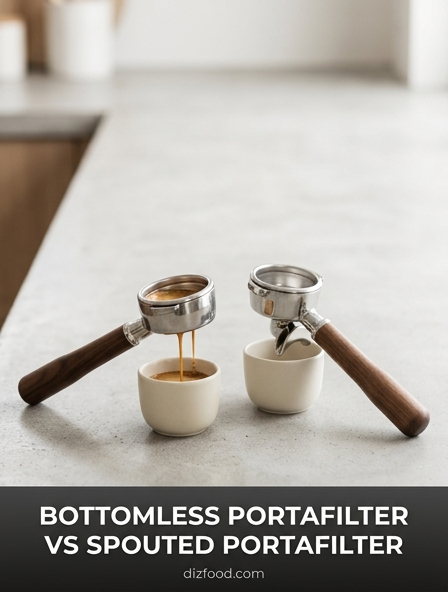
Bottomless vs Spouted Portafilter Key Differences
The primary distinction between a bottomless portafilter-often referred to as a naked portafilter-and a traditional spouted portafilter lies in the design of the filter head's base. A spouted portafilter features a solid metal floor with one or two directional nozzles that guide the extracted espresso into a cup. In contrast, the bottomless version has the entire lower portion removed, exposing the underside of the filter basket and allowing the espresso to flow directly from the mesh into the vessel. This fundamental structural change influences everything from visual diagnostics to the final mouthfeel of the coffee.
Beyond the visual aspect, these two tools cater to different priorities within the kitchen. The spouted portafilter is the industry standard for high-volume environments where splitting shots into two separate cups is a frequent requirement. The bottomless portafilter is largely viewed as a diagnostic tool, favored by home enthusiasts and professional baristas alike for its ability to reveal flaws in puck preparation. While they both lock into the group head using the same ear-locking mechanism, the way they interact with the coffee oils and thermal energy differs significantly.
- Spouted: Features a floor and channels (single or double spout).
- Bottomless: Fully open base exposing the filter basket.
- Materials: Usually stainless steel or chrome-plated brass for both.
- Function: Spouted prioritizes cleanliness; Bottomless prioritizes feedback.
Understanding the Visual Feedback of Naked Portafilters
One of the most compelling reasons to use a bottomless portafilter is the unparalleled visual feedback it provides during the extraction process. When you pull a shot, you can observe the espresso as it beads up across the entire surface of the basket. Ideally, these beads should converge into a single, steady stream in the center, often displaying "tiger striping"-the beautiful marbling of dark and light brown crema. This visual confirmation tells the barista that the water is moving evenly through the coffee puck, ensuring a balanced extraction.
Without the floor of a spouted portafilter to hide the action, any irregularities become immediately apparent. Baristas can watch for "dead spots" where no coffee is flowing, which indicates uneven tamping or poor distribution. The naked design also allows you to see "blonding" in real-time, which is the point where the desirable oils have been extracted and the stream turns watery and pale. By observing the color and flow rate directly at the source, you can make more precise adjustments to your grind size and dose than you ever could by looking at the stream coming out of a metal spout.
How Spouted Portafilters Improve Workflow and Consistency
While bottomless portafilters are excellent for learning, spouted portafilters remain the workhorse of the busy kitchen due to their contribution to a streamlined workflow. The presence of spouts allows the barista to rest the portafilter more securely on a tamping mat or a stand. Many bottomless portafilters are difficult to keep level during tamping because they lack the stabilizing weight and shape of the spout, which can actually lead to the very distribution issues they are meant to diagnose.
Consistency in a fast-paced environment is often higher with spouted models because they are more forgiving of minor preparation errors. If a puck has a tiny micro-channel, a bottomless portafilter might spray espresso across the counter, requiring a cleanup that interrupts the workflow. A spouted portafilter contains these minor "spritzers," ensuring that the coffee makes it into the cup rather than onto the machine. This containment makes them the preferred choice for commercial settings where speed and tidiness are just as important as the nuances of the extraction.
| Feature | Spouted Portafilter | Bottomless Portafilter |
|---|---|---|
| Stability | High (rests on spouts) | Low (requires specialized stand) |
| Mess Factor | Low (contains sprays) | High (vulnerable to channeling) |
| Efficiency | High (split shots possible) | Lower (single stream only) |
Crema Quality and Texture Comparison
The interaction between the espresso and the metal surfaces of the portafilter significantly impacts the texture of the crema. In a bottomless portafilter, the espresso drops directly from the basket into the cup with minimal contact with external surfaces. This lack of contact results in a thicker, more resilient crema because the delicate CO2 bubbles are not being agitated or popped by hitting the metal floor and traveling through the spouts. Many aficionados find that bottomless shots have a creamier, more velvety mouthfeel due to this direct-to-cup delivery.
Spouted portafilters, however, can slightly aerate the coffee as it travels through the internal channels. While this might result in a slightly thinner crema, the difference is often subtle. The major trade-off is the potential for temperature loss. As the espresso travels through the cold or room-temperature metal of the spouts, it loses heat. If the spouted portafilter is not properly pre-heated, the crema can become thin and dissipate quickly. Bottomless portafilters avoid this specific cooling phase, though they face their own challenges with ambient air exposure. Ultimately, if you prioritize the visual aesthetic and height of the crema, the bottomless design usually wins.
Diagnosing Extraction Issues with a Bottomless Portafilter
The bottomless portafilter is the ultimate truth-teller in the world of espresso. It exposes "channeling," a common problem where water finds a path of least resistance through the coffee puck rather than flowing through it evenly. When channeling occurs, you will see high-pressure jets of coffee-often called "spritzers"-shooting out at odd angles. These sprays are a clear sign that your distribution or tamping technique needs improvement. In a spouted portafilter, these issues are hidden, and the resulting bitter or sour taste might be blamed on the beans rather than the technique.
- Spritzing: Small jets of coffee indicate holes or cracks in the puck.
- Multiple Streams: If the espresso doesn't converge, the puck is unevenly compressed.
- Premature Blonding: Light-colored streams appearing too early indicate over-extraction in specific areas.
- Donut Extraction: Coffee appearing only at the outer edges suggests poor tamping at the perimeter.
By using these visual cues, baristas can refine their "puck prep." This might involve using a WDT (Weiss Distribution Technique) tool to break up clumps or adjusting the pressure applied during tamping. Without the bottomless portafilter, these diagnostic steps are largely based on guesswork and flavor alone, which can be frustrating for those trying to master the art of the perfect shot.
Temperature Stability and Heat Retention Differences
Temperature stability is a critical factor in espresso extraction, and both portafilter styles handle heat differently. A spouted portafilter has significantly more thermal mass due to the extra metal in the floor and the spouts. Once fully heated by the machine's group head, it acts as a heat sink that helps maintain a consistent temperature as the water passes through the coffee. However, the downside is that if the spouted portafilter is not adequately pre-heated, it will actively sap heat from the espresso, resulting in a lukewarm and sour shot.
Bottomless portafilters have less metal, meaning they reach the desired temperature faster. They also eliminate the cooling effect that occurs when espresso flows over the metal spouts. However, because the bottom of the basket is entirely exposed to the air, there is a theoretical risk of heat loss to the environment, especially in cold kitchens. In practice, most users find that the bottomless portafilter provides a more consistent temperature profile for the extraction itself because there is no chance for the coffee to be cooled by the "dead air" or under-heated metal found inside the internal chambers of a spouted portafilter.
Cleaning and Maintenance Requirements for Each Style
In terms of hygiene and ease of maintenance, the bottomless portafilter is the clear winner. Because the bottom is open, there are no hidden nooks or crannies where coffee oils and old grounds can accumulate. After a shot, a quick wipe of the basket and the rim is usually sufficient. There is no internal "floor" to scrub, making it much easier to keep the equipment pristine and ensuring that old, rancid oils do not taint the flavor of your fresh espresso.
Spouted portafilters require a more rigorous cleaning routine. Over time, coffee residue builds up inside the spouts and the chamber beneath the basket. This buildup is often invisible unless you remove the basket and look inside. If not cleaned regularly with a brush and backflushing detergent (like Cafiza), this residue will oxidize and impart a bitter, "burnt" flavor to every shot you pull. Professional kitchens must deep-clean spouted portafilters daily, whereas a bottomless portafilter stays clean simply by virtue of its design. For the home user who wants low-maintenance gear, the naked portafilter offers a significant advantage in cleanliness.
Cup Clearance and Group Head Height Advantages
Kitchen ergonomics often play a role in which portafilter is more practical. One of the most underrated benefits of a bottomless portafilter is the additional clearance it provides beneath the group head. By removing the spouts, you typically gain an extra inch or two of vertical space. This is a game-changer for those who prefer to brew directly into larger mugs, travel thermoses, or for baristas using a bulky espresso scale to measure their yields in real-time.
Spouted portafilters can be quite restrictive, especially on smaller home espresso machines. Often, you are forced to brew into a small shot glass and then transfer the coffee to a larger mug, which results in a loss of crema and heat. With a bottomless portafilter, you can fit a standard latte mug or a scale plus a cup comfortably. This convenience factor makes the bottomless option very popular for home users who have limited space between the drip tray and the group head and want to simplify their serving process.
Split Shots and Single Basket Versatility
The primary advantage of the spouted portafilter is its ability to split a double shot into two separate single servings. The dual spouts are designed to divide the flow equally, allowing a barista to serve two milk-based drinks or two espressos simultaneously from a single extraction. This is a critical feature in a commercial setting or a busy household. A bottomless portafilter, by its very nature, can only produce a single stream of coffee, meaning it cannot be used to split shots into two cups without making a significant mess.
Furthermore, spouted portafilters are often better suited for use with single-shot baskets. Single baskets have a distinct funnel shape that can sometimes lead to uneven flow when used with a bottomless portafilter, often causing the stream to be off-center or erratic. The spouts on a traditional portafilter help to consolidate this flow and direct it neatly into the cup, regardless of how the basket is shaped internally. If you frequently find yourself making single shots or serving multiple guests at once, the spouted portafilter remains the more versatile tool.
Which Portafilter Should Beginners Choose First
For a beginner, the choice depends on whether they view espresso as a hobby or a simple morning necessity. A spouted portafilter is generally the better starting point for someone who wants to minimize frustration. It is easier to tamp, it is less likely to spray coffee on the walls if the technique is imperfect, and it allows for more flexibility when serving drinks. It provides a "safe" environment where the user can focus on grind size and timing without being penalized by a mess every time they make a small mistake.
However, for the beginner who is serious about mastering espresso, a bottomless portafilter is an essential investment. It acts as a permanent coach, providing immediate visual evidence of errors that would otherwise go unnoticed. While the learning curve is steeper and the potential for a messy kitchen is higher in the first week, the long-term benefit of improved technique is invaluable. Many experts suggest using the spouted portafilter for daily convenience and switching to the bottomless one during weekend "practice sessions" to troubleshoot and refine your skills until your puck preparation is flawless.


Comments