
If you're looking to elevate your morning ritual, choosing between the Hario V60 and the Chemex is the ultimate pour-over showdown. The Hario V60 is a darling of professional baristas, prized for its internal spiral ridges and thin filters that highlight bright acidity and complex floral notes in light-roast beans. Conversely, the Chemex is a mid-century design icon that utilizes proprietary, extra-thick bonded filters to strip away oils and sediment, resulting in an incredibly clean, crisp, and tea-like cup of coffee. While the V60 rewards precision and technique with a vibrant flavor profile, the Chemex offers a more forgiving brewing process and a stunning aesthetic that doubles as a carafe for sharing. Both methods deliver a superior extraction compared to standard drip machines, but your choice ultimately hinges on whether you prefer the technical intimacy of a focused single cup or the elegant, sediment-free clarity of a larger batch.
| Feature | Hario V60 | Chemex |
|---|---|---|
| Filter Type | Thin, oxygen-bleached paper (fast flow) | Thick, multi-layered bonded paper (slow flow) |
| Flavor Profile | Bright, acidic, nuanced, and complex | Clean, crisp, sediment-free, and tea-like |
| Grind Size | Medium-Fine (similar to table salt) | Medium-Coarse (similar to Kosher salt) |
| Brewing Skill | High; requires precise pouring technique | Moderate; thick filters allow for more margin of error |
| Material/Build | Ceramic, glass, plastic, or metal dripper | Non-porous Borosilicate glass carafe |
| Best For | Single-cup connoisseurs & flavor clarity | Multiple servings & aesthetic appeal |
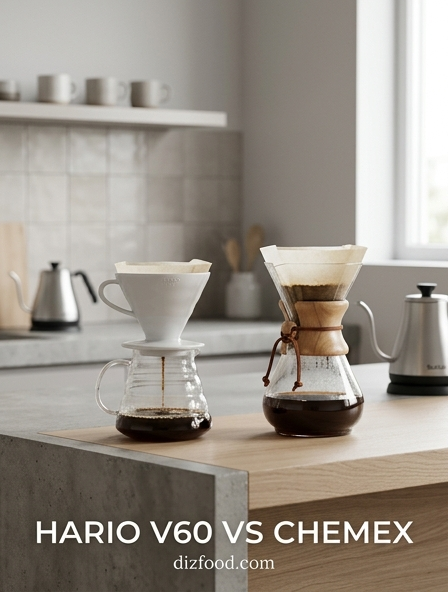
Hario V60 vs Chemex Comparison
The Hario V60 and the Chemex represent two distinct philosophies within the world of manual pour-over coffee brewing. While both utilize a gravity-fed extraction method, their engineering and final outputs cater to very different palates. The Hario V60, a Japanese innovation, is often celebrated for its precision and ability to highlight specific flavor notes in high-quality, single-origin beans. It is a favorite among professional baristas who enjoy the challenge of perfecting a brew through meticulous pouring technique.
In contrast, the Chemex is an American icon of mid-century design, doubling as both a brewing vessel and a stylish carafe. Its approach focuses on purity and clarity, removing the heavy oils and sediments that can sometimes muddy the flavor of coffee. This comparison explores how the internal geometry of the V60-characterized by its 60-degree angle and spiral ribs-competes with the thick, proprietary filters of the Chemex. Whether you are a morning ritualist seeking a clean, tea-like cup or a coffee enthusiast looking to experiment with extraction variables, understanding these two brewers is essential for any modern kitchen.
| Feature | Hario V60 | Chemex |
|---|---|---|
| Origin | Japan | USA |
| Body Type | Medium/Full | Light/Tea-like |
| Difficulty | Moderate/High | Moderate |
Design and Material Differences
The aesthetic and functional design of these two brewers could not be more different. The Hario V60 is a cone-shaped dripper that sits directly atop a mug or a server. Its most defining feature is the series of curved, spiral ribs on the interior walls. These ribs are designed to keep the paper filter from sticking to the sides, allowing air to escape and ensuring that water flows through the coffee grounds from all sides rather than just the bottom. It is available in a variety of materials including ceramic, glass, plastic, and metal, each offering different thermal retention properties.
The Chemex features an elegant hourglass shape made entirely from non-porous borosilicate glass, which does not absorb odors or chemical residues. Its design includes a polished wood collar and a leather tie, which serves as a heat-resistant handle for pouring. Unlike the V60, the Chemex is an all-in-one system where the coffee is brewed and served from the same vessel. The lack of internal ribs in the Chemex means the filter sits flush against the glass, relying entirely on the thick paper and the heavy grind size to regulate flow. This results in a slower, more controlled extraction compared to the rapid-flow design of the V60.
- V60 Materials: Plastic, Ceramic, Glass, Copper, Stainless Steel.
- Chemex Materials: Borosilicate Glass, Wood, Leather.
- V60 Portability: High (especially plastic models).
- Chemex Portability: Low (bulky and fragile glass).
Filter Thickness and Coffee Clarity
Perhaps the most significant difference between the Hario V60 and the Chemex lies in the filtration. The Chemex utilizes proprietary bonded filters that are 20% to 30% thicker than standard coffee filters. These heavy-duty papers are designed to perform a high level of filtration, trapping nearly all of the coffee oils and even the finest sediment. This results in a cup of coffee that is incredibly clear, bright, and free of bitterness. The clarity of a Chemex brew is often described as "tea-like," making it the ideal choice for those who want to experience the floral and citrus notes of a light roast without any heavy mouthfeel.
The Hario V60 uses much thinner paper filters, which allow more oils and micro-sediments to pass through into the final cup. This gives the V60 coffee a heavier body and a more complex texture than the Chemex. Because the filters are thinner, the water moves through the bed of grounds much faster, meaning the user must be more precise with their pour to avoid under-extraction. While V60 filters come in several variations-including bleached white and natural oxygen-cleansed versions-none offer the extreme level of oil retention found in the Chemex system. For drinkers who prefer a balance between clarity and body, the V60 provides a middle ground that the Chemex cannot reach.
Brewing Technique and Difficulty
Brewing with a Hario V60 is often considered a "barista's craft" because of how much the technique influences the final flavor. The large hole at the bottom of the cone means the water flow is restricted only by the coffee grounds and the user's pouring speed. If you pour too fast, the water rushes through, leading to a weak, sour cup. If you pour too slow, it may over-extract. Mastering the V60 requires a steady hand and a gooseneck kettle to control the agitation of the coffee bed.
The Chemex is generally more forgiving in terms of pouring technique but requires more patience. Because of the thick filters, the water naturally takes longer to drain, which acts as a built-in regulator for the flow rate. However, because the filter sticks to the glass, an "air-lock" can sometimes occur if the filter isn't positioned correctly over the pouring spout, which stops the drip entirely. To brew a perfect cup, follow these general steps:
- Rinse the filter with hot water to remove paper taste and pre-heat the vessel.
- Add coffee grounds and "bloom" them with a small amount of water for 30 seconds.
- Pour in slow, concentric circles, avoiding the very edges of the filter.
- Maintain a consistent water level until the desired volume is reached.
- Allow the water to draw down completely before removing the filter.
Flavor Profiles and Tasting Notes
When comparing flavor profiles, the V60 is known for producing a "vibrant" cup. Because it allows more oils to pass through, the acidity is often more pronounced and "sharp," which highlights the fruity and acidic characteristics of African beans particularly well. The body is medium, providing a satisfying mouthfeel while still remaining clean enough to distinguish individual flavor notes. It is a brewer that rewards those who enjoy complexity and a certain level of "punch" in their morning caffeine.
The Chemex produces what many consider the "cleanest" cup of coffee possible. By stripping away almost all fats and oils, the Chemex highlights the sweetness and the most delicate aromatic compounds of the bean. You might find that a coffee which tastes nutty or chocolatey in a V60 tastes more like stone fruit or jasmine in a Chemex. The bitterness is almost entirely removed, but the trade-off is a very thin body. If you enjoy the richness and "weight" of a French press, the Chemex might feel too thin or watery. However, for discovering the hidden nuances of high-altitude beans, the Chemex is unrivaled in its ability to produce a crisp, sparkling finish.
Ideal Grind Sizes for Each
Grind size is the primary variable used to control the contact time between water and coffee. For the Hario V60, a medium-fine grind is generally recommended. Because the water passes through the V60 quickly, the smaller particle size increases the surface area, allowing for a faster extraction. If the grind is too coarse, the water will fly through the brewer before it can pick up any flavor. The ideal consistency should look similar to table salt or slightly finer.
The Chemex requires a significantly coarser grind, typically described as medium-coarse, resembling sea salt or kosher salt. Because the Chemex filter is so dense, a fine grind would clog the paper and lead to an incredibly slow brew time, resulting in over-extracted, bitter coffee. The coarser grind allows the water to navigate through the coffee bed despite the resistance of the thick paper. Adjusting the grind size is the most effective way to "dial in" your brew for both devices; if your coffee tastes sour, grind finer, and if it tastes bitter or dry, grind coarser.
- V60 Grind: Medium-Fine (Salt-like).
- Chemex Grind: Medium-Coarse (Sea salt-like).
- V60 Brew Time: 2:30 to 3:00 minutes.
- Chemex Brew Time: 4:00 to 5:00 minutes.
Serving Capacity and Batch Brewing
One of the most practical differences for a kitchen setting is how much coffee each device can make at once. The Hario V60 is primarily designed for single-serve brewing. While it comes in three sizes (01, 02, and 03), even the largest size is most effective when brewing one or two cups. Attempting to brew a large batch in a V60 often leads to a deep coffee bed that is difficult to saturate evenly, often resulting in uneven extraction and a loss of flavor clarity.
The Chemex shines as a batch brewer. It is available in 3, 6, 8, and 10-cup models, making it the superior choice for serving a family or hosting guests. The large, open top and the wide bottom of the carafe allow for a significant volume of coffee to be brewed at once without sacrificing the quality of the extraction. Because it serves as its own carafe, it also keeps the coffee warm for a reasonable amount of time due to the thick glass, whereas coffee in a V60 setup usually needs to be transferred to a thermal server if not consumed immediately.
| Capacity | V60 (Size 02) | Chemex (6-Cup) |
|---|---|---|
| Max Output | Approx. 500ml | Approx. 900ml |
| Best For | Individual use | Couples or Groups |
| Footprint | Small/Compact | Large/Tall |
Durability and Portability Comparison
If you are someone who travels frequently or tends to be clumsy in the kitchen, the material of your brewer is a vital consideration. The Hario V60 is arguably the most durable pour-over option, provided you choose the plastic version. The plastic V60 is virtually indestructible, lightweight, and retains heat better than ceramic or glass models. It is a favorite for camping or office use because it can be tossed into a bag without fear of shattering. Even the metal and ceramic versions are relatively compact and easy to store in small kitchen cabinets.
The Chemex, conversely, is quite fragile. Made of glass, it is susceptible to thermal shock if not handled properly and can easily crack if knocked against a granite countertop or dropped in the sink. Its tall, wide shape also makes it difficult to pack for travel, and it takes up significant real estate on a kitchen counter or in a cupboard. While it is a beautiful centerpiece, the Chemex is strictly an "at-home" brewer. For those who prioritize a rugged, portable coffee setup, the V60-specifically the plastic 02 model-is the clear winner in the durability category.
Maintenance and Cleaning Guide
Keeping your brewing equipment clean is essential for maintaining the integrity of the coffee's flavor. The Hario V60 is incredibly easy to maintain. After brewing, you simply discard the filter and rinse the dripper under hot water. Most V60 models are dishwasher safe, though hand-washing is usually sufficient since coffee doesn't sit in the dripper for long. If you use a ceramic or glass model, you may occasionally need to use a descaling solution if you have hard water, but otherwise, maintenance is minimal.
The Chemex requires a bit more effort due to its unique design. The wood collar and leather tie must be removed before the glass can be thoroughly washed, as the wood can be damaged by excessive moisture or high heat in a dishwasher. Because of its narrow neck, reaching the bottom of the carafe to scrub away coffee oils can be difficult without a dedicated bottle brush. It is recommended to rinse the Chemex immediately after use to prevent staining. For deep cleaning, a mixture of ice, salt, and a little soap swirled around inside can help remove stubborn residues from the glass walls.
- Discard the used filter and grounds immediately.
- Remove the wood collar and leather strap (Chemex only).
- Rinse with hot water; use a soft brush for the V60 ribs or a bottle brush for the Chemex base.
- Air dry on a rack to prevent moisture buildup.
- Periodically use a coffee equipment cleaner to remove buildup of oils.
Which Pour Over Brewer to Choose
Choosing between the Hario V60 and the Chemex ultimately comes down to your personal taste preferences and your daily lifestyle. If you view coffee brewing as a hobby and enjoy the ritual of "dialing in" a recipe to find the perfect balance of acidity and body, the Hario V60 is the better tool. Its versatility allows you to experiment with different pouring styles and filters to achieve a wide range of results. It is also the more economical and durable choice for single drinkers or those who need a portable coffee solution.
However, if you prioritize aesthetics and prefer a very clean, crisp cup of coffee without any silt or heavy oils, the Chemex is the superior option. It is ideal for those who frequently brew for more than one person and want a device that looks as good as it performs. While the filters are more expensive and the glass requires more careful handling, the reward is a unique, tea-like coffee experience that no other brewer can replicate. Consider the V60 for technical precision and the Chemex for elegant simplicity and clarity. Many enthusiasts eventually find a place for both in their kitchen, using the V60 for their solo morning cup and the Chemex for weekend brunches with friends.



Comments