
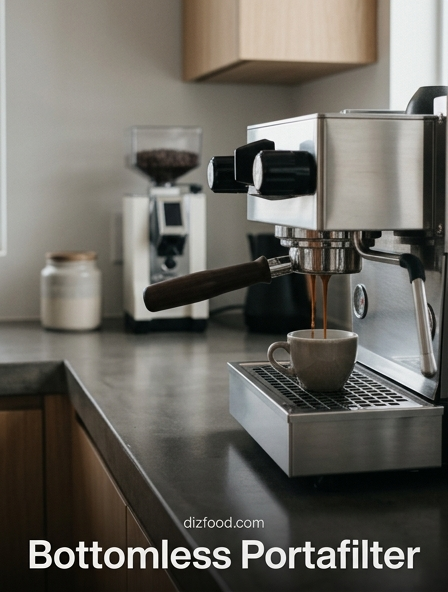
The Mechanics of Bottomless Portafilters
The bottomless portafilter, often referred to as a "naked" portafilter, serves as a critical diagnostic tool in the specialty coffee world. Unlike traditional portafilters that utilize a metal base and one or two spouts to direct the liquid, the bottomless version exposes the entire underside of the filter basket. This design modification is not merely for aesthetic appeal; it fundamentally alters the clearance under the group head, allowing for the use of larger cups and precision scales. Mechanically, the absence of spouts means the espresso travels directly from the basket into the vessel, reducing the amount of metal the coffee contacts during its exit.
This maintains the thermal stability of the shot more effectively and prevents the buildup of stale coffee oils that often hide within the spouts of conventional designs. Baristas prefer this tool because it provides an unobstructed view of the puck's performance under pressure. By removing the physical barrier, the user can observe how pressurized water interacts with the ground coffee. This transparency is essential for identifying whether the coffee is extracting evenly or if internal failures are occurring within the coffee bed.
Visual Indicators of Perfect Espresso Extraction
Achieving a perfect espresso extraction with a bottomless portafilter is a visually rewarding experience that signals a well-prepared puck. The first sign of a quality shot is the uniform appearance of droplets across the entire surface of the basket. Within seconds, these droplets should coalesce into a single, steady stream that hangs from the center of the basket. This is often referred to as the "cone" formation. The color of the extraction should transition smoothly from a deep, rich reddish-brown to a lighter caramel hue as the shot progresses.
- Beading: Even distribution of coffee across the bottom of the basket during the pre-infusion phase.
- Convergence: The migration of multiple small streams toward the center to form one cohesive flow.
- Viscosity: A thick, honey-like consistency that indicates a proper balance of oils and solids.
- Color Transition: A gradual shift from dark mahogany to golden tan without sudden "blonding."
When these indicators align, it suggests that the water is flowing through the coffee bed at a consistent rate, ensuring that the flavor profile remains balanced and free from excessive bitterness or sourness.
Identifying and Correcting Espresso Channeling
Channeling occurs when water finds a path of least resistance through the coffee puck rather than flowing evenly through the entire bed. On a bottomless portafilter, this is immediately obvious. You may see "bald spots" where no coffee is flowing, or multiple erratic streams that refuse to merge into a single cone. These channels result in uneven extraction, where some parts of the coffee are over-extracted and bitter, while others are under-extracted and sour. The primary cause is often poor distribution or an inconsistent tamping technique that creates weak points in the puck.
To correct channeling, baristas must focus on the preparation phase. Using a Weiss Distribution Technique (WDT) tool can help break up clumps and ensure a uniform density throughout the basket. Additionally, ensuring that the portafilter is dry before dosing prevents water from bypassing the coffee along the walls of the basket. If channeling persists, it may be necessary to check the flatness of the tamp. A slight tilt in the tamper can compress one side more than the other, inevitably leading to a high-velocity flow through the less-compressed side of the coffee bed.
The Role of Grind Consistency in Flow Rate
The relationship between grind size and the flow rate observed through a bottomless portafilter is foundational to espresso theory. The grind must be fine enough to provide resistance to the nine bars of pressure exerted by the machine, yet coarse enough to allow water to pass through within a specific timeframe. If the grind is too coarse, the espresso will gush through the basket, appearing thin and watery. Conversely, if the grind is too fine, the machine may struggle to push water through, resulting in a "choked" shot or very slow, dark drips.
| Grind Status | Visual Observation | Impact on Flow |
|---|---|---|
| Too Coarse | Fast, watery, light-colored flow | Under-extracted; sour and thin |
| Too Fine | Slow drips or no flow at all | Over-extracted; bitter and burnt |
| Optimal | Thick, syrupy, centered cone | Balanced; sweet and complex |
Consistent particle size is achieved through high-quality burr grinders. Inconsistent grinds create a mix of "fines" and boulders, which leads to unpredictable flow patterns and visible turbulence underneath the portafilter basket during the brewing process.
Precision Puck Preparation and Tamping Techniques
The bottomless portafilter is an unforgiving judge of puck preparation. Every micro-fissure or air pocket in the coffee bed is revealed the moment the pump is engaged. Precision preparation begins with an accurate dose, typically measured to within 0.1 grams. Once the coffee is in the basket, distribution is the next critical step. A level surface is required before any pressure is applied. Many professionals use a distribution tool to create a perfectly flat plane, which helps the tamper descend vertically without any deviation.
- Dosing: Weighing the grounds to ensure the basket is filled to its designed capacity.
- Distribution: Using a WDT tool or a leveler to eliminate voids and clumps.
- Tamping: Applying firm, level pressure to remove air gaps and create a solid puck.
- Polishing: A gentle spin of the tamper to ensure a clean, smooth surface (optional).
Tamping pressure is less important than tamping levelness. Even a moderate amount of pressure is sufficient to compress the coffee; however, if the tamp is slanted, the water will favor the lower side. This leads to an uneven "naked" extraction where one side of the basket appears more active than the other.
Analyzing Tiger Stripes and Crema Development
One of the most aesthetically pleasing aspects of using a bottomless portafilter is the observation of "tiger striping." This refers to the mottled pattern of dark and light browns visible in the stream and on the surface of the espresso. These stripes are a byproduct of the emulsification of coffee oils and the release of carbon dioxide. The presence of these patterns generally indicates a high concentration of solubles and a healthy level of freshness in the roasted beans. Crema development is also more apparent, as the absence of spouts prevents the crema from being broken up or dissipated.
The texture of the crema should be fine-bubbled and persistent. If the crema appears excessively frothy or dissipates quickly, it may indicate that the beans are either too fresh (excessive CO2) or too old (loss of oils). Through the naked portafilter, the barista can see the crema forming directly at the source. This visual feedback helps in understanding the lipid content of different coffee varieties and roast levels. Darker roasts tend to produce more abundant, darker crema, while lighter roasts may produce a thinner, more golden layer that reflects their higher acidity.
Diagnosing Extraction Spritzing and Uneven Flow
Spritzing, or the "espresso spray," is a common issue encountered when using bottomless portafilters. It occurs when a small channel forms, causing a high-pressure jet of espresso to shoot out sideways instead of joining the main stream. This can be messy and frustrating, but it provides invaluable data. Spritzing is usually a sign of "micro-channeling," where small pockets of air or uneven density exist within the puck. It can also be caused by using coffee that was roasted too recently, leading to aggressive degassing during the extraction process.
Uneven flow is another diagnostic cue. If the espresso consistently starts flowing from one side of the basket before the other, it indicates an issue with the machine's levelness, the distribution of the grounds, or a dirty shower screen. If the shower screen is clogged with old coffee particles, water will be forced through only certain sections of the screen, hitting the puck with uneven force. Checking the dispersion of water without the portafilter attached can help determine if the problem lies with the machine's maintenance or the barista's puck preparation technique.
Correlating Visual Cues with Flavor Profiles
The ultimate goal of using a bottomless portafilter is to improve the taste of the espresso. Visual cues provide a roadmap to the flavor profile before the cup even reaches the lips. A shot that flows too quickly and looks pale often tastes thin, acidic, and salty. On the other hand, a shot that looks dark and syrupy but begins to "blond" or turn translucent very early might indicate that the pleasant flavors have been exhausted, leaving only the bitter, woody notes behind. By watching the flow, you can learn exactly when to stop the extraction.
| Visual Cue | Likely Flavor Profile |
|---|---|
| Rapid Blonding | Astringent, bitter finish |
| Slow, Dark Drips | Overly intense, burnt, heavy |
| Balanced, Tiger-Striped | Sweet, balanced, complex |
| Erratic Spritzing | Muddled, sharp, inconsistent |
The "yield"-the weight of the liquid espresso-should be measured alongside these visual cues. If the visual quality degrades before the target yield is reached, it suggests the need for a finer grind or better puck preparation to extend the "sweet spot" of the extraction process.
Optimizing Dose and Yield for Maximum Clarity
To maximize clarity in espresso, particularly when working with light-roast specialty beans, the dose and yield must be precisely managed. The bottomless portafilter helps in this optimization by showing how the puck integrity holds up at different ratios. If you are aiming for a high-yield "lungo" shot, the naked portafilter will reveal if the puck begins to erode toward the end of the longer pull. Erosion is visible as a sudden thinning of the stream and a loss of color intensity. This visual "breaking point" tells the barista that the maximum useful yield has been reached.
Dose optimization involves finding the right amount of coffee for the specific basket size. If the basket is underfilled, there is too much headspace, which can lead to a "soupy" puck and uneven initial saturation. If overfilled, the coffee may touch the shower screen prematurely, disrupting the water flow. By using a bottomless portafilter, you can observe the "wetting" phase. A properly dosed and distributed basket will show a synchronized appearance of coffee across the entire bottom, ensuring that the water extracts the flavors evenly from the first drop to the last.
Essential Maintenance for Transparent Brewing Tools
Maintaining a bottomless portafilter is significantly easier than maintaining a spouted one, but it requires regular attention to ensure accuracy. Because the basket is fully exposed, any residue on the metal can affect the flow and the flavor. After every session, the basket should be removed from the portafilter ring and both components should be rinsed. Coffee oils can build up in the "lip" of the portafilter and around the basket's holes, which can eventually lead to clogs or off-flavors. A daily soak in a specialized espresso machine detergent will keep the stainless steel gleaming and free of buildup.
- Daily Rinse: Remove the basket and rinse both parts after use to prevent oil accumulation.
- Chemical Soak: Use a coffee-specific cleaner weekly to dissolve stubborn carbonized residues.
- Basket Inspection: Hold the basket up to a light source to check for blocked or deformed holes.
- Gasket Care: Ensure the portafilter ears are clean so they don't wear down the group head gasket.
A clean tool ensures that the visual feedback you receive is accurate. If the basket holes are partially blocked, it may mimic the appearance of channeling even if your puck preparation is perfect, leading to unnecessary adjustments and frustration.






Comments