
Have you ever wondered if your cooking habits are secretly draining the life out of your healthy ingredients? When it comes to the classic kitchen showdown between steaming and boiling, the method you choose determines whether nutrients stay in your food or disappear down the kitchen sink. While boiling is a convenient, high-heat staple, it often leads to "leaching," where essential water-soluble vitamins-like Vitamin C and B-complex-dissolve into the cooking liquid and are lost forever. In contrast, steaming uses gentle vapor to cook food without direct water contact, effectively locking in antioxidants, minerals, and vibrant natural colors. Choosing the right technique isn't just about texture; it's about ensuring the nutritional value of your meal survives the heat to actually reach your plate.
| Feature | Steaming (Vapor) | Boiling (Submersion) |
|---|---|---|
| Nutrient Retention | High; preserves up to 90% of water-soluble vitamins. | Lower; significant loss (30-50%) due to leaching. |
| Vitamin Stability | Protects heat-sensitive Glucosinolates and Vitamin C. | Degrades Folate and B-vitamins in high-heat water. |
| Texture & Flavor | Crisp-tender; maintains structural fiber and sugars. | Softer; can become mushy or waterlogged quickly. |
| Color Preservation | Vibrant; fixes chlorophyll and carotenoids. | Dull; pigments bleed into the surrounding liquid. |
| Cooking Speed | Slightly slower as heat transfers via gas/vapor. | Faster for dense items due to direct liquid contact. |
| Best For | Broccoli, leafy greens, fish, and delicate veg. | Potatoes, pasta, hard grains, and root vegetables. |
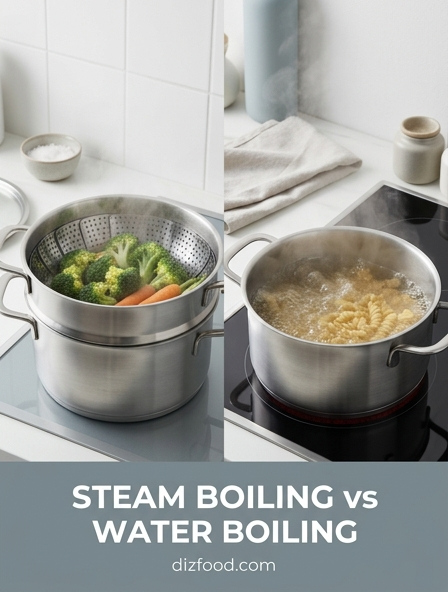
The Science Behind Steam vs Water Boiling
At the heart of kitchen thermodynamics lies the phase transition of water from a liquid to a gaseous state. While both steam and boiling water exist at approximately 100°C (212°F) under standard atmospheric pressure, their physical behaviors differ fundamentally due to molecular density and energy states. Boiling water involves the rapid movement of liquid molecules, creating a high-density environment where heat is transferred through direct contact and convection currents. In this state, the liquid surrounds the food entirely, facilitating a consistent thermal exchange but also subjecting the food to physical agitation and osmotic pressure.
Steam, conversely, represents the gaseous phase where water molecules have gained enough kinetic energy to break free from liquid bonds. Although the temperature may be the same as the boiling water from which it rose, the gas is significantly less dense. The science of steaming relies on the release of energy when these high-energy gas molecules collide with a cooler surface-the food-and undergo condensation. This transition back into a liquid state releases a massive amount of stored energy, often making steam a more potent medium for cooking than its liquid counterpart despite the apparent "thinness" of the air.
- Phase Transition: The shift from liquid to gas requires a massive input of energy known as enthalpy of vaporization.
- Vapor Pressure: Boiling occurs when the vapor pressure of the liquid equals the surrounding atmospheric pressure.
- Molecular Density: Water is roughly 1,600 times denser than steam at sea level, affecting how it carries thermal mass.
Comparing Heat Transfer Efficiency and Latent Heat
The primary distinction in efficiency between steam and water boiling is found in the concept of latent heat. When heating liquid water, we observe sensible heat; for every calorie added, the temperature rises until it hits the boiling point. However, to convert 100°C water into 100°C steam, a significant "hidden" energy boost is required. This latent heat of vaporization is approximately 2,260 kilojoules per kilogram. When steam hits a cold piece of broccoli, it doesn't just cool down; it condenses, instantly dumping all that latent heat onto the surface of the food. This makes steam an incredibly efficient vehicle for energy delivery.
In contrast, liquid boiling relies on the specific heat capacity of water. While water has a high heat capacity, it can only transfer the energy it holds through conduction and convection without the "bonus" energy of a phase change. This creates a different thermal profile in the kitchen. The following table illustrates the energy dynamics at play during these processes:
| Property | Liquid Boiling Water | Water Vapor (Steam) |
|---|---|---|
| Primary Energy Type | Sensible Heat | Latent Heat of Vaporization |
| Energy Content | ~418 kJ/kg (from 0°C) | ~2,670 kJ/kg (from 0°C) |
| Heat Transfer Mode | Convection/Conduction | Condensation/Conduction |
| Medium Density | High (1000 kg/m³) | Low (~0.6 kg/m³) |
Cooking Speed Differences in Steam and Water
The speed of cooking is often misunderstood when comparing these two methods. Because boiling water completely submerges the food, it provides a 360-degree environment of high-density thermal mass. This ensures that the entire surface of the food is in constant, direct contact with 100°C molecules. For dense items like large potatoes or thick pasta, boiling can be faster because the liquid's density allows for better conduction into the interior of the food, and the water helps hydrate starches more rapidly than steam could.
However, for delicate items or thinner vegetables, steam can often be the faster choice. The condensation process is nearly instantaneous and highly energetic. In a sealed steaming environment, the pressure can rise slightly, further increasing the temperature and driving heat into the food faster than an open pot of water. The speed of steam is also enhanced because you do not have to wait for a massive volume of water to reach a boil; a small amount of water can be converted to steam very quickly, reducing the overall "pre-heat" time in the kitchen.
- Submersion: Water provides a high-density thermal envelope, ideal for dense starches.
- Condensation Kick: Steam delivers a massive burst of energy upon contact with cool surfaces.
- Volume Efficiency: Steaming requires less water, meaning the cooking environment reaches the target temperature faster.
Nutrient Retention in Steaming vs Traditional Boiling
From a nutritional standpoint, the differences between steam and water boiling are stark. Traditional boiling involves submerging food in a large volume of liquid, which creates a significant gradient for osmosis and leaching. Water-soluble vitamins, particularly Vitamin C and the B-complex family, easily migrate from the plant tissues into the surrounding water. If that water is later drained down the sink, a substantial portion of the food's nutritional value is lost. Additionally, boiling can cause the leaching of minerals like potassium and magnesium, which are essential for a balanced diet.
Steaming is widely regarded as the superior method for preserving nutrients. Because the food does not come into direct contact with the bulk of the liquid, leaching is minimized. The food sits in a gaseous environment, and the only water it touches is the light film formed by condensation. This gentle process keeps the cellular structure intact and prevents the "washing out" of micronutrients. Research consistently shows that steamed vegetables retain up to 50% more antioxidants and vitamins compared to those that have been boiled for the same duration. This makes steaming the gold standard for health-conscious cooking.
- Vitamin Retention: Steam prevents the loss of water-soluble Vitamin C and Folate.
- Mineral Preservation: Minerals remain within the food's cellular matrix rather than dissolving in the pot.
- Glucosinolates: Crucial compounds in broccoli and kale are better preserved through steaming.
Temperature Management and Energy Consumption Analysis
Managing the temperature in a kitchen requires an understanding of energy consumption. Boiling a large pot of water (e.g., 4 to 6 liters) requires a massive amount of energy just to reach 100°C. Once at a boil, maintaining that temperature requires a constant high flame or electrical input to compensate for the heat lost to the air and the energy consumed by evaporation. Water has a high thermal mass, which means it stays hot for a long time, but the energy cost to get it there is substantial. This makes water boiling less energy-efficient for short cooking tasks.
Steaming, by contrast, is highly energy-efficient. Because you only need a fraction of the water volume-often just an inch or two at the bottom of the pot-the energy required to reach the cooking state is significantly lower. Once the water begins to vaporize, the steam fills the vessel and creates a localized high-energy environment. Modern steam ovens and pressurized steamers take this further by controlling the vapor pressure to ensure no energy is wasted. The following data highlights the energy footprint of these methods:
| Factor | Boiling (Full Submersion) | Steaming (Basket Method) |
|---|---|---|
| Water Volume | High (3 - 5 Liters) | Low (0.25 - 0.5 Liters) |
| Time to Reach Temp | 8 - 12 Minutes | 2 - 4 Minutes |
| Energy Waste | High (Heats excess water) | Low (Targeted heating) |
| Temperature Stability | Very High | Moderate |
The Impact of Steam vs Water on Food Texture
Texture is one of the most critical sensory attributes affected by the choice between steam and water. Boiling water is an aggressive medium. The physical turbulence of bubbling water can break apart delicate foods, such as fish or fragile vegetables. Furthermore, the absorption of water into the food can lead to a mushy or waterlogged texture. For starches like pasta or potatoes, this hydration is necessary, but for green vegetables, it can lead to a loss of the desirable "snap." The osmotic pressure in boiling water can also draw out sugars and salts, altering the inherent flavor profile and softening the cell walls too quickly.
Steaming provides a much gentler environment. Since the food is not being tossed about by bubbles, it retains its structural integrity. The heat is applied through condensation, which cooks the food from the outside in without saturating the interior with excess liquid. This results in vegetables that are bright, crisp, and tender. For proteins like dumplings or chicken breasts, steam prevents the fibers from tightening too aggressively, resulting in a moister and more delicate mouthfeel. Steam is particularly effective at gelatinizing starches on the surface of breads and dumplings, creating a glossy, smooth finish that boiling cannot replicate.
- Structural Integrity: Steam prevents physical damage from convection currents.
- Hydration Control: Steaming avoids the "soggy" texture caused by over-absorption.
- Surface Quality: Steam creates a distinct sheen on dough-based products.
Industrial Uses for Steam and Liquid Water Boiling
In industrial food processing, the choice between steam and boiling water is dictated by scale and precision. Boiling water is frequently used in large-scale blanching operations where uniform temperature is required for massive batches of produce. It is also the standard for industrial pasta production and certain types of canning where the displacement of air by liquid is necessary for preservation. The high thermal mass of large water baths makes them resistant to temperature fluctuations when cold product is introduced, which is vital for maintaining consistent "kill steps" in food safety protocols.
Steam, however, is the powerhouse of the modern food industry. Steam injection is used for rapid heating of sauces and soups, while steam tunnels are used to peel fruits and vegetables with minimal waste. One of the most critical industrial applications is sterilization. Saturated steam at high pressure is the most reliable way to eliminate pathogens in retort packaging and equipment. Because steam can reach into small crevices and release latent heat instantly, it is far more effective for sanitization than liquid water. Additionally, industrial steam ovens allow for precise moisture control, which is essential for the commercial baking of bread and pastries.
- Retort Processing: High-pressure steam used for shelf-stable food sterilization.
- Steam Peeling: Rapid surface heating to loosen skins on tomatoes and peaches.
- Blanching: Water baths used to deactivate enzymes before freezing.
Safety Comparison and Scald Risk Assessment
Safety is a paramount concern when dealing with 100°C water in any form. Boiling water poses a significant risk of splash and immersion burns. A spill can cause deep tissue damage because the liquid clings to the skin and continues to transfer heat through conduction. However, the risk of boiling water is usually localized to the pot and the immediate area of a spill. The visual and audible nature of boiling water-the steam rising and the sound of bubbles-serves as a natural warning to the cook.
Steam, while appearing less threatening, is often more dangerous. Because steam is a gas, it can expand rapidly to fill a room or escape from a cracked lid with extreme velocity. The "steam burn" is particularly devitalizing because of the latent heat mentioned earlier. When steam hits the skin, it condenses into liquid water, releasing 2,260 kJ/kg of energy instantly. This causes much deeper and more severe burns than boiling water at the same temperature. Furthermore, steam is sometimes invisible (dry steam), making it harder to detect until contact is made. Proper kitchen safety requires venting lids away from the face and using insulated gloves when opening steamers.
- Energy Release: Steam releases more energy upon skin contact than liquid water.
- Visibility: Steam can be transparent near the source, increasing the risk of accidental exposure.
- Expansion: Steam takes up more volume, leading to "pressure pops" when opening containers.
Optimizing Kitchen Results with the Right Boiling Method
To achieve professional results, a cook must match the method to the ingredient. Boiling is best reserved for items that require significant hydration or those where the cooking liquid becomes part of the final dish. For example, pasta must be boiled to allow the starch to hydrate and the noodles to move freely. Similarly, boiling is essential for making stocks and soups where the goal is to extract flavor from solids into the liquid medium. When boiling, the use of salt is critical, as it seasons the food deeply through the process of osmosis.
Steaming should be the default for almost all green vegetables, seafood, and delicate dumplings. It is the best way to maintain the vibrant color of chlorophyll-rich foods, as it prevents the acidic reactions that occur in large volumes of water which turn broccoli a dull olive brown. Steaming is also ideal for reheating leftovers without drying them out, as the moisture in the air prevents the food's internal water from evaporating. By understanding these nuances, a kitchen can operate more efficiently, producing food with better flavor, texture, and nutritional value.
| Best for Boiling | Best for Steaming |
|---|---|
| Dry Pasta and Grains | Broccoli, Asparagus, and Greens |
| Root Vegetables (for Mash) | Fish Fillets and Shellfish |
| Stocks, Soups, and Stews | Dumplings and Buns |
| Hard-Boiled Eggs | Reheating Prepared Meals |
Key Differences in Heat Capacity and Thermodynamic Properties
The final comparison between these two states of water comes down to their thermodynamic properties. Liquid water has a specific heat capacity of approximately 4.18 J/g°C, which is one of the highest among common substances. This means it can absorb a lot of heat without a massive change in temperature, making it a stable thermal reservoir. In a kitchen, this translates to the ability of a large pot of boiling water to maintain its temperature even when a pound of cold pasta is dropped into it.
Steam has a different profile. The specific heat of steam (water vapor) is approximately 2.0 J/g°C, which is less than half that of liquid water. This means steam itself doesn't "hold" as much sensible heat per gram as liquid water. However, its power is not in its heat capacity but in its enthalpy of vaporization. The transition from gas back to liquid provides a concentrated "thermal punch" that liquid water simply cannot match. Understanding this distinction allows for better control over cooking environments, especially in high-tech combi-ovens that manipulate both humidity and temperature to achieve precise thermodynamic outcomes.
- Thermal Mass: Liquid water provides a more stable, buffered temperature environment.
- Energy Density: Steam carries significantly more total energy per gram due to its gaseous state.
- Conductivity: Water conducts heat better than air, but steam's phase change overcomes this limitation.

Comments