
Simmering vs Boiling Science
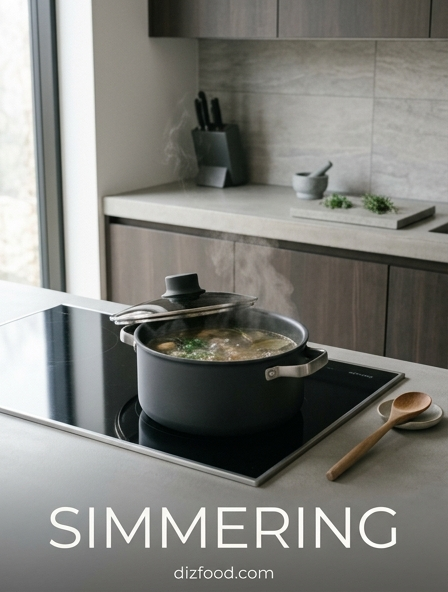
The distinction between simmering and boiling is a fundamental pillar of culinary science, primarily defined by the temperature and the resulting kinetic energy within the liquid. A simmer typically occurs between 185°F and 205°F, whereas boiling happens at 212°F at sea level. At a simmer, small bubbles rise gently from the bottom of the pot, occasionally breaking the surface without causing significant turbulence. In contrast, a full boil involves violent agitation that can damage delicate ingredients and emulsify fats and impurities back into a stock, leading to cloudiness.
| Process | Temperature Range | Visual Characteristics |
|---|---|---|
| Poaching | 160°F - 180°F | No bubbles, shimmering surface |
| Simmering | 185°F - 205°F | Small, infrequent bubbles |
| Boiling | 212°F | Vigorous, rapid bubble activity |
Understanding these thermal thresholds allows a chef to control the rate of evaporation and the physical impact on food. Maintaining a steady simmer ensures that the structural integrity of vegetables and proteins remains intact while providing enough heat to facilitate chemical transformations.
Breaking Down Tough Collagen
Simmering is the essential technique for transforming tough, inexpensive cuts of meat into tender delicacies. These cuts are often high in collagen, a structural protein that forms tough connective tissues. While heat eventually denatures all proteins, collagen requires a specific environment to convert into gelatin. This process is time-dependent and temperature-sensitive; if the heat is too high, the muscle fibers will contract and squeeze out moisture before the collagen has a chance to melt, resulting in dry, rubbery meat.
- Beef Chuck or Shank
- Pork Shoulder (Boston Butt)
- Lamb Necks or Shanks
- Oxtail and Short Ribs
By maintaining a low, consistent simmer, the collagen slowly unwinds and dissolves into gelatin. This transformation not only softens the meat but also adds a luxurious, silky mouthfeel to the surrounding liquid. The gelatin acts as a natural thickener, giving stews and braises a rich body that cannot be replicated by artificial starches. This slow breakdown is what defines classic slow-cooked comfort foods.
Texture and Tenderness Secrets
The secret to achieving the perfect texture in simmered dishes lies in the delicate balance of moisture retention and fiber relaxation. When meat is subjected to the high heat of a rolling boil, the protein filaments tighten aggressively, pushing out the internal juices. Because simmering uses a more moderate temperature, the fibers relax more gradually. This allows the cooking liquid to infiltrate the interstitial spaces between the muscle fibers, effectively seasoning the meat from the inside out while it cooks.
Vegetables also benefit from this gentle approach. Starchy vegetables like potatoes or carrots can become mushy on the outside while remaining hard in the center if boiled too rapidly. Simmering ensures even heat distribution, allowing the pectin in cell walls to soften uniformly. This results in a "fork-tender" consistency where the vegetable holds its shape but yields easily to pressure. Managing the lid of the pot is also crucial; a cracked lid can help regulate the temperature, preventing it from creeping up toward a boil and ensuring the texture remains refined and consistent throughout the cooking duration.
Maximizing Aromatic Infusion
Aromatic infusion is the process of extracting volatile oils and flavor compounds from herbs, spices, and mirepoix into a liquid medium. High heat can be destructive to these delicate compounds, often causing bright, herbal notes to turn bitter or evaporate entirely. Simmering provides a stable environment where the heat is high enough to break down the cellular walls of aromatics but low enough to preserve their nuanced profiles. This is particularly important for ingredients like bay leaves, thyme, and peppercorns.
- Bouquet Garni: A bundle of herbs that releases flavors slowly over several hours.
- Mirepoix: The foundation of onions, carrots, and celery that sweetens the base.
- Whole Spices: Toasting then simmering cinnamon or cloves for deep, woody notes.
As the liquid simmers, the movement of the water helps distribute these aromatics throughout the pot. Because the surface is not violently breaking, fewer of the aromatic steam molecules escape the pot, keeping the flavors concentrated within the sauce or stock. This results in a dish that smells as complex as it tastes.
Slow Extraction of Flavor
The art of making a world-class stock or broth relies almost entirely on the slow extraction of flavor through simmering. Whether using roasted bones, shells, or vegetable scraps, the goal is to draw out minerals, proteins, and glutamates. A rapid boil would create a cloudy, greasy liquid as the fats are emulsified. Simmering, however, allows the fats to rise to the top in large droplets, where they can be easily skimmed away, leaving a clear and pure essence of the ingredients.
- Start with cold water to allow proteins to dissolve slowly.
- Bring to a near-boil, then immediately drop to a simmer.
- Skim the foam (impurities) that rises during the first thirty minutes.
- Maintain the temperature for 4 to 12 hours depending on the bone type.
This prolonged exposure to gentle heat facilitates osmosis, where the flavored solutes move from the dense ingredients into the water. The result is a deep, savory profile characterized by umami. The patience required for this extraction is rewarded with a base liquid that possesses incredible clarity and a concentrated, unadulterated taste profile.
Reducing for Concentrated Depth
Reduction is a technique where simmering is used to evaporate water from a liquid, thereby concentrating its flavors and increasing its viscosity. As the volume of the liquid decreases, the sugars, acids, and proteins become more prominent. This is the foundation of creating classic French sauces like demi-glace or red wine reductions. While boiling would achieve volume reduction faster, it runs the risk of scorching the sugars at the edges of the pan and creating a "cooked" or burnt flavor profile.
A steady simmer allows for a controlled reduction, giving the chef time to monitor the evolving taste. As the water leaves the pan, the remaining liquid becomes thicker and more syrupy. This happens because the natural pectins and gelatins become more densely packed. A properly reduced sauce should coat the back of a spoon-a state known as nappe. This concentration of depth transforms a thin, watery broth into a powerful glaze that can carry the entire flavor of a dish, providing a punch of intensity that matches the heartiness of the main components.
Gentle Heat Protein Softening
Delicate proteins, such as fish, seafood, and eggs, are highly susceptible to overcooking. When these items are simmered, the goal is to reach the point of coagulation without over-tightening the protein matrix. For example, when poaching a salmon fillet in a simmering court bouillon, the gentle heat ensures the exterior does not become dry and chalky before the center is cooked through. This method preserves the natural fats and moisture within the protein, leading to a buttery and soft texture.
| Protein Type | Simmering Advantage |
|---|---|
| White Fish | Prevents flaking apart prematurely |
| Poultry Breast | Maintains juiciness and avoids stringiness |
| Eggs | Keeps whites tender and yolks creamy |
The lack of aggressive bubbles prevents the protein from being physically battered, which is essential for maintaining the visual appeal of the ingredient. By using a gentle simmer, the chef ensures that the protein remains succulent and structurally sound, providing a refined eating experience that highlights the quality of the raw product.
Achieving Melt in Mouth Results
The "melt-in-the-mouth" sensation is the holy grail of braising and stewing, achieved through the synchronization of fat rendering and tissue softening. During a long simmer, intramuscular fat (marbling) slowly liquefies. Rather than leaking out into the pot, much of this fat stays trapped within the softened gelatinous structure of the meat. This creates a self-basting effect that lubricates the meat fibers, making them slide apart with almost no resistance from the teeth.
- Low heat prevents the muscle fibers from "seizing."
- Liquid levels should partially cover the meat to maintain humidity.
- Time allows for the internal temperature to equalize perfectly.
This process cannot be rushed with higher heat. If the temperature exceeds the simmering range, the fat will render too quickly and the protein will dry out, resulting in a greasy but tough dish. Success is found in the "low and slow" philosophy, where the persistence of gentle heat eventually overcomes the toughest textures, turning them into something that feels rich, moist, and luxuriously tender upon the first bite.
The Role of Liquid Movement
While a simmer may look relatively still compared to a boil, there is a significant amount of internal liquid movement occurring through convection. As the liquid at the bottom of the pot heats up, it becomes less dense and rises, while the cooler liquid at the top sinks. This creates a gentle, circular current. This movement is vital for even cooking, as it ensures that the temperature remains consistent throughout the vessel without the need for constant stirring, which could break up delicate ingredients.
This subtle agitation also plays a role in clarifying the liquid. In a quiet simmer, the movement is slow enough that fine particles can coagulate and rise to the surface as scum or sink to the bottom as sediment. In a boil, these particles are whipped into the liquid, creating a permanent haze. The controlled movement of a simmer acts as a natural filtering system, allowing the chef to produce a clean, professional-grade sauce or soup. Furthermore, this movement ensures that salt and other seasonings are distributed evenly, preventing "hot spots" of flavor or salinity within the pot.
Building Complex Flavor Profiles
Complex flavor profiles are built through layers, and simmering is the stage where these layers meld into a cohesive whole. In the early stages of a simmer, individual ingredients-like the sharpness of onion or the acidity of wine-are distinct. As the simmer progresses, a series of chemical reactions, including the Maillard reaction (if ingredients were seared first) and the degradation of sugars, begin to bridge these flavors. The acidity softens, the sweetness deepens, and the savory notes broaden.
- Searing the base to develop browned, caramelized notes.
- Deglazing to incorporate flavorful fond into the liquid.
- Simmering to marry the primary ingredients with aromatics.
- Finishing with fresh herbs or acids to brighten the long-cooked base.
This marriage of flavors requires time for the molecules to interact and form new, more complex compounds. A dish that has simmered for two hours will always have more "roundness" than one cooked for twenty minutes at a higher heat. This depth of flavor is what distinguishes an amateur soup from a professional consommé or a home-cooked chili from a competition-winning recipe.

Comments