
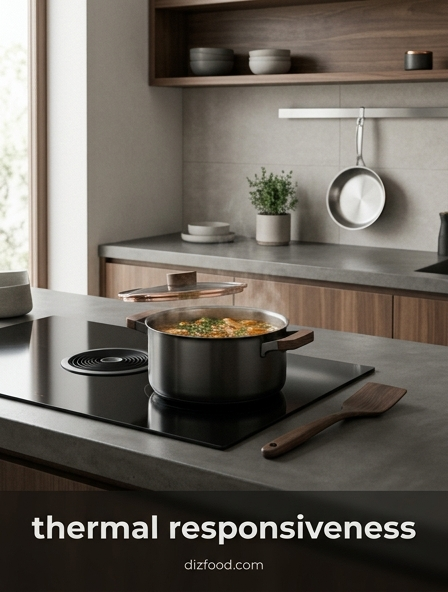
The Science of Thermal Conductivity
Thermal conductivity is a fundamental physical property that dictates how quickly heat energy moves through a solid material. In the culinary world, this process occurs at the atomic level, where kinetic energy is transferred via molecular collisions and the movement of free electrons. Metals like copper and aluminum possess high thermal conductivity due to their dense, organized atomic structures, allowing energy to propagate rapidly from the heat source to the food. Conversely, materials like stainless steel or ceramic have lower conductivity, acting as thermal resistors that slow the migration of heat.
Understanding the "k-value" of kitchen materials is essential for predicting how a vessel will behave on a range. A high k-value ensures that the temperature of the cookware equilibrates almost instantly with the burner's output. This microscopic dance of energy determines whether a pan will have localized hot spots or a perfectly even temperature across its entire surface. When a chef selects a tool based on conductivity, they are essentially choosing the speed at which they can manipulate the internal energy of their ingredients.
Optimal Cookware for Precision Boiling
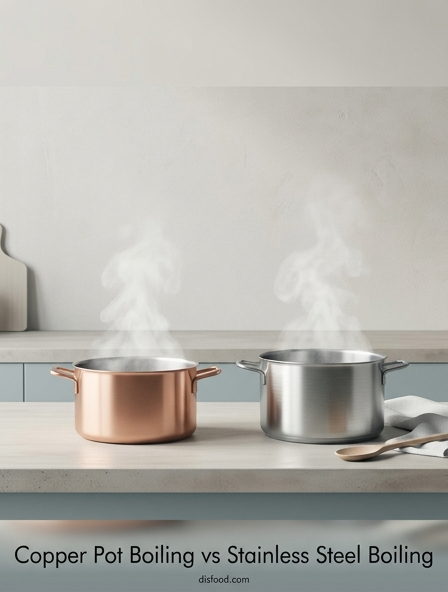
To achieve a precise boil, the interplay between the heat source and the vessel's base must be seamless. The ideal cookware for this task features a high-conductivity core encapsulated by a durable, non-reactive exterior. This "cladding" technique leverages the rapid energy transfer of internal layers while maintaining the structural integrity of the outer shell. Copper-core pots are often considered the gold standard for precision because they allow for granular control over the boiling point, responding to the slightest adjustment of the flame or induction setting.
| Material | Conductivity (W/m·K) | Responsiveness |
|---|---|---|
| Copper | 390-401 | Ultra-High |
| Aluminum | 205-237 | High |
| Cast Iron | 50-80 | Low |
| Stainless Steel | 14-16 | Very Low |
By selecting materials with high thermal responsiveness, users can prevent overshooting target temperatures. This is particularly vital when working with delicate liquids or hydrocolloids that may break if the boiling intensity is not strictly regulated.
Understanding Heat Transfer Dynamics
Heat transfer in the kitchen involves three distinct mechanisms: conduction, convection, and radiation. Conduction occurs where the vessel contacts the burner, moving energy into the pot's base. Once the liquid inside begins to warm, convection takes over. As the lower layers of liquid heat up, they become less dense and rise, while cooler, denser liquid sinks to take its place. This creates a continuous circulation loop that ensures the entire volume of liquid reaches the boiling point simultaneously.
- Conduction: Direct molecular contact between the stove and the pan.
- Convection: Fluid movement driven by density gradients in the liquid.
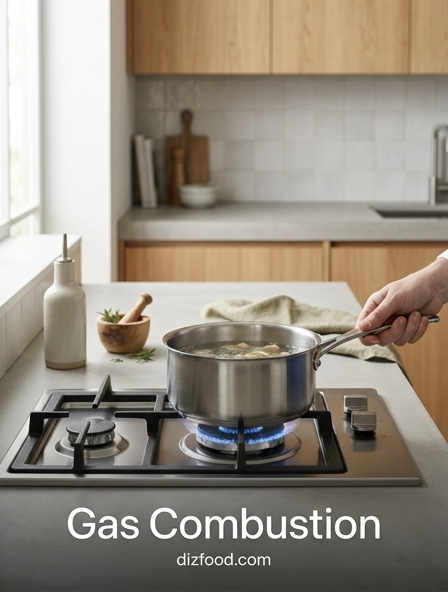
- Radiation: Infrared energy emitted from glowing coils or gas flames.
Mastering these dynamics allows for more efficient energy use. For instance, covering a pot minimizes heat loss via evaporation and radiation, forcing the energy to remain within the convection cycle. This increases the internal pressure and thermal density, significantly reducing the time required to reach a vigorous boil. Understanding these invisible forces transforms cooking from a trial-and-error process into a predictable thermodynamic exercise.
Rapid Response Temperature Control
Thermal responsiveness, or "reactivity," refers to how quickly a piece of cookware changes temperature in response to a change in the heat source. In high-stakes cooking, such as sugar work or sauce reduction, a lag of even thirty seconds can result in scorched proteins or crystallized syrups. Thin-walled copper or aluminum pans offer the fastest response times because they have less "thermal mass" to heat or cool. When the gas is turned down, the temperature drop in these materials is nearly instantaneous.
In contrast, heavy materials like cast iron or thick ceramic possess high thermal inertia. While they are excellent for maintaining a steady simmer once a temperature is reached, they are poorly suited for tasks requiring rapid fluctuations. A responsive kitchen setup allows the cook to "steer" the temperature with precision. This agility is the hallmark of professional-grade equipment, where the ability to halt a boil immediately upon reaching a specific threshold prevents the degradation of volatile flavor compounds and ensures the desired texture of the final product.
Impact of Material on Boiling Speed
The time it takes to bring a liquid to a boil is a direct function of the material's specific heat capacity and its thermal conductivity. Specific heat capacity measures how much energy a substance must absorb before its temperature rises by one degree. Materials with low specific heat, such as copper, require less energy to "charge up" than materials with high specific heat, like water itself. When a low-capacity material also possesses high conductivity, the result is an exceptionally fast boil.
- Energy is applied to the base of the vessel.
- The material absorbs energy based on its specific heat capacity.
- Conduction moves energy through the thickness of the base.
- Surface-to-liquid transfer initiates convection currents.
If the cookware material is a poor conductor, such as glass or stainless steel, the energy "piles up" at the contact point, wasting heat and potentially damaging the vessel through thermal shock. Using high-speed materials ensures that the maximum percentage of the burner's output is converted into liquid temperature gain, optimizing both kitchen efficiency and fuel consumption during the preparation of stocks, pastas, or blanched vegetables.
Mastering Heat Flux for Perfection
Heat flux is the rate of heat energy transfer through a given surface area. In a culinary context, managing heat flux is the difference between a gentle simmer and a violent, destructive boil. High flux is useful for rapidly heating large volumes of water, but it must be moderated when precision is required. If the flux is too high for the material's conductivity, the energy cannot spread outward fast enough, leading to localized "hot spots" where liquid may scorch or erupt into bubbles prematurely.
To master heat flux, one must match the burner size to the pan diameter perfectly. Using a small pan on a large high-output burner wastes energy and creates a ring of intense heat around the edges, while a large pan on a small burner results in a cold periphery. Achieving a uniform flux across the entire bottom surface ensures that steam bubbles form evenly across the base, rather than in concentrated bursts. This uniformity is essential for delicate tasks like poaching eggs or tempering chocolate, where thermal spikes can instantly ruin the consistency of the dish.
Precision Tools for Liquid Management
Modern kitchen technology has introduced tools that take the guesswork out of thermal responsiveness. Induction cooktops, for example, use electromagnetic fields to heat the vessel directly, bypassing the slow transfer from a glass surface or gas flame. This allows for unparalleled precision in boiling. Coupled with digital probe thermometers and PID (Proportional-Integral-Derivative) controllers, chefs can maintain a liquid at a specific temperature with an accuracy of within 0.1 degrees.
- Induction Hobs: Instantaneous energy transfer to ferromagnetic cookware.
- Digital Thermocouples: High-speed temperature sensing for real-time feedback.
- Immersion Circulators: Maintaining perfect thermal stability through constant agitation.
These tools are designed to mitigate the inherent lag found in traditional cooking methods. By utilizing sensors that provide immediate feedback, a cook can compensate for the thermal inertia of the cookware. This level of liquid management is crucial for molecular gastronomy and precision brewing, where the extraction of specific chemical compounds is dependent on maintaining a narrow and consistent thermal window throughout the boiling process.
Dynamic Cooling and Thermal Stability
While much focus is placed on heating, the ability of a material to cool down-dynamic cooling-is equally important for thermal stability. Once a boil is achieved, maintaining it without overshooting requires a balance between heat input and environmental loss. Highly responsive materials lose heat quickly when removed from the source, which is a safety mechanism for preventing over-cooking. Conversely, vessels with high thermal stability stay hot longer, which is ideal for table service but difficult for fine temperature adjustments.
The "steady state" of a boiling liquid occurs when the energy input exactly equals the energy lost to evaporation and radiation. Achieving this state requires a vessel that does not store excessive latent heat. If a pot has too much thermal mass, it will continue to boil the liquid for several minutes even after the heat is turned off, which can lead to over-reduction of sauces. Understanding the cooling curve of your cookware allows for better timing and prevents the unintended continuation of the cooking process after the desired outcome has been reached.
Surface Area and Boiling Efficiency
The geometry of a cooking vessel significantly impacts its thermal efficiency. A pot with a wide base increases the surface area in contact with the heat source, allowing for a higher total heat flux and faster boiling. However, a wide surface area at the top of the liquid also increases the rate of evaporation. This creates a dual-effect: while the liquid reaches boiling temperature faster due to the large base, it also loses volume more rapidly through the surface.
| Vessel Shape | Heating Surface | Evaporation Rate | Best Use |
|---|---|---|---|
| Tall Stockpot | Small | Low | Slow Simmering |
| Wide Saucier | Large | High | Rapid Reductions |
| Standard Saucepan | Medium | Medium | General Boiling |
For efficient boiling where water retention is desired, a vessel with a high height-to-width ratio is preferred. This minimizes the liquid's surface exposure to the air, reducing evaporative cooling and keeping the thermal energy trapped within the fluid. For reductions and thickenings, the inverse is true; maximizing surface area allows the steam to escape freely, concentrating the flavors as the temperature remains constant at the boiling point.
Achieving Consistent Thermal Uniformity
Thermal uniformity refers to the absence of temperature gradients across the cooking surface. In inferior cookware, the center of the pan might be significantly hotter than the edges, leading to uneven boiling and inconsistent results. Achieving uniformity requires the use of thick-gauge, high-conductivity materials or multi-ply construction where an aluminum or copper core extends from the base all the way up the sides of the pot. This ensures that heat is not just coming from the bottom, but is enveloping the liquid from all sides.
Consistent uniformity prevents the "scorched ring" effect often seen in thin-bottomed pots. It also ensures that when ingredients are added to boiling water, the temperature recovery is even across the entire volume. This is particularly important in commercial settings where large batches of food are processed. By eliminating cold spots, the chef ensures that every portion of the food undergoes the same thermal treatment, resulting in a professional standard of consistency that is repeatable across different burners and kitchen environments.


Comments