
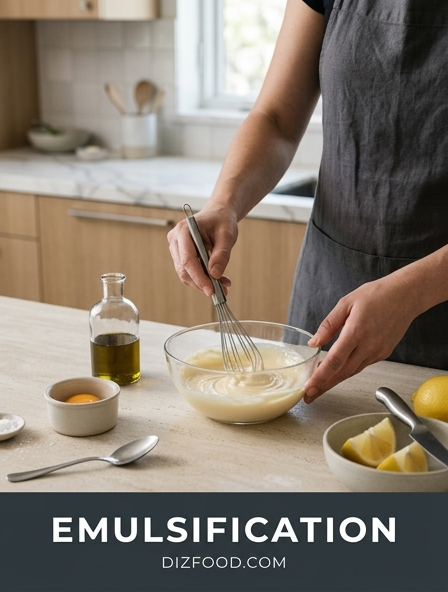
The Science of Fat and Water
At the molecular level, fat and water are natural adversaries. Water molecules are polar, meaning they carry a slight electrical charge that causes them to cling to one another. Fat molecules, conversely, are non-polar and hydrophobic, actively repelling water. In a culinary context, creating a successful emulsion requires overcoming this chemical standoff. When you attempt to mix oil and vinegar or butter and pasta water, the substances remain separated unless physical or chemical intervention occurs. This is where the science of emulsification transforms two disparate liquids into a unified, creamy sauce.
The process involves dispersing one liquid into the other in the form of microscopic droplets. To keep these droplets from immediately recombining-a process known as coalescence-the chef must introduce kinetic energy and often a stabilizing agent. The stability of the resulting mixture depends on the size of the fat globules; the smaller the droplets, the more stable the emulsion. Understanding this fundamental tension allows cooks to manipulate ingredients to achieve textures that are neither greasy nor watery, but perfectly homogenized.
- Discontinuous Phase: The liquid being broken into droplets (usually fat).
- Continuous Phase: The liquid surrounding the droplets (usually water-based).
- Interfacial Tension: The force that keeps the two liquids from mixing.
Starch Power in Pasta Water
Often referred to by chefs as "liquid gold," starchy pasta water is the secret engine behind professional-grade sauces. As pasta cooks, it releases amylose and amylopectin into the boiling water. These starch molecules act as a physical barrier and a thickening agent, which is essential for creating a stable bridge between the fats in your sauce and the water-based components. Unlike plain tap water, starchy water increases the viscosity of the liquid phase, making it harder for fat droplets to migrate and merge back together.
When you add a splash of this cloudy water to a pan of sautéed aromatics and fat, the starch granules surround the fat particles. This creates a protective coating that prevents the fat from separating, resulting in a sauce that clings to the noodles rather than pooling at the bottom of the bowl. The concentration of starch matters significantly; for the best results, use less water when boiling pasta to ensure the resulting liquid is highly saturated with starch. This simple byproduct turns a thin, oily mess into a cohesive, velvety coating that defines high-quality Italian cookery.
Achieving the Perfect Glossy Finish
A truly successful emulsion is recognizable by its distinct visual characteristics, specifically its sheen and opacity. When fat is broken down into sufficiently small droplets, light reflects off the surface of the liquid differently, creating a brilliant, glossy finish. This luster is a hallmark of sauces like hollandaise, beurre blanc, or a well-executed pan sauce. If a sauce appears dull or matte, it often indicates that the fat has not been properly integrated or that the ratio of fat to water is insufficient.
The glossiness is also a sign of structural integrity. A shiny sauce suggests that the fat particles are evenly distributed and suspended within the liquid matrix. To achieve this, the final addition of fat-usually cold butter-should be done off the direct heat to prevent the milk solids from separating too quickly. The following table highlights the visual cues of various emulsion states:
| Sauce State | Visual Appearance | Tactile Quality |
|---|---|---|
| Perfect Emulsion | High Gloss / Opaque | Velvety and Smooth |
| Weak Emulsion | Slightly Translucent | Thin and Runny |
| Broken Sauce | Greasy / Matte | Grainy or Oily |
The Role of Constant Agitation
Mechanical force is the primary catalyst for emulsification in the kitchen. Without agitation, the interfacial tension between fat and water remains too high for them to bond. Whether using a whisk, a blender, or the vigorous tossing of a sauté pan, the goal is to apply shear force. This force physically tears the fat into tiny globules, increasing the surface area and allowing the continuous phase to surround each particle. The more vigorous the agitation, the finer the droplets and the more stable the final sauce will be.
In pasta preparation, this agitation is often achieved through the "mantecatura" process, where the pan is shaken rapidly while the pasta is stirred. This movement, combined with the heat, encourages the starch and fats to marry. In a blender, the high-speed blades provide even more intense shear, which is why vinaigrettes made in a machine are significantly creamier and more shelf-stable than those shaken in a jar. Constant motion is not just a suggestion; it is a physical requirement to prevent the natural tendency of fat to float to the top and coalesce.
Why Boiling Water Is Not Enough
A common misconception in the kitchen is that high heat alone will force fat and water to mix. In reality, excessive heat can be the enemy of a delicate emulsion. While boiling water provides some kinetic energy through turbulence, the high temperature can cause proteins to denature too quickly or cause the water to evaporate at a rate that leaves the fat unsupported. If the water evaporates too fast, the ratio of fat to liquid becomes skewed, leading the sauce to "break" or separate into a greasy mess.
Furthermore, boiling can be too violent for emulsions that rely on temperature-sensitive stabilizers like egg yolks or mustard. In sauces like hollandaise or mayonnaise, the heat must be carefully regulated to ensure the emulsifiers remain functional. Instead of a rolling boil, a gentle simmer or even residual heat is often preferred when finishing a sauce with butter. This controlled environment allows for a gradual integration of ingredients, ensuring that the moisture remains trapped between the fat molecules rather than escaping as steam, which would inevitably lead to a disintegrated texture.
Emulsifiers Beyond the Butter Pat
While butter and cream are the most common fats used for emulsification, several other ingredients contain natural chemical emulsifiers that can bridge the gap between oil and water. These ingredients contain molecules with a hydrophilic (water-loving) head and a hydrophobic (oil-loving) tail. These "surfactants" sit at the interface of the two liquids, holding them together like chemical glue. Identifying and using these ingredients can significantly improve the stability of your culinary creations.
Common kitchen emulsifiers include:
- Egg Yolks: Contain lecithin, a powerful stabilizer for mayonnaise and hollandaise.
- Mustard: The mucilage in mustard seeds helps stabilize vinaigrettes.
- Miso Paste: Fermented soybeans provide both flavor and emulsifying proteins.
- Honey: While less powerful, its viscosity helps slow down the separation of oils.
- Garlic: When crushed into a paste, it releases compounds that aid in emulsification, as seen in traditional aioli.
Incorporating these elements allows for more complex flavor profiles while ensuring the sauce remains homogenized throughout the meal.
Preventing Broken Sauce Disasters
A "broken" sauce occurs when the fat separates from the liquid, resulting in a curdled or oily appearance. This is usually caused by adding fat too quickly, overheating the mixture, or lack of sufficient agitation. Preventing this requires a disciplined approach to temperature and timing. When adding fat to a liquid base, it must be introduced gradually-literally drop by drop or in small cubes-to allow the existing liquid to "catch" and surround the fat particles before more are added.
If you notice the edges of your sauce becoming oily, it is a warning sign that the emulsion is failing. You can often save it by immediately removing it from the heat and adding a small amount of "bridge" liquid, such as a teaspoon of cold water or cream, while whisking vigorously. This restores the balance of the continuous phase. For dairy-based sauces, maintaining a temperature below 180°F (82°C) is critical, as higher temperatures can cause the proteins that help stabilize the fat to tighten and squeeze the fat out, leading to an irreversible break.
Mantecatura Techniques for Home Cooks
Mantecatura is the Italian art of finishing pasta or risotto to achieve a creamy, emulsified consistency without necessarily adding excessive amounts of heavy cream. For home cooks, mastering this technique is the difference between a dry pasta dish and one that rivals a high-end trattoria. The process begins when the pasta is roughly 90% cooked. It is transferred to a sauté pan with the sauce and a generous splash of starchy pasta water. The heat is kept medium-high to encourage evaporation and concentration.
- The Addition: Add cold butter or high-quality olive oil to the pan.
- The Agitation: Use a vigorous "flip and stir" motion to incorporate air and move the fats through the starch-heavy liquid.
- The Observation: Watch for the liquid to transform from a thin broth into a thick, ivory-colored glaze that coats the back of a spoon.
- The Rest: Allow the dish to sit for thirty seconds off the heat before serving, which lets the emulsion set slightly.
This technique relies on the synergy of temperature, starch, and mechanical energy to create a luxurious mouthfeel naturally.
Texture Control and Mouthfeel
The primary reason chefs obsess over emulsification is the profound impact it has on mouthfeel. An emulsion changes the viscosity of a liquid, making it feel heavier and more substantial on the palate. This is because the suspended fat droplets increase the internal friction of the liquid, creating a "velvet" sensation. When a sauce is properly emulsified, it coats the tongue evenly, allowing flavors to linger longer. This prolonged contact enhances the perception of aromatics and spices that might otherwise be washed away quickly.
Texture control also involves managing the density of the emulsion. A tight emulsion, like a mayonnaise, is thick and holds its shape, while a loose emulsion, like a jus lié, flows easily but still possesses a rich body. The chef controls this by adjusting the ratio of fat to liquid. By manipulating these variables, you can create a sensory experience that ranges from light and refreshing to rich and indulgent. Ultimately, emulsification is the tool that transforms the "wetness" of a sauce into "richness," providing a satisfying weight that defines professional cooking.
Restaurant Secrets for Velvety Sauces
Professional kitchens use a few specific "cheats" and techniques to ensure their sauces are consistently velvety and never break during service. One of the most common secrets is the use of beurre monté. This involves whisking cold butter into a small amount of water to create a stable emulsion that can then be used to poach proteins or finish sauces without the fat ever separating. Because the butter is already "mounted" in water, it integrates into other liquids much more easily than plain butter would.
Another restaurant staple is the high-powered immersion blender. While whisking by hand is traditional, the sheer RPM of a commercial blender creates an emulsion so fine that it is nearly impossible to break. Some chefs also add a tiny pinch of xanthan gum-a powerful stabilizer-to their sauces. This prevents syneresis (the leaking of water) and keeps the sauce perfectly smooth even if it sits under a heat lamp. Finally, passing every sauce through a fine-mesh chinois ensures that any tiny clumps of un-emulsified fat or solids are removed, leaving behind only the most refined, silken texture possible.


Comments