
Understanding Collagen and Elastin
Connective tissue in culinary applications primarily consists of two proteins: collagen and elastin. Collagen is a robust, triple-helix protein that provides structural integrity to muscles, tendons, and ligaments. In the kitchen, it is the primary target for transformation, as it is naturally tough but can be converted into silky gelatin through proper cooking techniques. Unlike collagen, elastin-often referred to as "silver skin"-is a highly resilient, rubbery protein that does not break down when exposed to heat or moisture. It remains tough and chewy regardless of the cooking duration, making its mechanical removal essential during the butchery process.
- Collagen: Soluble in heat, turns into gelatin, found in high concentrations in hard-working muscles.
- Elastin: Heat-stable, remains yellow and elastic, requires physical trimming before cooking.
- Reticulin: A minor connective fiber similar to collagen but found in much smaller quantities.
The concentration of these tissues varies significantly depending on the age of the animal and the specific muscle's function. Younger animals typically possess more soluble collagen, while older animals develop more cross-links, requiring longer cooking times to achieve tenderness.
The Role of Heat Transfer
Effective cooking of connective tissue relies on the principles of heat transfer: conduction, convection, and radiation. In a kitchen environment, the goal is to move thermal energy from the heat source into the center of the meat to initiate the breakdown of protein structures. Because connective tissue is often found in large, dense cuts, the rate of heat transfer must be carefully managed. If the exterior reaches a high temperature too quickly, the muscle fibers will contract and expel moisture before the collagen in the interior has even begun to soften.
| Method | Primary Heat Source | Effect on Connective Tissue |
|---|---|---|
| Conduction | Direct contact (pan) | Rapid surface searing, minimal deep breakdown. |
| Convection | Fluid medium (braising) | Uniform heat distribution for collagen hydrolysis. |
| Radiation | Infrared/Microwave | Fast heating but often uneven for tough cuts. |
By utilizing liquid mediums in techniques like braising, convection ensures a consistent temperature that surrounds the meat, allowing for a steady energy transfer that targets the interstitial collagen without scorching the exterior surfaces.
Hydrolysis and Gelatin Formation
Hydrolysis is the fundamental chemical reaction that occurs when collagen is cooked in the presence of moisture. This process involves the thermal denaturation of the collagen's triple helix structure. As the meat is heated, the hydrogen bonds holding the protein chains together begin to weaken. Eventually, the helix unwinds and the individual protein strands disperse into the surrounding liquid. Once these strands are liberated and hydrated, they form gelatin, a substance that provides a rich, viscous mouthfeel and savory depth to sauces and stews.
This transformation is not instantaneous; it is a kinetic process that depends on both temperature and the availability of water. Without sufficient moisture, collagen will simply dehydrate and become brittle rather than turning into gelatin. This is why dry-heat methods like grilling are unsuitable for cuts with high connective tissue content. The resulting gelatin acts as a natural lubricant between muscle fibers, compensating for the moisture lost by the muscle proteins during the cooking process and creating the sensation of "succulence" even in well-done meats.
Optimal Temperature for Softening
The breakdown of connective tissue is highly temperature-dependent, occurring within specific thermal windows. While muscle proteins begin to coagulate and release moisture at temperatures as low as 120°F (49°C), collagen requires higher energy levels to undergo hydrolysis. The process generally begins in earnest when the internal temperature reaches approximately 140°F (60°C), but it proceeds very slowly at this stage. To achieve efficient softening within a reasonable timeframe, the temperature must be maintained in a higher range.
- 140°F - 150°F: Collagen begins to shrink and squeeze out juices from the muscle fibers.
- 160°F - 180°F: Rapid hydrolysis occurs; collagen significantly converts to gelatin.
- 200°F+: Connective tissue is completely dissolved, but muscle fibers may become overly dry if not basted.
Maintaining a steady internal temperature between 160°F and 180°F is considered the "sweet spot" for most tough cuts. This range is hot enough to ensure the collagen breaks down efficiently while remaining low enough to prevent the muscle fibers from becoming excessively graining or disintegrated. Precise temperature control is the hallmark of professional slow-cooking.
Benefits of Slow Boiling
Slow boiling, or more accurately simmering, is an essential technique for managing connective tissue. By keeping the cooking liquid just below the boiling point (around 180°F to 200°F), the chef ensures a constant but gentle supply of energy. This prevents the aggressive physical agitation associated with a rolling boil, which can mechanically tear apart the muscle fibers before the collagen has had time to fully dissolve into gelatin. The "low and slow" approach provides the necessary duration for chemical transformation without the destructive effects of high heat.
- Maintains a stable environment for collagen hydrolysis.
- Prevents the toughening of muscle proteins through excessive heat.
- Allows flavors from aromatics and liquids to penetrate the meat deeply.
- Ensures the resulting gelatin remains suspended in the sauce for better body.
A gentle simmer also facilitates the rendering of fat, which works in tandem with the melting collagen to provide a luxurious texture. If the heat is too high, the fat can emulsify or "break," leading to a greasy rather than a velvety sauce. Patience in this stage is the key to unlocking the flavor potential of tougher meat sections.
Breaking Down Tough Fibers
The perceived toughness of meat is a combination of the thickness of the muscle fibers and the density of the surrounding connective tissue "sheaths." In hard-working muscles, such as the shank or shoulder, these sheaths are thick and reinforced with numerous cross-links. Breaking them down requires a two-pronged attack: thermal and mechanical. While heat handles the chemical dissolution of collagen, mechanical methods like cubing, slicing against the grain, or pounding can physically disrupt the fiber alignment, making the meat easier to masticate.
When the collagen dissolves, it leaves behind the individual muscle fibers. If the cooking has been successful, these fibers should easily slide past one another because the "glue" holding them together has been removed. This is the definition of "fork-tender." However, even if the collagen is gone, the muscle fibers themselves can still feel dry if they have been overcooked. Therefore, the goal is to reach the point where the connective tissue is liquidated while the muscle fibers retain enough structural integrity to hold on to the newly formed gelatin and rendered fats.
Impact of pH and Acidity
The acidity of the cooking environment plays a significant role in the rate of collagen breakdown. Using acidic ingredients such as wine, vinegar, citrus, or tomatoes can accelerate the hydrolysis of collagen. Acids work by denaturing the protein strands, making them more susceptible to the effects of heat and water. This is why marinades often include an acidic component, although their penetration is limited to the surface of the meat. In a braise, the acidity of the liquid works throughout the entire cooking process to soften the connective tissues.
| Ingredient | Acid Type | Role in Tenderization |
|---|---|---|
| Red Wine | Tartaric Acid | Slowly softens fibers during long braises. |
| Vinegar | Acetic Acid | Rapidly denatures surface proteins; adds brightness. |
| Lemon Juice | Citric Acid | Best for short-term marinades on thinner cuts. |
However, balance is critical. If the environment becomes too acidic (pH below 5.0), the muscle proteins can become mushy or develop an unappealing mealy texture. The goal is to use enough acidity to assist the breakdown of collagen without compromising the structural integrity of the meat fibers themselves.
Importance of Cooking Time
Time is arguably the most critical variable when dealing with connective tissues. Unlike the coagulation of egg whites or the searing of a steak, which happen quickly, the conversion of collagen to gelatin is a time-dependent reaction. Even at the optimal temperature, the complex molecular structure of collagen requires hours to fully unwind. This is why a brisket or short rib cannot be "rushed" by simply turning up the heat. High heat will only tighten the muscle fibers into a dry, cord-like state while leaving the collagen intact and rubbery.
Extended cooking times allow for a gradual transition where the meat passes through various stages of toughness before reaching tenderness. Initially, the meat gets tougher as it loses water (the "stall" in barbecue), but eventually, the collagen breakdown overtakes the fiber contraction. This results in a net gain in tenderness. Achieving this equilibrium requires patience; the length of time needed is directly proportional to the amount and age of the connective tissue present in the specific cut of meat being prepared.
Selecting Cuts for Braising
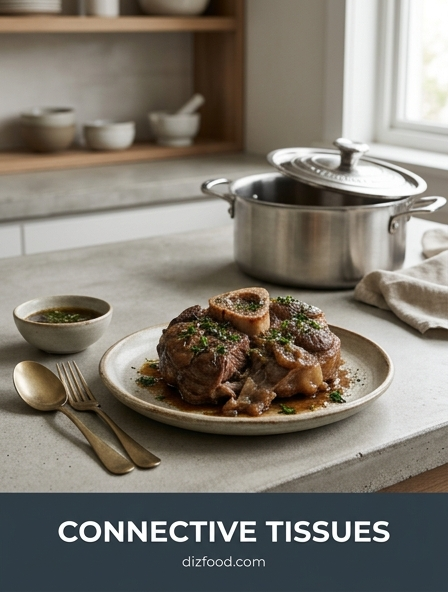
Successful kitchen outcomes depend on selecting the right cut for the intended cooking method. Cuts that are high in connective tissue are often the most flavorful because they come from muscles that have worked the hardest and have high concentrations of myoglobin and fat. These cuts are generally found in the extremities and moving parts of the animal. When braised, these "tough" cuts transform into the most succulent dishes, whereas lean cuts with little collagen, like tenderloin, would become dry and flavorless in a long-simmered environment.
- Beef: Chuck roast, short ribs, oxtail, and shank (osso buco).
- Pork: Shoulder (butt or picnic), hocks, and belly.
- Lamb: Shoulder and shanks.
When selecting these cuts, look for visible "marbling" and thick bands of white connective tissue. These are not defects; they are the fuel for gelatin production. The presence of a bone also aids in the process, as the marrow and bone collagen contribute additional body and minerals to the cooking liquid, enhancing the overall richness of the final dish.
Science of Moisture Retention
The relationship between connective tissue and moisture is paradoxical. As meat cooks, the muscle fibers shrink and squeeze out their internal water. In a lean cut, this results in a dry piece of meat. However, in cuts rich in collagen, the formation of gelatin creates a moisture-trapping matrix. Gelatin is a hydrocolloid, meaning it can hold many times its weight in water. As it dissolves into the cooking liquid and coats the muscle fibers, it mimics the sensation of juiciness, providing a moist "mouthfeel" even if the actual water content of the muscle is low.
Furthermore, well-dissolved gelatin increases the viscosity of the cooking juices, allowing them to cling to the meat rather than running off. This is why a rested braise often tastes better the next day; as the meat cools slightly, the gelatin begins to thicken and "set," pulling the flavorful cooking liquid back into the spaces between the muscle fibers. Understanding this science allows cooks to manipulate the texture of their dishes, ensuring that the final product is not just tender, but deeply hydrated and rich in flavor.


Comments