
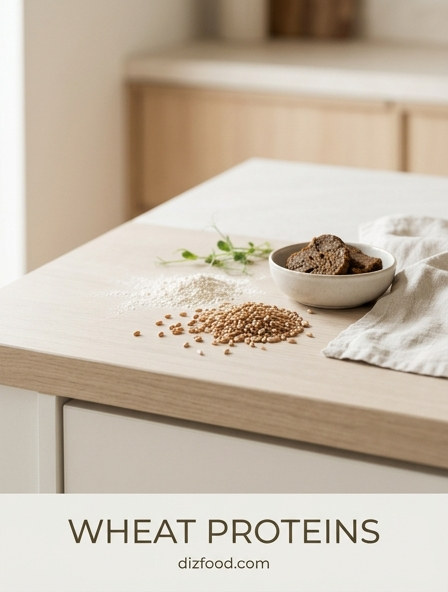
Molecular structure of wheat proteins
Wheat proteins are primarily categorized based on their solubility, a classification system known as the Osborne sequence. In the culinary context of the kitchen, the most significant are the storage proteins found within the starchy endosperm: gliadins and glutenins. These proteins are characterized by an unusually high concentration of prolamins and glutamines. Their molecular architecture is defined by complex folding patterns held together by hydrogen bonds and hydrophobic interactions.
The primary structure consists of long polypeptide chains. Gliadins are monomeric proteins with relatively low molecular weights, typically appearing in globular forms. In contrast, glutenins are multimeric aggregates that form massive macro-polymers through inter-chain disulfide linkages. This molecular arrangement is what allows wheat flour to transform into a cohesive dough when hydrated and mechanically agitated.
- Albumins: Water-soluble proteins, often enzymes.
- Globulins: Salt-soluble proteins involved in seed germination.
- Gliadins: Alcohol-soluble monomers responsible for extensibility.
- Glutenins: Acid-soluble polymers responsible for elasticity.
Glutenin and gliadin binding properties
The functionality of wheat-based foods relies heavily on the specific binding properties of glutenin and gliadin. When water is introduced to wheat flour, these proteins begin to hydrate, leading to the formation of a gluten complex. This process is not merely a mixing of ingredients but a chemical transformation where proteins align and bond. Gliadins act as a plasticizer, allowing the dough to flow and stretch without breaking. Glutenins provide the structural framework, acting like a molecular spring that resists deformation.
The interaction between these two proteins is facilitated by the formation of disulfide bridges. These are strong covalent bonds that link cysteine residues across different protein chains. The balance between these proteins determines the physical characteristics of the final product, from the chewiness of a sourdough bread to the delicate bite of fresh pasta.
| Protein Type | Mechanical Property | Molecular Interaction |
|---|---|---|
| Gliadin | Extensibility (Viscosity) | Intramolecular disulfide bonds |
| Glutenin | Elasticity (Strength) | Intermolecular disulfide bonds |
Protein denaturation during boiling
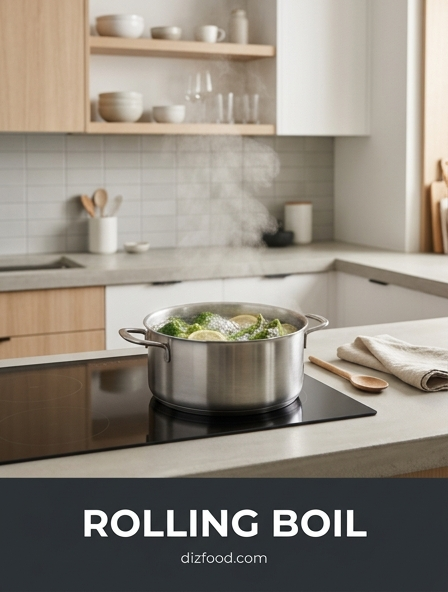
Boiling pasta is a controlled process of protein denaturation and starch gelatinization. As wheat-based products are submerged in boiling water, the increase in thermal energy disrupts the weak hydrogen bonds and van der Waals forces that maintain the proteins' tertiary and quaternary structures. This causes the protein chains to unfold, exposing hydrophobic regions that were previously tucked away in the center of the molecular fold.
Once unfolded, these proteins begin to bump into one another, leading to new cross-links. This secondary bonding creates a firm, cooked structure that encapsulates the starch granules. If the protein content is too low or the boiling time too long, the matrix weakens, leading to a mushy texture. Proper denaturation is essential for achieving the "al dente" state, where the protein network is firm enough to offer resistance to the tooth while remaining flexible.
- Hydration: Water penetrates the outer layers of the pasta.
- Thermal Agitation: Heat breaks internal molecular bonds.
- Unfolding: Polypeptide chains expand and lose their original shape.
- Coagulation: New bonds form a permanent, solid protein lattice.
The science of sauce adhesion
The ability of a sauce to cling to pasta is a direct result of the surface chemistry of the wheat protein matrix. During the cooking process, some proteins and starches leach out of the pasta, creating a microscopic, rugged landscape on the surface. This roughness is critical for sauce adhesion. A perfectly smooth surface would allow the sauce to slide off, whereas a textured surface provides "anchoring points" for the fats and liquids in the sauce to grip.
Wheat proteins, specifically the coagulated gluten on the surface, interact with the sauce through a combination of capillary action and chemical affinity. High-quality pasta extruded through bronze dies has a rougher protein surface than pasta made with Teflon dies. This increased surface area enhances the friction between the pasta and the sauce, ensuring that every bite carries a consistent amount of flavor and moisture.
- Surface Porosity: Small pits in the protein matrix trap sauce particles.
- Starch Film: A thin layer of amylose acts as a biological glue.
- Protein Roughness: Denatured gluten provides mechanical grip.
How heat activates protein networks
Heat is the primary catalyst for structural changes in wheat proteins. In the kitchen, applying heat to a dough or pasta triggers a transition from a plastic state to a solid state. This activation begins when temperatures reach approximately 60°C to 70°C. At this point, the kinetic energy is sufficient to overcome the stabilization energy of the protein's native state. This is known as the glass transition temperature, where the protein network becomes more mobile before eventually setting into a rigid form.
As the heat continues to rise, the sulfhydryl groups on the glutenin chains become highly reactive. They undergo thiol-disulfide exchange reactions, essentially "locking" the protein network into its final shape. This heat-activated network is what gives baked goods their height and pasta its structural integrity. Without this thermal activation, the wheat proteins would remain a viscous slurry rather than a structured food product.
- Thermal Expansion: Water vapor expands within the protein gaps.
- Thiol Activation: Heat increases the reactivity of sulfur atoms.
- Cross-linking: Permanent covalent bonds replace temporary interactions.
- Set Point: The protein matrix becomes a continuous, heat-stable solid.
Starch and protein interaction dynamics
Wheat products are essentially a composite material consisting of starch granules embedded within a protein matrix. The relationship between these two components is dynamic and changes significantly during cooking. As heat and water are applied, the starch granules undergo gelatinization, swelling and releasing amylose. Simultaneously, the gluten proteins undergo coagulation, forming a protective barrier that prevents the starch from leaching out entirely into the cooking water.
This interaction is a delicate balance. If the protein matrix is too weak, the starch granules burst and disperse, resulting in a sticky, gummy mess. If the protein matrix is too dense, it can prevent the starch from hydrating properly, leading to a hard or chalky center. The optimal texture is achieved when the protein network is strong enough to contain the swollen starch while still allowing for uniform heat distribution throughout the food.
| Component | Function in Matrix | Transformation |
|---|---|---|
| Gluten Protein | Structural Framework | Coagulation and Cross-linking |
| Starch Granule | Bulking Agent / Filler | Swelling and Gelatinization |
Achieving the perfect sauce viscosity
Viscosity is the measure of a fluid's resistance to flow, and in the kitchen, it is often managed through the manipulation of wheat proteins and starches. When making a roux-based sauce, the heat-treated wheat proteins provide a foundation, but it is the dispersed starch that primarily increases thickness. However, the proteins play a vital role in stabilizing the emulsion and providing a "silky" mouthfeel that starch alone cannot achieve.
A sauce with the correct viscosity should exhibit "nappe" consistency, meaning it coats the back of a spoon evenly. This is achieved by balancing the concentration of wheat-derived solids with the liquid base. The proteins act as surfactants, helping to keep fat droplets suspended in the watery medium. By carefully controlling the reduction of the sauce, you increase the density of the protein-starch complex, which leads to a more robust and clinging texture.
- Concentration: Reducing liquid increases the density of proteins.
- Temperature: Viscosity generally decreases as heat increases.
- Mechanical Shearing: Whisking breaks down protein clumps for a smoother flow.
Role of pasta water in emulsification
Pasta water is often referred to as "liquid gold" in professional kitchens because of its high concentration of leached starch and soluble wheat proteins. When pasta is boiled, a portion of its surface proteins and amylose dissolves into the water. This cloudy liquid serves as a powerful emulsifying agent when added to a fat-based sauce, such as butter, oil, or cheese-based emulsions. The proteins act as a bridge between the polar water molecules and non-polar fat molecules.
The inclusion of pasta water facilitates the creation of a stable, creamy sauce without the need for heavy cream. The soluble proteins lower the interfacial tension between the oil and water phases, allowing them to mix into a homogenous fluid. Furthermore, the starches provide a thickening effect that helps the sauce bind to the pasta's surface, creating a cohesive dish rather than a puddle of oil at the bottom of the plate.
- Introduction: Add a ladle of starchy water to the sauce pan.
- Agitation: Stir vigorously to distribute protein and starch.
- Emulsion: Fats break into tiny droplets suspended by the proteins.
- Reduction: Simmer until the desired thickness is reached.
Building a stable protein matrix
Creating a stable protein matrix is the fundamental goal of dough preparation and pasta making. This process begins with hydration, where water molecules work their way between the protein chains, followed by mechanical work. Kneading provides the energy necessary to align the disorganized proteins into a structured, three-dimensional lattice. During this phase, the glutenin polymers extend and hook onto one another, creating a web that can trap gases and withstand the stresses of cooking.
The stability of this matrix is influenced by several factors, including the protein content of the flour and the presence of salt. Salt ions interact with the charged amino acids on the protein chains, reducing repulsive forces and allowing the proteins to pack more tightly together. A stable matrix ensures that the food retains its shape, provides a satisfying chew, and manages the release of starch during the final preparation steps.
- Hydration Time: Allows for uniform water distribution.
- Mechanical Energy: Aligns protein fibers through shearing.
- Ionic Strength: Salt helps tighten the gluten network.
Surface tension and sauce coating
Surface tension determines how a liquid interacts with a solid surface. In the kitchen, the goal is often to lower the surface tension of a sauce so that it "wets" the pasta effectively. The proteins leached from wheat during cooking act as natural surfactants. These proteins have both hydrophilic (water-loving) and hydrophobic (water-fearing) regions. By positioning themselves at the interface of the sauce and the pasta, they allow the liquid to spread out and cover the surface rather than beading up.
This coating phenomenon is also affected by the temperature of the protein matrix. A warm pasta surface has lower surface energy, making it easier for the sauce to adhere. When the sauce successfully coats the pasta, it forms a thin film that is held in place by intermolecular forces. This ensures that the flavor profile is distributed across the entire surface area of the wheat-based product, providing a superior sensory experience.
| Factor | Effect on Coating | Kitchen Application |
|---|---|---|
| Surfactants | Lowers surface tension | Using pasta water in the sauce |
| Temperature | Increases wettability | Tossing pasta in sauce while hot |
| Viscosity | Resists runoff | Reducing sauce to nappe stage |



Comments