
Finding the perfect balance between raw pulverizing power and kitchen tranquility is the ultimate goal for any home chef or smoothie enthusiast. While standard high-speed blenders are famous for their performance, they often produce ear-splitting noise levels exceeding 90 decibels, making morning meal prep a disruptive experience. In contrast, "silent" blenders utilize advanced acoustic engineering, including thick sound enclosures and vibration-dampening motor mounts, to significantly muffle the roar without sacrificing torque. Selecting the right model requires weighing the necessity of peak motor wattage against the desire for a peaceful environment, ensuring you achieve professional-grade textures-from silky nut butters to crushed ice-without the acoustic tax.
| Feature | Standard Blenders | Silent / Quiet Blenders |
|---|---|---|
| Noise Level | 88 - 95+ dB (Lawnmower equivalent) | 60 - 75 dB (Normal conversation) |
| Sound Insulation | Minimal; open motor housing | Integrated sound shields & gaskets |
| Motor Cooling | High-airflow (adds to noise) | Complex air-channeling or low-RPM torque |
| Physical Size | Compact to Average | Bulkier due to outer sound enclosure |
| Best For | Quick tasks; budget-conscious users | Early risers; open-plan living; cafes |
| Price Range | $50 - $300 | $250 - $700+ |
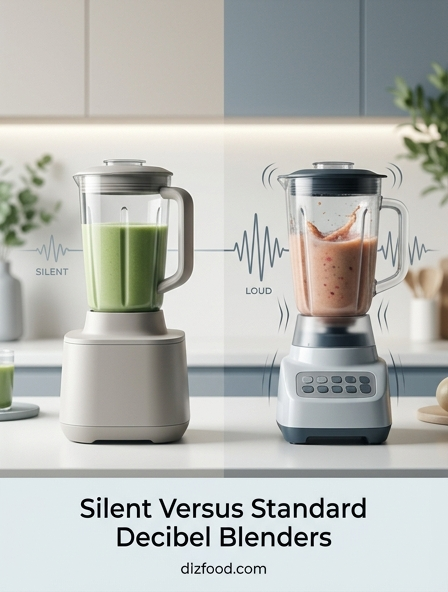
Decibel Differences Between Silent and Standard Blenders
The acoustic output of a kitchen blender is measured on a logarithmic decibel (dB) scale, meaning a small numerical increase represents a significant jump in perceived volume and sound pressure. Standard high-performance blenders typically operate between 88 and 95 decibels. At these levels, the noise is comparable to a motorcycle engine or a lawnmower, often requiring users to raise their voices or even wear hearing protection during prolonged use. This intensity is primarily generated by the high-velocity friction of the blades and the unshielded mechanical vibrations of the motor housing.
In contrast, silent or noise-reduced blenders are engineered to operate within the 60 to 72 decibel range. This reduction brings the sound profile down to the level of a normal conversation or background office noise. Achieving this 20-decibel drop is a significant engineering feat, as it represents a nearly 75% reduction in perceived loudness. The following table illustrates common decibel benchmarks found in modern kitchen environments:
| Blender Type | Average Decibel Range | Comparative Sound |
|---|---|---|
| Standard Personal Blender | 80 - 85 dB | Garbage Disposal |
| Professional High-Speed Blender | 90 - 98 dB | Hand Drill / Chainsaw |
| Silent Commercial Blender | 64 - 70 dB | Normal Conversation |
| Ultra-Quiet Home Model | 60 - 65 dB | Background Music |
Engineering Quiet Power in High Performance Blenders
Creating a blender that maintains professional-grade torque while minimizing noise requires a multifaceted approach to mechanical engineering. Manufacturers of quiet blenders focus on three primary areas: vibration isolation, airflow management, and motor stabilization. Rather than simply slowing down the motor, which would compromise the texture of the blend, engineers use rubberized motor mounts that float within the chassis. these mounts absorb the kinetic energy that would otherwise resonate through the blender base and the countertop, turning the entire surface into a sounding board.
The internal geometry of the blender base is also redesigned to break up sound waves. Instead of flat surfaces that reflect noise, quiet models utilize baffled chambers and non-linear paths for internal components. The blades themselves are often precision-balanced to minimize "blade slap," a phenomenon where the leading edge of the blade creates a mini-sonic boom as it cuts through dense frozen ingredients. By optimizing the pitch and weight of the assembly, the frequency of the sound is shifted from a high-pitched whine to a lower, less intrusive hum.
- Vibration dampening gaskets at the jar-to-base interface.
- Specially tuned cooling fans that move air without creating wind turbulence noise.
- Heavy-duty zinc or die-cast aluminum housings to provide mass-based sound deadening.
- Brushless DC motors which eliminate the high-frequency electrical "scream" of traditional carbon brushes.
The Evolution of Sound Enclosure Technology
The most visible distinction between a standard and a silent blender is the sound enclosure, often referred to as a "hush shield." This technology originated in commercial juice bars and smoothie shops where the constant roar of multiple blenders hindered customer interaction and staff productivity. Early enclosures were bulky, retrofitted acrylic boxes that were difficult to clean and required significant counter space. However, modern evolution has integrated these shields into the sleek design of premium home appliances, utilizing advanced polymers that offer clarity and durability without the weight of glass.
Modern enclosures utilize magnetic seals and double-walled construction to trap sound waves before they escape the immediate vicinity of the blending jar. The "air gap" between two layers of plastic acts as an insulator, similar to how double-paned windows insulate a home from street noise. Furthermore, the hinge mechanisms have evolved to be smoother and more robust, allowing for one-handed operation. Some high-end models now feature sensors that prevent the motor from engaging unless the shield is fully seated, ensuring that the noise-reduction benefits are maximized during every cycle. This integration represents a shift from after-market utility to a core design philosophy in luxury kitchenware.
Comparing Motor Insulation and Cooling Systems
The primary challenge in silencing a blender is heat management. Standard blenders rely on open-air vents and high-RPM fans to cool the motor, which allows sound to escape freely from the base. Silent blenders, however, must insulate the motor to dampen noise, which naturally traps heat. To solve this, engineers develop sophisticated "maze" cooling systems. These systems force air through a series of lined baffles that allow heat to escape while the sound waves are absorbed by the internal padding. This requires more powerful, yet quieter, fans to maintain the same thermal regulation found in open-frame models.
Motor insulation typically involves the use of high-density acoustic foam or specialized silicone wraps. These materials must be heat-resistant and durable enough to withstand the rapid temperature fluctuations of a kitchen environment. While a standard blender might have a simple plastic shell around the motor, a silent model utilizes a layered approach:
- An inner layer of heat-shielding material to protect sensitive electronics.
- A middle layer of acoustic foam to soak up high-frequency vibrations.
- An outer structural housing made of dense, non-resonant materials.
- Directional exhaust ports that point away from the user to further dissipate remaining decibels.
Acoustic Comfort vs Blending Speed Benchmarks
A common concern among consumers is whether "silent" means "weak." In the early days of noise-reduced appliances, manufacturers often lowered the motor's RPM (revolutions per minute) to achieve lower noise levels, resulting in gritty smoothies and chunky soups. Modern benchmarks show that this trade-off is no longer necessary. High-end silent blenders can maintain speeds of up to 30,000 RPM, matching the performance of their louder counterparts. The difference lies not in the speed, but in how the energy is managed and contained.
Benchmarking tests often compare the time it takes to achieve a perfectly smooth consistency using frozen fruit and fibrous greens. In these tests, silent blenders often perform just as quickly as standard models, though they may take a few extra seconds to reach peak velocity due to the ramp-up programmed into their motor controllers. This gradual acceleration prevents the sudden "clunk" of the motor starting, which is a significant source of noise in traditional designs. The table below compares typical performance benchmarks for both categories:
| Metric | Standard Blender | Silent/Shielded Blender |
|---|---|---|
| Peak Blade Speed | 28,000 - 37,000 RPM | 25,000 - 32,000 RPM |
| Green Smoothie Time | 45 Seconds | 50 Seconds |
| Peak Noise Level | 94 dB | 68 dB |
| Motor Wattage | 1200W - 1600W | 1000W - 1500W |
Why Noise Reduction Impacts Daily Kitchen Productivity
The impact of blender noise on kitchen productivity is often underestimated until it is removed. In a standard kitchen setting, a 95-decibel blender effectively halts all other activity. Conversations stop, television audio becomes unintelligible, and the operator often experiences a "fight or flight" sensory response due to the sudden, jarring volume. For parents of young children, early morning athletes, or those living in small apartments, the noise of a standard blender can dictate their entire schedule, forcing them to avoid healthy habits at certain hours of the day to maintain domestic peace.
By switching to a silent model, the kitchen remains a social and productive space. Users can listen to podcasts, follow video recipes, or converse with family members while the machine is running. In professional or open-concept living environments, this allows for a "fluid kitchen" where meal prep does not interrupt the flow of life. Furthermore, reduced noise levels decrease overall stress and auditory fatigue for the cook, making the process of healthy eating more sustainable and enjoyable over the long term. This psychological benefit is a primary driver in the shift toward quiet appliance technology.
The Price of Silence in Premium Blending Appliances
The price discrepancy between standard and silent blenders is often substantial, sometimes ranging from a $200 to $500 premium. This cost is not merely a "luxury tax" but a reflection of the complex bill of materials required to dampen sound. High-density polymers, specialized acoustic foam, and heavy-duty hinges for sound enclosures add significant manufacturing costs. Additionally, the engineering required to design a motor that runs cool while heavily insulated involves extensive R&D and higher-quality copper and steel components.
Furthermore, silent blenders are often positioned at the top of a brand's product line, meaning they come bundled with other premium features such as capacitive touch interfaces, pre-programmed settings, and longer warranties. When evaluating the price, consumers are essentially paying for a more refined mechanical experience and the longevity of the components. Standard blenders use cheaper, louder fans and thinner plastic housings that are more prone to cracking or vibrating loose over time. Investing in silence often correlates with investing in a machine that is built to a much higher standard of industrial durability.
Evaluating Texture Results Across Sound Levels
The ultimate goal of any blender, regardless of its noise level, is to produce a consistent texture. Some critics argue that the sound enclosure on silent blenders can occasionally interfere with the user's ability to "hear" the blend's progress-an intuitive skill many cooks use to know when frozen chunks have been fully processed. However, modern silent blenders compensate for this with more sophisticated sensor arrays that monitor motor load. If the blades hit a hard obstruction, the motor adjusts its torque automatically, a feature often missing in cheaper, louder models.
In terms of micron-level consistency, silent blenders typically produce results that are indistinguishable from standard high-performance machines. The vortex created inside the jar is a function of blade geometry and jar shape, neither of which are negatively impacted by sound-dampening technology. In fact, because silent blenders are often more pleasant to use, operators are more likely to let the machine run for the full duration of a cycle rather than cutting it short to stop the noise, which often results in a smoother final product. Texture evaluation usually reveals:
- Identical emulsification for vinaigrettes and dressings.
- Superior aeration in nut milks due to consistent, vibration-free motor speeds.
- Excellent "hot soup" capabilities where friction is used to heat ingredients quietly.
Maintenance Requirements for Sound Shield Blenders
While silent blenders offer a superior acoustic experience, they do introduce additional maintenance considerations. The most prominent is the cleaning of the sound enclosure. Because the shield traps steam and food particles, it can develop a cloudy appearance or harbor bacteria if not wiped down regularly. Many enclosures are removable and dishwasher-safe, but their size makes them awkward to fit into standard dish racks. Additionally, the rubber gaskets and seals that are essential for noise reduction can degrade over time due to exposure to heat and cleaning chemicals.
Users must also be mindful of the motor's air intake. Because the cooling system is more complex, it is more susceptible to dust buildup. It is recommended to vacuum the base vents every few months to ensure the motor doesn't overheat within its insulated housing. Maintenance for these machines typically includes:
- Regular inspection of the enclosure hinges for smooth movement.
- Cleaning the interface between the jar and the base to maintain a tight, vibration-dampening fit.
- Replacing the acoustic gaskets every 2-3 years to maintain peak silence.
- Ensuring the drain hole in the base (if present) is clear of spills to prevent moisture from reaching the insulation.
Choosing Between Whisper Quiet and Traditional Models
Choosing the right blender depends heavily on the specific environment and the frequency of use. For a household where the blender is used once a day for a quick smoothie, the 90-second burst of noise from a standard model may be a tolerable trade-off for the lower price point. These traditional models are often lighter, easier to store under low cabinets, and have fewer moving parts that could potentially fail. They remain the workhorses of the kitchen for users who prioritize raw power and simplicity over acoustic comfort.
However, for those who value the kitchen as a social hub or who have sensitivities to loud noises, the investment in a silent blender is transformative. It is the ideal choice for open-plan homes, early-morning gym-goers, or anyone who enjoys the "set it and forget it" convenience of longer blending cycles for soups and batters. When making a decision, consider the "nuisance factor": if the sound of a blender causes you to avoid using it, then the quieter model-despite its higher cost and larger footprint-is the more economical choice in the long run as it will actually be utilized. The decision ultimately balances the budget against the value of a peaceful home environment.



Comments