
Deciding between a compact single-serve blender and a robust family-size model often comes down to your daily rhythm and kitchen real estate. If you're a busy professional or fitness enthusiast looking for quick, "grab-and-go" smoothies with minimal cleanup, a single-serve unit offers the perfect 12-24 oz capacity to eliminate waste and save counter space. However, for those fueling a full household or tackling heavy-duty meal prep like large batches of soup, nut butter, or frozen margaritas, a high-capacity family blender-typically ranging from 48 to 72 oz-provides the motor power and volume needed to get the job done in one cycle. Whether you prioritize portability or sheer culinary versatility, choosing the right capacity ensures your blender remains a daily staple rather than a cabinet-cluttering afterthought.
| Feature | Single Serve Blender | Family Size Blender |
|---|---|---|
| Typical Capacity | 12 oz - 24 oz (Single cup) | 48 oz - 72 oz (Large pitcher) |
| Best For | Personal smoothies, protein shakes | Batch cooking, soups, entertaining |
| Motor Power | 200W - 900W | 1000W - 1500W+ |
| Footprint | Compact; easily fits in small condos | Bulky; requires dedicated counter space |
| Cleanup | Dishwasher-safe blade/cup; 1 min | Self-cleaning modes or hand wash; 3 min |
| Average Price | $30 - $100 | $150 - $600+ |
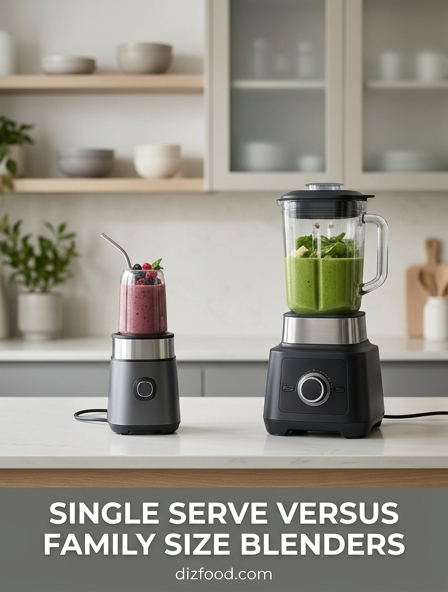
Single Serve vs Full Size Blenders Comparison
Choosing between a single-serve blender and a full-size countertop model depends largely on your daily culinary habits and the number of people you typically feed. Single-serve blenders are designed for speed and individual portions, usually featuring a blending jar that doubles as a travel cup. In contrast, full-size blenders are robust machines built to handle large volumes, varying textures, and tougher ingredients like ice or frozen fruits in bulk. While the personal blender excels in convenience, the full-size version offers superior versatility for a wider range of kitchen tasks beyond simple smoothies.
| Feature | Single Serve Blender | Full Size Blender |
|---|---|---|
| Typical Capacity | 12 oz - 24 oz | 48 oz - 72 oz |
| Motor Power | 200W - 900W | 1000W - 1500W+ |
| Primary Use | Individual smoothies | Soups, batches, ice crushing |
| Footprint | Compact/Minimal | Large/Substantial |
Full-size models often include variable speed controls and preset programs, providing the user with precision over the final texture. Single-serve models usually operate with a simple pulse function or a single-speed setting activated by pressing the cup into the base. Understanding these fundamental differences is the first step in determining which appliance earns a permanent spot on your kitchen counter.
Benefits of Personal Single Serve Blenders
Personal blenders have revolutionized the morning routine for health enthusiasts and professionals alike. The primary advantage lies in the streamlined workflow; you blend your ingredients directly in the vessel you drink from, which eliminates the need for extra glassware and minimizes cleanup. These machines are engineered for efficiency, focusing their power into a smaller area to create smooth consistencies for liquid-based recipes in seconds. Because they are smaller, they are also significantly quieter than their industrial-sized counterparts, making them ideal for early morning use in shared living spaces.
- Reduced food waste by making exact single portions.
- Lower energy consumption compared to high-wattage full-size motors.
- Simplified storage, as the base and cups fit easily in standard cabinets.
- Portability of the blending cups, often featuring leak-proof travel lids.
- Affordability, making them accessible for students and budget-conscious shoppers.
Beyond smoothies, personal blenders are excellent for small tasks that larger blenders struggle with, such as emulsifying a single serving of salad dressing, grinding a handful of coffee beans, or making a quick protein shake after a workout. Their specialized design ensures that the blades reach all ingredients without leaving large chunks stuck at the bottom of a massive pitcher, which is a common frustration when using a large blender for a small amount of food.
Why Choose a Family Size Countertop Blender
When it comes to culinary versatility, the family-size countertop blender is an unmatched powerhouse in the kitchen. These machines are built with high-torque motors and hardened stainless steel blades that can pulverize the toughest ingredients, from fibrous kale to solid ice cubes. A full-size blender is essential for households that enjoy hosting dinner parties or families who want to prepare large batches of nutritious meals at once. The sheer volume of the pitcher allows for the creation of family-sized servings of gazpacho, large batches of frozen margaritas, or smooth purees for home-made baby food.
- High-capacity pitchers ranging from 64 to 72 ounces accommodate multiple servings.
- Vented lids allow for the safe blending of hot liquids like steamed vegetables for soup.
- Advanced speed settings offer control over textures, from chunky salsas to silky nut milks.
- Durability and long-term warranties often accompany these professional-grade appliances.
- Multi-functional capabilities often replace other gadgets like food processors or juicers.
The stability of a full-size blender is also a significant benefit. These units are heavy and often feature suction-cup feet or weighted bases to prevent "walking" across the counter during high-speed operation. For the home cook who experiments with nut butters, flours, and complex sauces, the investment in a full-size model provides the necessary horsepower to achieve professional results that smaller motors simply cannot replicate.
Personal Blenders for Busy On the Go Lifestyles
For individuals juggling career, fitness, and social commitments, time is the most valuable commodity. Personal blenders cater specifically to this "on-the-go" demographic by reducing the time spent on meal preparation and sanitation. The design philosophy centers on the "blend-and-bolt" concept. Instead of pouring a drink from a large pitcher into a separate container, the user attaches a flip-top lid to the blending cup and heads out the door. This seamless transition is perfect for gym-goers who need a post-workout recovery drink or commuters who prefer to drink their breakfast during the drive.
- Lightweight components make the cups easy to carry in bags or car cup holders.
- One-touch operation requires zero technical knowledge or setup time.
- Minimal parts mean the entire assembly can be rinsed in under a minute.
- Compact bases can be kept in office breakrooms or dorm rooms without taking up space.
Furthermore, many personal blenders come with multiple cups, allowing different family members to customize their own drinks without having to wash the equipment between uses. This customization is particularly helpful for families with different dietary needs or taste preferences. The ability to quickly whip up a nutritious snack prevents the temptation of reaching for processed convenience foods when time is short, supporting a healthier lifestyle amidst a hectic schedule.
High Performance Features of Large Batch Blenders
Large batch blenders are defined by their sophisticated engineering and performance-driven features. Unlike basic models, high-performance blenders utilize "total crushing" technology or high-speed vortex blades to ensure every particle is processed. One of the most sought-after features in these units is the variable speed dial, which allows the user to manually adjust the blade's rotations per minute. This is crucial for recipes that require a gradual increase in speed to properly emulsify fats or incorporate air into mixtures like mousses or whipped creams.
| Feature | Functional Benefit |
|---|---|
| Pulse Setting | Provides bursts of power for controlled chopping and texture. |
| Pre-Programmed Settings | Automatic cycles for smoothies, soups, and self-cleaning. |
| Tamper Tool | Allows for pushing thick ingredients into the blades safely. |
| Metal Drive System | Ensures longevity and better power transfer than plastic. |
Additionally, high-end large blenders often feature thermal protection systems that prevent the motor from overheating during intensive tasks like grinding grains or kneading dough. Some models also incorporate "smart" technology, which detects the size of the container attached and adjusts the blending times and speeds accordingly. These professional-grade features justify the higher price point for those who prioritize culinary precision and require a machine that can withstand daily, heavy-duty usage without loss of performance.
Small Kitchen Solutions with Compact Personal Blenders
In urban apartments or homes with limited counter space, every inch of real estate is precious. Compact personal blenders are the ideal solution for these environments, offering a small footprint without sacrificing basic functionality. These units typically have a base no wider than a standard coffee mug, allowing them to tuck into corners or sit neatly under low-hanging cabinets. For those who live in "tiny homes" or travel in RVs, the portability and low storage requirements of a personal blender make it an essential kitchen tool that doesn't contribute to clutter.
- Vertical design maximizes counter space by utilizing height rather than width.
- Cord storage compartments keep the kitchen looking organized and tidy.
- Modular attachments can be stored in drawers rather than on the counter.
- Lightweight enough to be moved easily from a cupboard to a workspace.
The aesthetic of modern personal blenders has also evolved to complement minimalist kitchen designs. Available in a variety of colors and sleek finishes, they function as both a tool and a design element. Because they are easy to move, they can be brought out only when needed, keeping the workspace clear for other tasks like chopping or baking. For the minimalist cook, a high-quality personal blender provides just enough power to get the job done while maintaining the clean, uncluttered environment that is vital in a small kitchen.
Large Capacity Blenders for Family Meal Prepping
Meal prepping has become a cornerstone of modern nutrition, and a large capacity blender is a vital instrument in this process. When preparing meals for a week, the ability to blend two liters of sauce or a massive batch of hummus in a single cycle saves hours of labor. Family-size blenders allow for the "bulk-blend" method, where base ingredients for multiple recipes are prepared simultaneously. For instance, a large batch of roasted tomato base can be blended and then divided into portions for pasta sauce, soup, and chili, ensuring consistency across all meals.
- Measure and prep all bulk ingredients for the week's sauces or dressings.
- Utilize the large pitcher to blend all liquid components in one go.
- Use the pulse feature to add texture to larger batches without over-processing.
- Pour the finished product into individual meal-prep containers for storage.
- Use the self-cleaning feature to quickly reset for the next prep task.
These blenders are also adept at handling frozen ingredients for large-scale breakfast prep. You can create a giant smoothie base, pour it into freezer-safe jars, and have a week's worth of breakfasts ready to go. The high-volume pitcher is also useful for families who bake, as it can often handle the liquid and dry ingredients for pancakes or muffins, allowing for quick pouring directly onto a griddle or into tins. By centralizing these tasks in one powerful machine, family meal prepping becomes a faster, more organized endeavor.
Ease of Cleaning Single Serve versus Full Size
Cleaning is often the deciding factor when choosing between blender types. Single-serve blenders are widely considered the easiest to maintain because they consist of fewer parts. The blade assembly usually twists off the cup, allowing both the vessel and the blades to be rinsed under a tap or placed in the top rack of a dishwasher. Because the cups are narrow, there are fewer crevices where food can get trapped, making them highly hygienic for daily use. However, users must be careful to clean the rubber gaskets, as residue can sometimes build up underneath the seal.
Full-size blenders, while appearing more daunting, have made significant strides in ease of cleaning. Many high-end models now feature a dedicated "clean" cycle. By adding a drop of dish soap and some warm water, the blender can essentially wash itself in 60 seconds at high speed. The challenge with larger pitchers is often their height; they may not fit easily in a standard dishwasher, requiring manual scrubbing. Furthermore, some large models have non-removable blades, which necessitates the use of a long-handled brush to safely clean the area beneath the sharp edges. While single-serve units win on simplicity, full-size units with self-cleaning modes offer a "hands-off" convenience that many users find equally appealing.
Cost Analysis of Personal versus High End Blenders
The price gap between personal blenders and high-end full-size models can be substantial, often ranging from $30 to over $600. A personal blender is a low-risk investment, perfect for those who are just starting a healthy habit or need a secondary device for the office. These units are affordable because they use smaller motors and plastic components. However, their lifespan may be shorter if they are frequently pushed beyond their intended limits, such as trying to crush large amounts of ice or hard nuts daily.
| Category | Price Range | Value Proposition |
|---|---|---|
| Budget Personal | $30 - $60 | Low entry cost, basic smoothie functions. |
| Premium Personal | $70 - $130 | Better motors, more durable cups/accessories. |
| Standard Full Size | $80 - $180 | Versatile, good for families on a budget. |
| High-End Professional | $300 - $600+ | Longevity, 7-10 year warranties, peak performance. |
In contrast, a high-end blender is viewed as a long-term kitchen investment. While the upfront cost is high, these machines are built to last a decade or more. They often feature commercial-grade motors and metal drive systems that do not wear down like the plastic gears found in cheaper models. When you factor in the cost of replacing a cheap blender every two years versus buying one premium machine that lasts ten, the "expensive" option often proves to be more economical over time for the serious home cook.
Choosing the Right Blender for Your Kitchen Needs
Ultimately, the decision between a single-serve and a full-size blender should be based on your specific lifestyle requirements. If your primary goal is to make a quick protein shake before work and you have limited space, a personal blender is the logical choice. It saves time, money, and counter space. However, if you have a family, enjoy hosting, or want to explore advanced culinary techniques like making hot soups and nut butters from scratch, the power and capacity of a full-size blender are indispensable. Some users even find that owning both is the best solution, using the personal blender for daily drinks and the full-size model for weekend meal prep.
- Assess your daily volume: Are you cooking for one or four?
- Consider your recipes: Do you need to blend hot liquids or hard grains?
- Evaluate your space: Do you have room for a permanent countertop fixture?
- Determine your budget: Are you looking for a quick fix or a lifetime tool?
Before purchasing, check the warranty and the availability of replacement parts. A blender is a workhorse in the kitchen, and ensuring that you can easily find new blades or extra cups will extend the life of your appliance. Whether you choose the compact efficiency of a single-serve unit or the robust power of a family-size model, the right blender will serve as a catalyst for a healthier and more creative culinary experience in your home.

Comments