

The Science of Blending Vortices
The vortex is the cornerstone of high-performance blending, relying on principles of fluid dynamics to transform solid ingredients into homogenous liquids. When the blades spin at high revolutions per minute, they create a low-pressure center that draws material inward and downward. This phenomenon, known as a forced vortex, ensures that gravity and centrifugal force work in tandem. As the liquid is pushed toward the container walls, it rises and then falls back into the center, creating a continuous cycle of circulation. This motion is critical for ensuring that every particle, regardless of its initial position in the jar, eventually passes through the high-shear zone of the blades.
Without a properly maintained vortex, ingredients would simply spin in a horizontal circle, leading to uneven results and stagnant pockets. The efficiency of this process is determined by the torque of the motor and the atmospheric pressure within the vessel. By mastering the physics of the vortex, kitchen technology allows for the mechanical breakdown of cell walls, releasing nutrients and creating a level of smoothness that traditional mixing methods cannot replicate. This science ensures that even the most fibrous vegetables are reduced to a silky consistency through repeated, high-velocity impacts.
Maximizing Efficiency with Manual Tampers
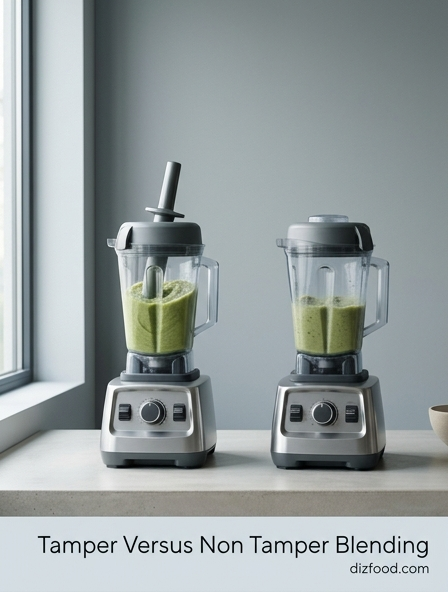
While the vortex is naturally self-sustaining in thin liquids, dense mixtures often require manual intervention to maintain flow. The tamper is a specialized tool designed to interact with the vortex without coming into contact with the blades. Its primary function is to burst air pockets, also known as cavitation bubbles, which can stall the blending process by surrounding the blades with air instead of food. Using a tamper effectively requires a rhythmic pressing motion targeted at the corners of the container.
- Breaking Air Bridges: Pushing thick ingredients like frozen fruit into the blade path to restart the vortex.
- Improving Circulation: Forcing stubborn chunks toward the low-pressure center for consistent processing.
- Thermal Management: Reducing the time the motor runs, which prevents overheating during heavy-duty tasks.
- Consistency Control: Ensuring that thick pastes move uniformly without needing excessive added liquids.
By targeting the four corners of a square jar, the user redirects the flow of material back into the "eye" of the storm. This synergy between the mechanical power of the blender and the manual guidance of the operator ensures that even the most viscous recipes, such as hummus or thick frozen desserts, achieve a perfectly uniform consistency.
How Vortex Motion Impacts Texture
The quality of a blend is defined by its micro-texture, which is directly influenced by the stability of the vortex. In a well-formed vortex, the shear forces are distributed evenly, allowing for the precise reduction of particle size. This is particularly important for green smoothies, where the goal is to pulverize fibrous leafy greens into a liquid state. When the vortex is consistent, the friction generated by the blades can also be used to emulsify fats and liquids, creating stable dressings and sauces that do not separate over time.
The speed of the vortex dictates the level of aeration. At lower speeds, the vortex is shallow, minimizing the amount of air incorporated into the mixture. This is ideal for clear soups or heavy batters. At higher speeds, the deep funnel draws in more air, which can be used to create light, frothy foams or whipped creams. Understanding this relationship allows users to manipulate the mouthfeel of their culinary creations, moving beyond simple chopping to true molecular transformation of the ingredients involved. Proper vortex control results in a luxurious, professional-grade finish that distinguishes high-end appliances from standard kitchen mixers.
Eliminating Air Pockets for Smooth Blends
One of the most common challenges in high-speed blending is the formation of a "cavitation" pocket. This occurs when the blades spin so fast that they create a vacuum around themselves, effectively disconnecting from the food above. To eliminate these air pockets and restore the vortex, a combination of speed adjustment and ingredient layering is necessary. Starting the blender at its lowest setting allows the blades to grab the ingredients and establish a small vortex before increasing the velocity to maximum power.
If an air pocket forms, the motor's pitch will typically rise to a high-pitched whine. At this point, the user must either use a tamper to displace the air or pulse the machine to allow the ingredients to settle. By maintaining a solid column of food above the blades, the vortex can continue to exert downward pressure, ensuring that the blend remains smooth and free of un-processed lumps. Proper hydration levels also play a vital role in preventing these voids from interrupting the culinary process. Strategic use of the pulse function can break the vacuum and allow gravity to pull the mixture back into the cutting zone for a perfect finish.
The Role of Blade Design in Circulation
The geometry of the blade assembly is the engine that drives the vortex. High-performance blades are not merely sharp; they are engineered with specific angles and "wingtips" to manipulate fluid flow. These angles are designed to create a powerful upward lift on the outer edges and a vacuum-like suction in the center. This dual-action motion ensures that ingredients are not just sliced, but are also vigorously circulated throughout the entire container. The material and durability of the blades also impact how they maintain this flow over long blending cycles.
| Blade Feature | Functional Impact |
|---|---|
| Blunt Edges | Uses sheer force to pulverize cell walls rather than just cutting. |
| Vertical Offset | Prevents ingredients from being trapped under the blades. |
| Hardened Steel | Maintains shape and vortex integrity under high-torque resistance. |
| Wingtips | Increases the reach of the vortex to prevent stagnant zones. |
When the blades are properly aligned with the container's base, they create a "rolling" effect. This means the food travels up the sides, across the top, and back down into the center. This constant circulation is what prevents the motor from overworking and ensures that even hard spices or seeds are ground into a fine powder.
Mastering Thick Mixtures and Nut Butters
Creating nut butters or thick pastes is the ultimate test of vortex technology. In these scenarios, the lack of added liquid makes it difficult for a traditional vortex to form immediately. The process relies on the release of natural oils from the ingredients to provide the necessary lubrication. To master these mixtures, the operator must utilize a high-torque setting while simultaneously using a tamper to prevent the blades from spinning in an air pocket.
- Start with dry-roasted nuts to facilitate faster oil release during the initial breakdown.
- Begin at a low speed to crush the solids into a coarse meal, ensuring the base is fully engaged.
- Quickly increase to high speed to generate the friction heat needed for liquefaction.
- Maintain the vortex until the mixture transitions from a paste to a smooth, flowing butter.
- Monitor the container temperature to prevent the natural oils from scorching.
The heat generated by the high-speed vortex is actually beneficial here, as it helps thin the oils, making the mixture more fluid. However, patience is key, as it may take several minutes for the vortex to become fully self-sustaining in such a viscous environment.
Optimizing Jar Shape for Vortex Creation
The design of the blending container is just as important as the motor's power. A perfectly round jar often leads to a "spinning" effect where ingredients simply swirl without being processed. To counter this, engineers design jars with flat sides, ridges, or cloverleaf shapes. These "disturbances" in the jar's geometry break the circular flow and redirect the ingredients back toward the center of the blades. This redirection is essential for creating the turbulent environment necessary for high-speed blending.
Square containers are particularly effective at creating a turbulent vortex. When the liquid hits the flat side of the wall, it is forced inward at a sharp angle. This prevents the formation of "dead zones" where small pieces of food might otherwise get stuck in a corner. The taper of the jar also plays a role; a narrower base helps concentrate the energy of the blades on smaller volumes of food, while a wider top allows for larger batches to circulate freely. By optimizing the interaction between the liquid and the container walls, the blender ensures a more efficient and faster processing time for all types of recipes, from smoothies to soups.
Precision Control with Manual Intervention
Modern kitchen technology offers a range of automated programs, yet the highest level of precision often comes from manual control. By manually adjusting the variable speed dial, a cook can fine-tune the intensity of the vortex to suit the specific resistance of the ingredients. For example, when making a chunky salsa, a low-speed vortex is used to provide a controlled chop without liquefying the vegetables. Conversely, a high-speed vortex is essential for achieving the silky-smooth consistency required for a bisque or a fine puree.
Manual intervention also includes the strategic use of the pulse button. Pulsing allows the ingredients to fall back onto the blades, resetting the vortex and ensuring that no large pieces escape the high-shear zone. This technique is particularly useful for managing the "jump" that occurs when the blades first engage with hard items like ice or frozen fruit. By combining mechanical power with human observation, the user can achieve a specific texture that automated cycles might overlook, ensuring that every dish meets the desired culinary standard. This hands-on approach allows for real-time adjustments based on the visual feedback of the vortex's shape.
Achieving Professional Consistency at Home
The hallmark of professional-grade blending is the ability to produce consistent results every time. This reliability is achieved through the synergy of a high-horsepower motor and a scientifically designed vortex. In a home kitchen, reproducing the textures found in fine-dining restaurants requires an understanding of how to layer ingredients. To optimize the vortex, liquids should always be added first, followed by powders, soft foods, and finally ice or frozen items. This layering ensures that the blades can immediately establish a liquid vortex.
- Bottom Layer: Water, juice, or milk to start the flow and lubricate the blades.
- Middle Layer: Grains, proteins, or soft fruits that are easily pulverized.
- Top Layer: Ice and frozen ingredients to provide weight and force the lower layers into the blades.
This "bottom-up" approach prevents the blades from getting stuck and ensures a smooth ramp-up to maximum speed. When the vortex is correctly managed, the result is a perfectly homogenized mixture with no grit or unblended chunks, allowing home cooks to achieve a level of sophistication in their food preparation that was once reserved for commercial kitchens.
Advanced Techniques for Superior Food Texture
Advanced vortex techniques allow for the creation of unique culinary textures that go beyond simple liquid blends. One such technique is "aeration control," where the user manipulates the vortex to incorporate specific amounts of air. This is the secret to creating light-as-air chocolate mousses or perfectly emulsified hollandaise sauce. By starting with a high-speed vortex to break down ingredients and then finishing at a lower speed, you can remove excess bubbles for a denser, creamier finish. This technique is essential for achieving the right mouthfeel in delicate desserts.
Another technique involves the use of the vortex to cook raw ingredients through friction. In a high-powered blender, the kinetic energy of the blades spinning at over 20,000 RPM can bring a soup from room temperature to steaming hot in under six minutes. This method preserves the fresh flavor of the vegetables while utilizing the vortex to create a natural creaminess without the need for heavy dairy. These advanced applications demonstrate that the vortex is not just a mixing tool, but a versatile heat source and emulsifier that is essential for modern food preparation.




Comments