
Deciding between a compact personal blender and a robust countertop model often comes down to your daily routine and the complexity of your recipes. If you're a busy commuter who values portability and quick cleanup, a personal blender offers the "to-go" convenience of blending directly into a travel cup, making it the ultimate tool for straightforward fruit shakes. However, if you're prepping nutrient-dense green smoothies for the whole family or need to pulverize ice and tough leafy greens into a velvety consistency, a high-performance countertop unit provides the raw motor wattage and large-scale capacity that smaller motors simply can't match. Choosing the right fit ensures you achieve that perfect, lump-free texture without overworking your appliance.
| Feature | Personal Blender | Countertop Blender |
|---|---|---|
| Motor Power | 200W - 900W (Light duty) | 1,000W - 1,500W+ (Heavy duty) |
| Typical Capacity | 12 oz - 24 oz (Single serve) | 48 oz - 72 oz (Family size) |
| Best For | Soft fruits, protein powders | Frozen fruit, ice, leafy greens |
| Portability | High; blend-in travel cups | Low; stationary kitchen base |
| Functionality | One-touch pulse or single speed | Variable speeds, timers, presets |
| Cleanup | Quick; dishwasher-safe cups | Self-cleaning cycles or hand wash |
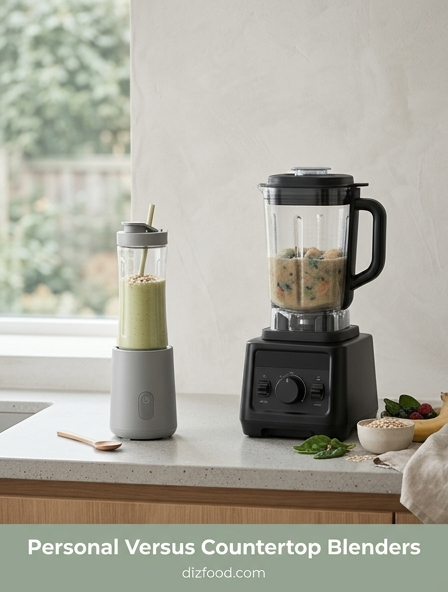
Choosing the Right Blender Size for Your Lifestyle
Selecting between a personal and a countertop blender begins with an honest assessment of your daily habits and the number of people you typically serve. If your morning routine revolves around a quick, nutritious smoothie consumed on the way to work, the compact nature of a personal blender is likely your best match. These units are designed for individual portions, usually ranging from 12 to 24 ounces, ensuring you don't over-prepare or waste ingredients. They fit seamlessly into smaller kitchens or studio apartments where every inch of counter space is a premium commodity.
On the other hand, if you are a head of a household or someone who enjoys hosting dinner parties, a full-sized countertop blender becomes an essential tool. These larger appliances offer pitchers that hold between 48 and 72 ounces, making them capable of handling family-sized batches of frozen margaritas or large pots of pureed vegetable soup. When determining which size fits your lifestyle, consider the following factors:
- The number of servings required during a single blending cycle.
- Available storage space in kitchen cabinets or on the countertop.
- Your frequency of use for specialized tasks like meal prep versus quick snacking.
- Whether you prioritize "grab-and-go" convenience or batch-processing efficiency.
Ultimately, the right size is the one that minimizes friction in your daily routine. A blender that is too large for a single smoothie feels like a chore to clean, while a personal blender used to serve four people results in frustrating, repetitive cycles.
Comparing Motor Power and Ice Crushing Capabilities
Motor power is the engine that drives your blending experience, measured primarily in wattage. Personal blenders typically operate within the 250 to 900-watt range. While this is more than sufficient for soft fruits, protein powders, and yogurt, these motors can struggle when faced with dense frozen ingredients or large ice cubes. Overloading a low-wattage motor can lead to overheating or a lingering smell of burnt plastic, which signifies the motor is under too much stress to complete the task.
Countertop blenders occupy a different tier of performance, often boasting motors between 1,000 and 1,500 watts, with some professional models reaching even higher. This high wattage translates into torque, allowing the blades to pulverize ice into snow-like consistency in seconds. If you enjoy frozen cocktails or acai bowls with a thick, sorbet-like texture, the raw power of a countertop model is indispensable. Below is a comparison of how different power levels handle common kitchen tasks:
| Task | Personal Blender (250W-600W) | Countertop Blender (1000W+) |
|---|---|---|
| Fresh Fruit Smoothies | Excellent | Excellent |
| Crushing Large Ice Cubes | Poor / Moderate | Excellent |
| Nut Butters | Not Recommended | Excellent |
| Leafy Green Pulverization | Moderate | Excellent |
Choosing based on power ensures that you won't be left with unblended chunks or a stalled motor when working with challenging ingredients.
Single Serve Portability Versus Large Batch Pitcher Capacity
The defining feature of the personal blender is its "blend-in-cup" design. This innovation eliminates the need for a separate vessel, as the blending jar doubles as a travel mug. Once the ingredients are processed, you simply swap the blade attachment for a flip-top lid. This portability is a significant advantage for commuters, gym-goers, and students. It streamlines the morning workflow by reducing the number of items to wash and ensuring that your meal is ready to leave the house as soon as you are.
Conversely, countertop blenders are built for volume and versatility. The large pitcher allows for the creation of complex recipes that require ingredients to be added in stages. Because of the sheer volume, countertop models are the better choice for holiday cooking or prepping large quantities of sauce to be frozen for later use. While they lack the immediate portability of a single-serve cup, they offer a central hub for various culinary tasks that a small personal blender simply cannot accommodate. When deciding, evaluate how often you take your blends "to-go" versus how often you serve meals at a shared table. The choice between portability and capacity is often the most significant factor in long-term satisfaction with your purchase.
Key Differences in Blade Design and Blending Efficiency
Blade geometry plays a critical role in how ingredients move within the blender. In personal blenders, the blades are often smaller and positioned very close to the base of the cup. This design is optimized for "extraction," where the goal is to break down seeds and skins in a relatively small volume of liquid. Because the cup is inverted during blending, gravity pulls ingredients directly into the blades, making them highly efficient for liquid-heavy recipes like protein shakes. However, the lack of space means they can occasionally get stuck if the ratio of solids to liquids is too high.
Countertop blenders utilize a more complex blade system designed to create a powerful vortex. The blades are often tiered or angled to pull ingredients down from the top of the large pitcher and circulate them back up the sides. This ensures that every part of the mixture is processed evenly, regardless of the volume. High-end countertop models also feature blades made of hardened stainless steel that are dull to the touch; they rely on high-speed friction and impact rather than sharpness to pulverize food. This makes them more durable over time, as they do not "lose their edge" in the traditional sense. Understanding this efficiency helps in choosing a machine that won't require you to constantly stop and stir the contents with a spoon to get an even consistency.
Ease of Cleaning and Maintenance for Each Model
Maintenance is the primary reason many kitchen gadgets end up forgotten in the back of a cupboard. Personal blenders excel in this category due to their minimalist design. Most consist of only three parts: the cup, the blade assembly, and the lid. Since the cup is typically dishwasher-safe and the blade assembly can be rinsed under a tap immediately after use, the entire cleaning process takes less than a minute. This low-friction maintenance encourages daily use, particularly for those with busy schedules.
Countertop blenders require more effort, though modern designs have bridged the gap. Many premium models now include a "self-clean" cycle, where you fill the pitcher with warm water and a drop of dish soap, then run the motor on high for sixty seconds. However, the larger footprint of the pitcher can make it difficult to fit into a standard dishwasher, and the base unit is heavier to move for wiping down the counter beneath it. To keep your blender in top condition, consider these maintenance steps:
- Rinse the container immediately after use to prevent sugars and fibers from drying on the blades.
- Periodically check the rubber gaskets on the blade assembly for wear or mold buildup.
- Deep clean the base unit with a damp cloth to prevent sticky residue from affecting the buttons or dials.
- Avoid submerged blade assemblies in water for long periods, as this can degrade the internal bearings.
If you find cleaning chores particularly detestable, the simplicity of a personal blender is a major selling point that shouldn't be overlooked.
Versatility in the Kitchen from Smoothies to Soups
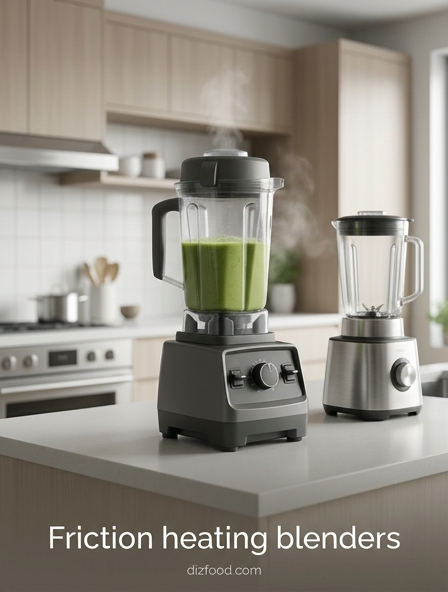
When it comes to culinary versatility, the countertop blender is the undisputed champion. While a personal blender is largely limited to cold liquids and soft textures, a high-performance countertop model can function as several appliances in one. With variable speed controls and high-speed friction, these machines can actually heat raw ingredients into a steaming soup in about six minutes. They are also capable of "dry milling," turning whole grains into flour or coffee beans into a fine grind, tasks that would quickly dull or damage a smaller personal unit.
Personal blenders are specialized tools. They do one thing-smoothies-exceptionally well, but they lack the controls for diverse tasks. They usually feature a single pulse setting or a "one-touch" button, offering no way to control the texture for chunky salsas or delicate emulsions. If your kitchen goals include making homemade almond butter, grinding spices, or preparing hot purees, the investment in a countertop model is justified. However, if your only goal is a consistent fruit smoothie, the extra features of a large blender may go unused, representing a waste of both money and counter space. The countertop model is for the "chef," while the personal model is for the "specialist."
Space Saving Benefits of Compact Personal Blenders
For many urban dwellers and minimalist enthusiasts, the physical footprint of an appliance is just as important as its performance. Personal blenders are designed with a vertical, narrow profile that takes up roughly the same amount of space as a large coffee mug. This makes them ideal for kitchens with limited counter real estate or for users who prefer to keep their workspaces clear. Many models are light enough to be stored in a drawer or on a high shelf and brought out only when needed, a feat that is nearly impossible with a heavy, 15-pound countertop unit.
The compact nature also extends to the accessories. Because the blending jars are the drinking vessels, you do not need to find extra cabinet space for a bulky 64-ounce pitcher. Furthermore, the cords are often shorter or can be tucked into the base, reducing "cord clutter" behind other appliances. In households where multiple people have different morning routines, having a small personal blender can be a lifesaver, as it can be tucked away into a corner, leaving the main workspace free for coffee makers or toasters. If you value a clutter-free environment and do not need to cook for a crowd, the space-saving benefits of a personal blender are a significant lifestyle upgrade.
Durability and Build Quality Across Blender Categories
The build quality of blenders varies wildly across the price spectrum, but generally, countertop blenders are engineered for a longer lifespan. Premium countertop models often feature metal-to-metal drive systems, where the gear on the base and the gear on the pitcher are both made of durable alloys. This prevents the "stripping" of gears that often occurs in cheaper models that use plastic components. These machines are built to withstand the heat generated by long blending cycles and the vibration of crushing hard ingredients daily.
Personal blenders, while convenient, are often constructed with more plastic components to keep weight and costs low. They are more prone to wear and tear if used heavily for non-liquid tasks. However, within the personal blender category, there is a "pro" tier that uses higher-quality plastics and better seals to prevent leaks. When assessing durability, look for the following indicators of quality:
- The weight of the base (heavier usually indicates a more robust motor).
- The material of the drive socket (metal is superior to plastic).
- The thickness and BPA-free rating of the blending jars.
- The length and comprehensiveness of the manufacturer's warranty.
While a personal blender may last two to five years with daily use, a high-end countertop blender is often seen as a ten-year investment, with some brands offering seven to ten-year full warranties to back up their build quality.
Price Point Analysis for Budget and Premium Blenders
The financial investment required for a blender depends entirely on the features and power you demand. Personal blenders are the entry point for most consumers, with budget-friendly models starting as low as $30. Even "premium" personal blenders rarely exceed $150. This makes them an accessible option for students or those testing out a new healthy eating habit. Because the components are smaller and the motors are less complex, the manufacturing costs are lower, which is passed on to the consumer.
Countertop blenders span a much wider price range. Entry-level full-sized blenders can be found for $50 to $100, but these often lack the power to crush ice smoothly or the durability to last more than a few years. The "high-performance" category begins around $300 and can climb to $600 or more. While this seems steep, the cost-per-use often justifies the price for power users. Below is a general price tier breakdown:
| Category | Price Range | Primary Audience |
|---|---|---|
| Basic Personal | $30 - $60 | Students, occasional users |
| Pro Personal | $70 - $150 | Daily smoothie drinkers, commuters |
| Standard Countertop | $100 - $250 | Families, casual cooks |
| Premium Countertop | $300 - $600+ | Culinary enthusiasts, health-focused households |
Consider the "total cost of ownership." A $50 blender that breaks every year is more expensive in the long run than a $400 blender that lasts a decade.
Selecting the Perfect Blender for Your Specific Needs
The final decision between a personal and a countertop blender should be based on your primary use case. If you are focused on efficiency, portability, and individual portions, the personal blender is the clear winner. It simplifies the process of healthy eating by removing the barriers of setup and cleanup. It is the perfect tool for someone whose kitchen is a transition point between home and the outside world. The simplicity of these devices ensures they get used every day rather than gathering dust.
However, if you view the blender as a versatile culinary tool capable of expanding your cooking repertoire, the countertop blender is a necessary investment. Its ability to handle heat, create various textures, and serve multiple people makes it a foundational piece of kitchen equipment. For those who can afford the space and the budget, having both is often the ideal solution-a large unit for weekend meal prep and a small unit for weekday mornings. To make your final choice, ask yourself these three questions:
- Will I be blending for more than one person most of the time?
- Do I need to process "hard" ingredients like ice, nuts, or frozen ginger?
- Is the convenience of a travel lid more important than the ability to make hot soup?
By aligning the machine's capabilities with your actual daily behavior, you ensure that your blender becomes a helpful assistant rather than a source of frustration.

Comments