
The Importance of Pulse Control
Pulse control is more than a simple button; it is a fundamental technique for culinary precision. When a blender runs continuously, it creates a powerful vortex that draws everything into a smooth, homogenized puree. While this is ideal for soups, it is often detrimental to recipes requiring specific textures. By using the pulse function, the user takes command of the motor's torque, allowing the blades to spin briefly before gravity pulls the ingredients back down toward the blade assembly. This mechanical cycle ensures that food is chopped rather than liquefied. Effective pulse control allows for a versatile range of outcomes, from a coarse dice to a fine mince, without the risk of overworking the ingredients. Mastering this tool transforms the blender from a one-dimensional appliance into a sophisticated processing station. It bridges the gap between manual knife work and high-speed automation, offering the efficiency of technology with the nuance of hand-crafted preparation. Understanding when to stop is just as vital as knowing when to start, making the pulse button an essential ally for any serious home cook or professional chef.
Achieving Consistency with Manual Bursts
Achieving consistency in the kitchen often depends on the level of control a cook has over their equipment. Manual bursts provide a tactical advantage by preventing the "dead zone" often found in continuous blending, where some ingredients stay at the top while others are pulverized at the bottom. By manually pulsing the blender, the user forces the contents to rearrange after every brief surge of power. This movement ensures that every piece of food eventually makes contact with the blades at various angles.
- Ensures even distribution of dry ingredients like nuts or spices.
- Maintains structural uniformity in hearty vegetable soups.
- Prevents heavy ingredients from settling and stalling the motor.
- Allows for incremental adjustments to the final thickness.
When these bursts are executed with intentionality, the result is a professional-grade finish where every bite has the same mouthfeel. Consistency is the hallmark of quality cooking, and manual bursts are the most reliable method for reaching that standard in a high-speed environment. This method eliminates the guesswork associated with automated timers and puts the focus back on the physical state of the ingredients.
Preventing Overprocessing in the Blender
One of the most common pitfalls in blender usage is overprocessing, which quickly turns a vibrant salsa into a watery foam or a thick pesto into a muddy paste. This occurs because the high RPM of modern blender motors generates significant kinetic energy, breaking down cell walls faster than the human eye can often track. Once the cellular structure of a vegetable is completely compromised, it releases all its internal moisture, leading to a loss of texture and "bite." Preventing this requires a shift from continuous blending to the strategic use of the pulse feature. By engaging the blades in short, sharp intervals, you interrupt the creation of a permanent vortex. This interruption gives the user a moment to assess the state of the ingredients before the next rotation. It acts as a safety net, providing a literal "stop" to the mechanical action. Without the constant downward suction of a continuous run, the ingredients are less likely to be sucked into a state of total homogenization, thereby preserving the desired character of the dish.
The Art of Creating Chunky Textures
The art of creating chunky textures requires a delicate balance between power and restraint. Whether you are preparing a rustic gazpacho or a hearty tapenade, the goal is to reduce the size of the ingredients while maintaining distinct, identifiable pieces. The pulse function is the primary tool for this task because it mimics the action of a chef's knife. Unlike a continuous blend that results in a uniform liquid, pulsing allows the blades to strike the food at full speed for a fraction of a second, followed by a total stop.
- Begin with large, uniform chunks of raw ingredients to ensure even contact.
- Engage the pulse button for exactly one second, then release.
- Wait for the ingredients to settle completely before the next burst.
- Repeat only until the largest pieces reach the desired size.
This method prevents the bottom layer from turning into mush while the top remains untouched. By utilizing these controlled intervals, you can create complex textures that add a satisfying tactile element to your culinary creations without resorting to labor-intensive manual chopping.
Rhythmic Pulsing for Uniform Results
Rhythmic pulsing is a technique where the timing between bursts is just as important as the bursts themselves. Creating a steady cadence allows the blender to behave predictably, making it easier to achieve uniform results across different batches. When you pulse rhythmically, you are essentially establishing a cycle of agitation and settling. During the agitation phase, the blades strike the ingredients, and during the settling phase, the food falls back into the path of the blades. If the rhythm is too fast, the food does not have time to fall, leading to uneven chopping. If it is too slow, the process becomes inefficient. Developing a "one-two" count-one second of power followed by one second of rest-is often the golden rule for standard vegetable processing. This mechanical harmony ensures that every component of the mixture is treated equally. By treating the pulse button like a musical instrument, the cook gains a sensory connection to the machine, allowing for a level of precision that automated programs simply cannot replicate in a dynamic kitchen environment.
How Manual Bursts Preserve Food Integrity
Preserving the integrity of food involves maintaining its natural color, flavor profile, and nutritional value. High-speed blending can be violent, often shearing fibers and oxidizing delicate ingredients. Manual bursts offer a gentler approach that minimizes the physical stress placed on the food. By limiting the duration of blade contact, you protect the volatile compounds that provide flavor and aroma.
| Factor | Continuous Blend | Manual Pulse |
|---|---|---|
| Oxidation | High air incorporation | Minimal air exposure |
| Fiber Structure | Completely pulverized | Maintains structural fiber |
| Flavor Retention | Can become dull | Preserves bright notes |
This comparison illustrates how the method of blending directly affects the final quality of the ingredient. For delicate herbs like basil or cilantro, pulsing is the only way to avoid the bruised, dark appearance that results from over-agitation. Using manual bursts ensures that the food on the plate reflects the high quality of the raw ingredients used, maintaining both aesthetic appeal and nutritional density.
Mastering Pulse Timing for Better Blends
Mastering the timing of a pulse is the difference between a successful prep and a kitchen disaster. Timing is not universal; it must be adapted based on the density and moisture content of the ingredients. For example, hard vegetables like carrots require slightly longer bursts to overcome their initial resistance, whereas soft fruits like tomatoes need mere flickers of power. The goal is to reach the motor's peak torque without allowing it to reach maximum velocity for an extended period. This requires the user to develop a physical "feel" for the machine's engagement. A short, half-second pulse is ideal for folding in delicate ingredients at the end of a recipe, while a full two-second pulse might be necessary for breaking down ice or frozen components. By varying the duration of the "on" cycle, the cook can manipulate the mechanical force applied to the food. This nuanced approach allows for a customized blending experience, ensuring that each specific ingredient is handled with the exact amount of force required to achieve the perfect result.
Reducing Friction Heat with Manual Bursts
Friction heat is an often-overlooked variable in blending that can ruin temperature-sensitive recipes. As blades spin at thousands of rotations per minute, they generate heat through friction with both the food and the air. In a continuous blend, this can raise the temperature of a sauce or smoothie by several degrees in less than a minute, which is detrimental to raw food preparations or cold soups.
- Keeps emulsion-based sauces like hollandaise from breaking.
- Prevents the wilting of fresh greens in pestos and dips.
- Maintains the chill in frozen desserts and smoothies.
- Ensures that raw enzymes in health-focused blends remain intact.
Using manual bursts allows the motor and the blades to cool down for a split second between rotations. More importantly, it prevents the constant friction that generates rapid thermal increases. This thermal management is crucial for maintaining the fresh, crisp flavors of uncooked ingredients and ensuring that your cold dishes stay truly cold from start to finish, protecting the sensory profile of the dish.
Visual Cues for Perfect Texture Control
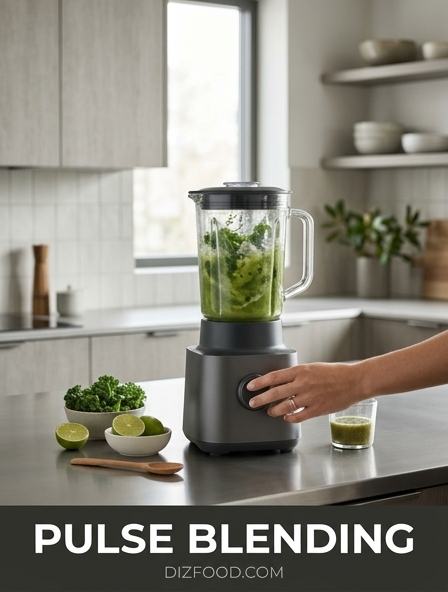
Effective pulse blending relies heavily on the cook's ability to interpret visual cues through the blender jar. Because the process is so rapid, one must watch for specific changes in the movement and appearance of the ingredients. Initially, you will see large chunks bouncing off the walls of the container. As you pulse, these chunks will begin to decrease in size and move more fluidly. A key visual indicator is the "tumble"-when the ingredients stop flying erratically and start to roll over themselves in a controlled manner. This is usually the sign that the blend is nearing its ideal texture. If you notice a liquid layer forming at the very bottom while the top remains solid, it is a cue to stop and stir or to use a more forceful pulse to break the air pocket. Paying attention to the color is also vital; a sudden change toward a lighter, aerated shade suggests that you are over-pulsing and incorporating too much air. By using these visual benchmarks, you can stop at exactly the right moment.
Customizing Blade Speed Through Bursts
Even on blenders with limited speed settings, the pulse button can be used to effectively customize the blade speed through mechanical modulation. By tapping the pulse button rapidly, you prevent the motor from ever reaching its full RPM, essentially creating a "low-speed" setting on a high-power machine. This technique is particularly useful for tasks that require a gentle touch, such as incorporating dry flour into a wet batter or folding chocolate chips into a thick mixture. Conversely, holding the pulse for a slightly longer duration allows the motor to ramp up to full power for a heavy-duty strike against hard objects like frozen fruit. This manual control over the motor's acceleration curve gives the user a level of versatility that fixed-speed buttons cannot match. It allows for a gradual increase in intensity, preventing the "splatter effect" that occurs when a blender is turned on to high speed immediately. Through the clever use of bursts, the cook dictates the energy of the blades, ensuring the appliance works for the food, not against it.

Comments