
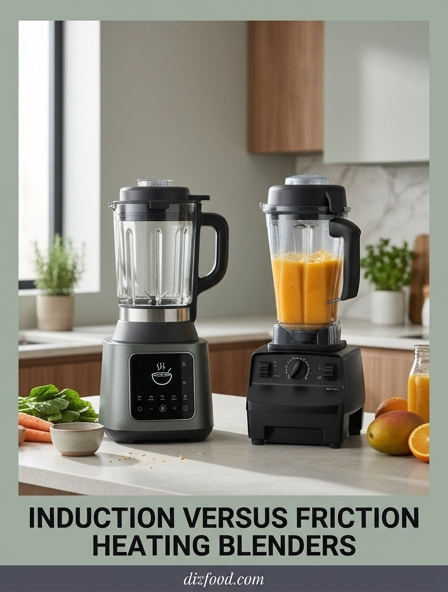
Ever wondered how a high-speed appliance transforms raw vegetables into a steaming bisque in minutes? The magic lies in the battle between induction and friction heating technologies. Friction heating blenders rely on sheer mechanical force, spinning blades at upwards of 30,000 RPM to generate heat through molecular collisions, making them the go-to for quick, "raw" soups. In contrast, induction blenders integrate magnetic coils into the base to turn the pitcher itself into a precise heating element, allowing for actual simmering, sautéing, and temperature-specific culinary control. Whether you value the raw power and speed of kinetic energy or the stovetop-level precision of magnetic heating, choosing the right tech is the definitive first step toward mastering the perfect bowl of soup.
| Feature | Friction Heating Blenders | Induction Heating Blenders |
|---|---|---|
| Heating Method | Kinetic energy from ultra-high RPM blades. | Electromagnetic field heats the pitcher base. |
| Temperature Control | Variable; depends entirely on blending duration. | Precise; selectable degrees (e.g., 40°C to 100°C). |
| Noise Level | High (85+ dB); blades must spin at max speed. | Quiet; heating is independent of blade speed. |
| Culinary Range | Limited to heating liquids via speed. | Can sauté, boil, and slow-cook delicate sauces. |
| Nutrient Profile | Higher oxidation due to extreme blade speeds. | Low oxidation; gentle stirring while heating. |
| Best For | Quick, rustic soups and high-fiber smoothies. | Gourmet bisques, soy milk, and baby food. |
Understanding Induction and Friction Heating in Blenders
In the evolving landscape of kitchen technology, the method by which a blender heats its contents defines its utility and performance. Traditionally, high-performance blenders have relied on friction heating, a process where mechanical energy is converted into thermal energy. This occurs as the blades spin at extraordinary speeds, creating intense resistance against the liquid or food particles. Over several minutes, this kinetic energy raises the temperature of the ingredients, eventually reaching a simmer. This method is inherent to the motor's power and does not require an external heating element.
Conversely, induction heating blenders represent a more modern, sophisticated approach. These appliances utilize electromagnetic fields to generate heat directly within the blender jar or a specialized base plate. Unlike friction heating, which is a byproduct of movement, induction is a deliberate and controlled thermal process. This technology allows the blender to heat ingredients even when the blades are stationary or rotating at very low speeds. Understanding these two mechanisms is essential for enthusiasts who prioritize either raw mechanical power or culinary precision.
- Friction Heating: Dependent on blade velocity and blending duration.
- Induction Heating: Dependent on electromagnetic coils and compatible metallic vessels.
- Mechanical Impact: Friction involves high sheer; induction involves thermal transfer.
How Friction Blenders Generate Heat Through Blade Speed
Friction blenders operate on the principle of fluid dynamics and molecular agitation. When the motor engages, the stainless steel blades reach speeds exceeding 20,000 revolutions per minute (RPM). At these velocities, the blade tips are traveling at hundreds of miles per hour. As they strike the ingredients, they break down cellular structures while simultaneously creating immense friction between the molecules of the liquid. The resistance encountered by the blades as they push through the dense medium transforms the kinetic energy of the motor into heat.
The process of heating through friction is gradual and requires a sustained high-speed cycle. It is not an instantaneous thermal event but rather a cumulative gain in temperature over a five to eight-minute period. Because the heat is generated throughout the entire mass of the liquid via agitation, there are rarely "hot spots" in the mixture. However, this process is inseparable from the blending action itself, meaning you cannot heat the food without simultaneously pureeing it into a very fine consistency.
- Motor activates and reaches peak RPM.
- Blade edges create high-velocity collisions with food particles.
- Molecular friction increases as the viscosity provides resistance.
- Thermal energy builds up within the vessel over several minutes.
The Science Behind Induction Heating Technology in Blenders
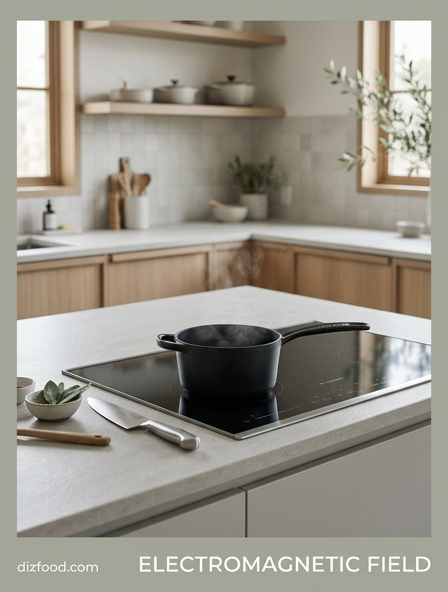
Induction heating in blenders is governed by the principles of electromagnetism, specifically Faraday's Law of Induction. Inside the base of the blender, a copper coil conducts an alternating current, which creates a rapidly oscillating magnetic field. When a jar with a ferromagnetic base is placed on the blender, this magnetic field penetrates the metal, inducing "Eddy currents." These currents flow through the resistance of the metal, generating heat almost instantaneously. This heat is then transferred to the food via conduction from the bottom of the jar.
This technology is significantly more advanced than simple electric resistance heating because the vessel itself becomes the heat source. There is no traditional "burner" that gets hot; the energy transfer happens at the molecular level within the metal base. This allows for a high degree of energy efficiency and safety, as the surrounding surface remains relatively cool. Furthermore, because the heating is independent of the motor, induction blenders can stir ingredients slowly while simmering them, which is impossible for friction-based models that require maximum speed to generate warmth.
- Excitation Coil: The primary source of the magnetic field in the base.
- Ferromagnetic Plate: The element in the jar that reacts to the field.
- Eddy Currents: The loops of electrical current that generate heat through resistance.
- Hysteresis Loss: Additional heat generated by the rapid reversal of magnetic dipoles.
Temperature Precision in Induction versus Friction Blending
The primary differentiator between these two technologies is the level of control the user has over the final temperature. Induction blenders are typically equipped with internal thermostats and digital sensors that allow for degree-specific adjustments. Because the heat is generated by an electromagnetic circuit, the software can modulate the power to maintain a steady temperature, such as 175°F for a delicate sauce or 212°F for a rolling boil. This makes the induction blender a versatile tool for tasks that require strict thermal management.
Friction blenders lack this level of precision. The temperature is a variable of time and speed; the longer the blender runs at high speed, the hotter the contents become. There is no "set it and forget it" temperature control. Users must manually stop the process once they estimate the desired temperature has been reached. While friction heating is excellent for reaching high temperatures quickly for soups, it is poorly suited for recipes that require low, sustained heat without over-processing the ingredients.
| Feature | Friction Heating | Induction Heating |
|---|---|---|
| Temperature Control | Variable/Estimated | Precise/Digital |
| Minimum Speed for Heat | Maximum RPM Only | Works at any RPM |
| Maximum Temperature | Approx. 180°F - 190°F | Can reach 212°F+ |
| Heat Regulation | Manual Intervention | Automated Thermostat |
Why Friction Blenders Require High RPM for Cooking
To understand why friction blenders require high RPMs, one must look at the relationship between velocity and thermal output. At low speeds, the resistance offered by the ingredients is insufficient to generate noticeable heat; the energy is simply used to move the liquid. Only when the blades reach a "critical velocity" does the friction become intense enough to overcome the cooling effect of the surrounding air and the jar's surface area. Most friction-based soup programs require the motor to run at 90% to 100% capacity to produce a steaming result.
This reliance on high RPMs means that friction cooking is inherently loud and aggressive. The blades must continuously shear the ingredients to keep the temperature rising. This is why friction blenders are synonymous with ultra-smooth textures. You cannot make a "chunky" soup using friction heating because by the time the liquid is hot, the high-speed blades have inevitably pulverized any solid pieces. The high RPM is the engine of the heat, but it also dictates the final texture of the dish, limiting the user to purees, bisques, and silken sauces.
- Kinetic Threshold: The speed required to start the heating process.
- Shear Force: The mechanical action that breaks down fibers during heating.
- Air Resistance: The cooling factor that high RPMs must overcome.
Energy Efficiency Comparison of Induction and Friction Models
When evaluating energy efficiency, induction heating is the clear winner from a thermodynamic perspective. Induction technology transfers approximately 85% to 90% of its energy directly into the vessel. There is very little "waste" heat escaping into the kitchen environment because the heating is localized to the base of the jar. This direct transfer allows for faster boiling times and less electricity consumption when the goal is specifically to cook or simmer food for an extended period.
Friction heating is considerably less efficient as a dedicated heating method. A large portion of the energy consumed by the high-wattage motor is lost to sound, vibration, and the cooling fans required to keep the motor from melting down. While the motor is powerful, using a 1500-watt engine to heat a liter of water through mechanical agitation takes more time and energy than using an induction coil. Friction blenders are designed primarily for structural breakdown; the heat is a secondary benefit that, while useful, is not an efficient primary heat source for long-duration cooking.
| Efficiency Metric | Friction Blender | Induction Blender |
|---|---|---|
| Energy Transfer Rate | Low (approx. 30-40%) | High (approx. 85-90%) |
| Primary Energy Loss | Sound & Motor Heat | Minor Magnetic Flux |
| Ambient Heat Gain | Moderate (Motor Fan) | Minimal |
| Ideal Use Case | Quick Emulsions | Slow Simmering |
Culinary Applications for Induction Heating in Blenders
The inclusion of induction heating expands a blender's repertoire into the territory of a multicooker. Because it can heat without spinning the blades at high speeds, it is perfect for delicate culinary tasks. For example, making a Hollandaise sauce or a custard requires precise, low heat to prevent the eggs from curdling. An induction blender can stir at a "keep warm" setting while the electromagnetic field maintains a steady 140°F. This allows for the emulsification and cooking of temperature-sensitive ingredients that would be destroyed by the violent action of a friction blender.
Furthermore, induction blenders are excellent for "chunky" recipes. One can sauté aromatics like onions and garlic in the bottom of the blender jar before adding liquids, then simmer the soup while the blades only occasionally stir to prevent sticking. This dual-functionality allows for the creation of complex stews, risottos, and even tempered chocolate. The ability to decouple the heating element from the motor speed provides a level of creative freedom that traditional high-speed blenders cannot match, effectively turning the appliance into a motorized saucepan.
- Emulsions: Bearnaise, Hollandaise, and mayonnaise bases.
- Confectionary: Tempering chocolate and making fruit preserves.
- Dairy: Pastry creams, puddings, and béchamel sauces.
- Sautéing: Pre-cooking vegetables before adding liquid for soup.
Motor Longevity and Wear in High Speed Friction Blenders
Heating through friction places a significant strain on a blender's motor. To generate enough heat to cook a soup, the motor must run at peak output for several continuous minutes. This creates internal thermal stress on the windings, bearings, and carbon brushes. Manufacturers of high-end friction blenders, such as Vitamix or Blendtec, engineer their motors with sophisticated cooling systems and "heavy-duty" ratings to handle this load, but the reality remains: the more the motor is used for heating, the faster the mechanical components will wear out over the years.
In contrast, the motor in an induction blender is under much less duress during the cooking process. Since the heat is provided by a separate electronic circuit, the motor only needs to spin the blades at a fraction of its maximum speed-or not at all. This separation of concerns means that the mechanical parts of an induction blender are protected from the high-heat, high-stress cycles required by friction models. While induction blenders have more complex electronics that could potentially fail, their mechanical components typically experience a longer lifespan because they aren't forced to work at 25,000 RPM just to make a bowl of soup hot.
- Continuous high-load operation increases internal motor temperature.
- Bearing grease can degrade faster under sustained friction-heat cycles.
- Carbon brushes wear down more quickly at maximum RPM.
- Induction models bypass these issues by using electromagnetic heat.
Nutrient Preservation During the Heating and Blending Process
A significant debate in the health community revolves around how these two heating methods affect the nutritional integrity of food. Friction heating is often criticized for its potential to oxidize ingredients. Because the blades are spinning so fast, they pull a large volume of air into the mixture. This high-speed aeration, combined with rising temperatures, can lead to the rapid oxidation of sensitive vitamins like Vitamin C and certain phytonutrients. The result is often a "frothy" soup that may have lost some of its antioxidant potential due to the sheer mechanical violence of the process.
Induction heating offers a gentler alternative for those concerned with nutrient density. Since the blades can rotate at a very slow speed during the heating cycle, there is minimal air incorporation and significantly less oxidation. The ingredients are essentially poached or simmered rather than beaten into submission. Additionally, the precise temperature control of induction prevents "overshooting" the heat, ensuring that enzymes and vitamins are not subjected to higher temperatures than necessary. For users who prioritize "living foods" or specific nutrient-retention goals, the low-shear, controlled-heat environment of an induction blender is generally superior.
- Oxidation: High-speed friction introduces more oxygen into the food.
- Enzyme Activity: Induction allows for sub-boiling temperatures to preserve enzymes.
- Texture: Friction creates a cellular breakdown that is more extreme.
- Color Retention: Lower aeration in induction blending often results in brighter colors.
Choosing Between Induction and Friction for Soup Making
The choice between an induction or friction blender for soup making ultimately depends on the desired end product. If the goal is a perfectly smooth, steaming-hot puree in under six minutes, a friction blender is the most efficient tool. These machines are designed for speed and simplicity; you throw in the raw ingredients, turn the dial to high, and return to a finished soup. The sheer power of the motor ensures that even fibrous vegetables like kale or woody ginger are rendered into a silky liquid, with the friction heat providing the finishing touch.
However, if your soup repertoire includes varieties with texture-such as minestrone, chunky vegetable, or rustic potato leek-the induction blender is the better investment. It allows you to control the heat independently of the blade speed, enabling you to simmer vegetables until tender without obliterating them. The induction blender also excels at "one-pot" cooking, where you can sauté, boil, and then lightly pulse the contents. While the friction blender is a "sprint" tool for purees, the induction blender is a "marathon" tool for culinary depth and variety.
| Preference | Recommended Technology | Reasoning |
|---|---|---|
| Silky Smooth Purees | Friction Heating | Maximum shear and high-speed aeration. |
| Chunky Textures | Induction Heating | Allows cooking with low-speed stirring. |
| Delicate Sauces | Induction Heating | Precise temperature control prevents curdling. |
| Raw/Quick Prep | Friction Heating | Speed and mechanical power over thermal control. |

Comments