
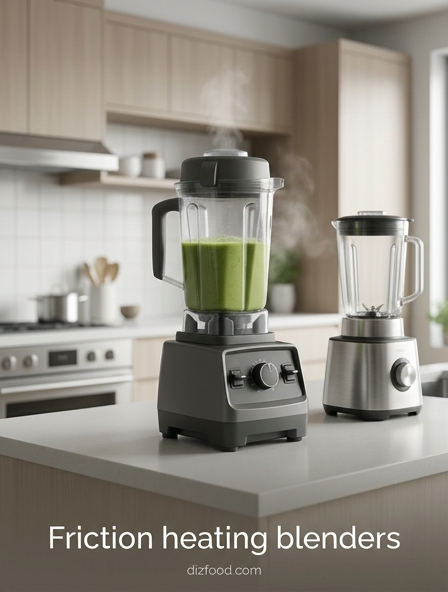
The Science of Blade Friction
The primary mechanism behind a friction-heating blender is the transformation of mechanical resistance into thermal energy. Unlike traditional stovetop cooking that relies on external heating elements, these high-performance machines utilize the physical interaction between the stainless steel blades and the liquid contents. As the blades rotate at tens of thousands of revolutions per minute, they encounter significant resistance from the viscosity of the ingredients. This resistance, known as fluid friction, generates heat at a molecular level throughout the entire container.
- Surface Area: The contact point between the metal edge and the liquid.
- Viscosity: Thicker liquids create more drag, resulting in faster heat accumulation.
- Shear Force: The tearing of liquid layers which dissipates energy as heat.
Because the heat is generated internally through the motion of the food itself, the process is remarkably efficient. The container walls act as an insulator, while the constant movement ensures that no hot spots develop. This prevents the scorching or burning common with traditional pots, as the temperature rises uniformly across the entire volume of the soup or sauce being prepared.
Kinetic Energy to Thermal Heat
In the realm of physics, energy cannot be created or destroyed, only transformed. A high-speed blender serves as a perfect demonstration of converting kinetic energy-the energy of motion-into thermal energy. The powerful motor draws electrical current to spin the drive socket, which in turn rotates the blade assembly. This rapid movement imparts massive amounts of kinetic energy to the molecules within the pitcher. As these molecules are forced to move and collide, the kinetic energy is "lost" to the environment in the form of heat.
| Energy Phase | Mechanism | Result |
|---|---|---|
| Electrical | Motor Draw | Rotation torque |
| Kinetic | Blade Velocity | Molecular motion |
| Thermal | Molecular Friction | Temperature rise |
This conversion is so effective that a standard high-end blender can bring cold water to a rolling boil in under ten minutes. The efficiency of this process depends heavily on the motor's ability to maintain high torque even as the liquid thickens and resistance increases during the blending cycle.
Optimal Motor Speeds for Soup
To achieve the temperatures necessary for a "piping hot" soup, the motor must operate within a specific range of speed and power. Most friction-heating blenders require a minimum tip speed to overcome the cooling effect of the surrounding air and the heat dissipation through the container walls. Generally, a motor capable of reaching 20,000 to 30,000 RPM is required to facilitate rapid thermal gains.
- Start Phase: Begin at low speeds (1,000-3,000 RPM) to incorporate raw ingredients and break down large solids.
- Ramp-Up: Gradually increase to maximum speed over 30 seconds to initiate the friction process.
- Sustained Friction: Maintain 25,000+ RPM for 5 to 7 minutes to reach serving temperatures near 170°F (77°C).
If the speed is too low, the blender will merely purée the food without generating sufficient heat. Conversely, maintaining maximum speed for too long can eventually trigger thermal protection sensors in the motor. The balance lies in using the highest speed setting once the mixture is smooth, as this maximizes the friction-to-surface-area ratio, ensuring the most rapid temperature climb possible within the kitchen environment.
Molecular Agitation Explained
At a microscopic level, the heating process in a high-speed blender is a result of extreme molecular agitation. When the blades strike the liquid, they do not just move the bulk fluid; they accelerate individual molecules to high velocities. These molecules then collide with neighboring molecules at a frequency of billions of times per second. These collisions are inelastic, meaning some of the energy of the movement is converted into internal vibration and rotation of the molecules.
In water and water-based liquids, the hydrogen bonds are constantly being stressed and broken by this mechanical interference. As the molecules vibrate more violently, the macroscopic temperature of the liquid rises. This is why the heat feels "even" compared to a microwave or a stove. In those methods, heat travels from the outside in or via electromagnetic waves that might hit certain spots more than others. In a friction blender, every molecule that passes through the high-velocity "kill zone" of the blades becomes a tiny heater, contributing to a total rise in the system's thermal state.
Vortex Dynamics and Temperature
The shape of the container and the resulting vortex play a critical role in how heat is distributed and maintained during the blending process. A well-designed blender pitcher creates a controlled "rolling" vortex that pulls ingredients down through the blades and pushes them back up the sides. This ensures that every part of the mixture is subjected to the high-friction environment of the blade assembly repeatedly.
- Centripetal Force: Drives denser, cooler particles toward the blades.
- Thermal Stratification: Prevented by constant turbulent mixing.
- Vapor Pressure: Managed by vented lids that allow steam to escape while retaining heat.
Without a proper vortex, the liquid near the blades would overheat and potentially cavitate, while the liquid at the top would remain cool. The vortex ensures that the kinetic-to-thermal energy conversion happens uniformly. As the temperature rises, the viscosity of many soups decreases, which would normally reduce friction; however, the increased speed and turbulent flow patterns compensate for this, allowing the temperature to continue climbing until the desired heat level is achieved for the specific recipe.
Nutrient Retention in High Speed Blends
A common concern with friction heating is whether the high speeds and subsequent heat damage the nutritional profile of the food. Interestingly, the short duration of the heating cycle often preserves more nutrients than traditional long-simmering methods. Because the blender reaches serving temperature in minutes rather than hours, heat-sensitive vitamins like Vitamin C and B-complex vitamins have less time to degrade through oxidation or prolonged thermal exposure.
| Nutrient | Traditional Boiling | Friction Blending |
|---|---|---|
| Vitamin C | High Loss | Moderate Retention |
| Enzymes | Fully Denatured | Partially Preserved |
| Fiber | Softened | Pulverized/Accessible |
Furthermore, the high-speed blades rupture the cell walls of vegetables, specifically the cellulose structures that are difficult for the human digestive system to break down. This "microwaves" the nutrients out of the cellular matrix, making phytonutrients and antioxidants more bioavailable. While the heat will eventually denature some enzymes, the speed of the process offers a unique middle ground between raw and fully cooked states.
Achieving Silky Smooth Textures
The same forces that generate heat through friction are also responsible for the superior textures found in high-performance blending. As the blades spin, they create a high-shear environment that can emulsify fats and liquids that would otherwise remain separate. In the context of a heated soup, this means that even without cream or dairy, a blender can create a velvety mouthfeel by pulverizing fibers and skins into microscopic particles.
- Emulsification: Breaking oil droplets into sub-micron sizes.
- Cellular Breakdown: Total destruction of fibrous stalks (like celery or kale).
- Aeration: Incorporating tiny air bubbles for a "bisque" effect.
When the temperature rises, the starches in vegetables like potatoes or cauliflower begin to gelatinize. The blender's constant mechanical agitation at high speeds prevents these starches from becoming gummy-a common issue with food processors. Instead, the friction heating works in tandem with the blade speed to produce a texture that is light, airy, and completely devoid of grit, resulting in professional-quality purées and coulis.
Total Blending Time for Steam
The progression from room temperature to a steaming state follows a predictable timeline based on the volume of the liquid and the power of the motor. Generally, the temperature rise is non-linear; it takes longer to move from 70°F to 100°F than it does to move from 140°F to 170°F because the efficiency of the motor and the fluid dynamics change as the liquid thins out and becomes more turbulent.
- Minute 1-2: Ingredients are liquefied; temperature rises roughly 10-15 degrees.
- Minute 3-4: Friction becomes the dominant force; steam begins to form under the lid.
- Minute 5-6: The mixture reaches "serving hot" (approximately 150°F).
- Minute 7+: The mixture approaches the boiling point (212°F depending on altitude).
Most users stop the process at the six-minute mark. At this stage, the steam is visible when the lid plug is removed, and the soup is hot enough to require cautious sipping. It is important to note that blending for more than 10 minutes is rarely recommended, as the heat can cause the pressure inside the container to expand the lid, potentially causing spills if the vent is not clear.
The Role of Blade Aerodynamics
The design of the blades in a friction blender involves complex aerodynamics that go beyond simple sharpening. In fact, many high-speed blender blades are intentionally blunt. This is because, at 300 miles per hour (the tip speed of some blades), a sharp edge would dull almost instantly. Instead, the blades are designed as "hammers" that use blunt force and aerodynamic drag to pulverize food and generate heat.
The angle of the blade-often called the "pitch"-determines how much air and liquid are moved with each rotation. A steeper pitch increases the drag, which in turn increases the friction and the heat generated. Some manufacturers include "winglets" on the ends of the blades to reduce cavitation-the formation of vacuum bubbles-which can actually slow down the heating process by reducing the contact between the blade and the liquid. By optimizing the airflow and liquid-flow around the blade assembly, engineers can maximize the thermal output of the motor without requiring additional wattage, making the blender a more efficient cooking tool.
From Cold Prep to Piping Hot
The transition from cold, raw ingredients to a finished, hot meal is the hallmark of the friction blender experience. This "one-container" cooking method simplifies the kitchen workflow significantly. A user can place raw carrots, ginger, broth, and cashews into the pitcher at a refrigerated temperature. Within minutes, the mechanical energy has not only cooked the vegetables but also transformed the nuts into a creamy base and brought the entire mixture to a steaming 175°F.
- Convenience: No need to pre-boil or sauté ingredients.
- Safety: No open flames or red-hot coils.
- Consistency: The digital timer ensures the same temperature every time.
Safety is a primary consideration during this transition. High-speed blenders designed for heating always include a vented lid. As the friction increases and the liquid reaches the boiling point, the air inside the pitcher expands. The vent allows this pressure to escape safely while preventing the hot liquid from splashing out. This allows the user to watch the transition from a cold slurry to a steaming, smooth soup through the transparent walls of the container, marking the completion of the friction-heating cycle.

Comments