
Cordless Vs Corded Blenders: Which Is The Best For Your Kitchen?
Choosing between a cordless and a corded blender often boils down to a battle between ultimate portability and raw, consistent power. If you are a culinary enthusiast who demands high-speed blending for frozen fruits and tough greens, a traditional corded model remains the gold standard because of its limitless electrical supply and high-wattage motors. However, for the modern home cook seeking clutter-free countertops or the ability to whip up a smoothie at the office or while camping, cordless blenders offer revolutionary freedom without the tether of a wall outlet. Whether you prioritize the heavy-duty endurance of a plug-in appliance or the grab-and-go convenience of a rechargeable lithium-ion battery, understanding the trade-offs in torque and runtime is essential for optimizing your kitchen workflow and achieving the perfect consistency every time.
| Feature | Corded Blenders | Cordless Blenders |
|---|---|---|
| Power Output | High (300W - 1500W+) | Moderate (Battery-optimized) |
| Runtime | Continuous/Unlimited | 15-25 blends per charge |
| Best For | Ice, nuts, and large batches | Smoothies, protein shakes, sauces |
| Portability | Stationary (Needs outlet) | High (Travel & outdoor friendly) |
| Storage | Requires cord management | Sleek, no-wire footprint |
| Maintenance | Standard cleaning | Requires regular recharging |
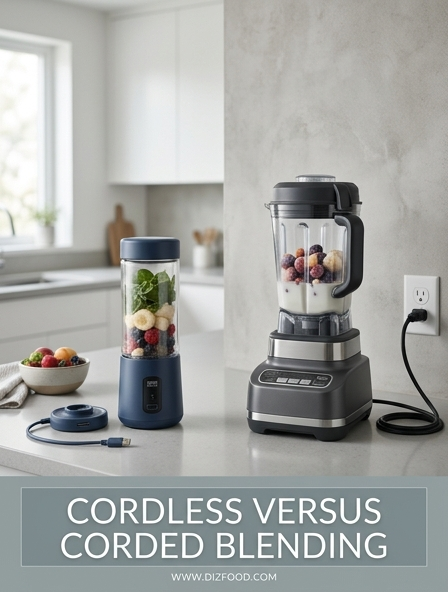
The Power Gap Between Corded and Cordless
When comparing corded and cordless blenders, the most immediate distinction lies in raw power output. Corded blenders draw energy directly from a wall outlet, typically providing a continuous flow of 120 volts in North America. This allows manufacturers to equip these machines with high-wattage motors ranging from 600 to 1,500 watts or more. The result is a high level of torque and sustained blade speed that can pulverize the toughest fibers without the motor overheating or slowing down under load.
In contrast, cordless blenders rely on DC motors powered by internal lithium-ion batteries. While battery technology has advanced significantly, there is an inherent physical limitation to how much energy can be discharged at once without damaging the battery cells. Most cordless models operate at lower voltages, which translates to less torque. This doesn't mean they are ineffective, but they are generally designed for lighter tasks like mixing protein shakes or soft fruit smoothies rather than heavy-duty food processing. The power gap is most noticeable during long blending cycles where a corded motor remains consistent, while a cordless motor may experience a "sag" in performance as the battery depletes.
- Corded Advantage: Unlimited high-wattage output for industrial-strength tasks.
- Cordless Limitation: Regulated power discharge to preserve battery health.
- Torque Comparison: Corded motors maintain RPM under heavy resistance better than battery-operated counterparts.
Portability and the Modern Cordless Kitchen
The rise of the cordless kitchen is driven by the desire for ergonomic freedom and a clutter-free environment. In modern kitchen designs, especially those featuring large islands without built-in electrical outlets, a cordless immersion or personal blender is a game-changer. It allows the cook to move freely from the stove to the prep station without being tethered to a specific corner of the countertop. This portability eliminates the safety hazard of stretching a cord across a hot burner or a sink filled with water.
Beyond the layout of the kitchen, cordless portability extends to the lifestyle of the user. These devices are often designed to be lightweight and modular, making them ideal for individuals who want to prepare fresh ingredients in different areas of the home. For example, a parent might use a cordless immersion blender to puree soup directly in a pot on the stovetop and then immediately move to the dining table to finish a sauce. The lack of a cord also simplifies storage, as there is no need to wrap and secure thick cables before tucking the appliance into a drawer or cabinet. This streamlined experience appeals to minimalists and those living in small apartments where outlet access is limited and counter space is at a premium.
Battery Longevity vs Unlimited Power Supply
The debate between corded and cordless blenders often boils down to the reliability of the power source over time. A corded blender offers an unlimited power supply, meaning as long as your home has electricity, the blender will function at peak performance. This makes corded models the "buy it for life" choice for many consumers. The internal components of a corded blender are primarily mechanical and electrical, lacking the chemical components that naturally degrade over time.
Cordless blenders, however, are dictated by the chemistry of lithium-ion batteries. Every battery has a finite number of charge cycles-usually between 300 and 500-before its capacity begins to diminish noticeably. This means that while a cordless blender offers great convenience today, it may only hold half its original charge in three to five years. Furthermore, if a cordless blender is left uncharged for several months, the battery can fall into a deep discharge state, potentially rendering the device useless. Users must weigh the immediate convenience of cordless operation against the long-term reliability of a plug-in model.
| Feature | Corded Blenders | Cordless Blenders |
|---|---|---|
| Power Duration | Continuous / Unlimited | Limited (approx. 15-30 mins) |
| Lifespan | 10+ years (motor dependent) | 3-5 years (battery dependent) |
| Reliability | Always ready to use | Requires pre-charging |
Blending Performance on Tough Ingredients
Performance is where the distinction between these two categories becomes most apparent to the home chef. If your cooking style involves frequent use of frozen fruits, ice cubes, fibrous kale, or hard nuts, a corded blender is almost always the superior choice. The high-speed blades of a professional-grade corded blender create a vortex that pulls heavy ingredients down into the blades, crushing them into a perfectly smooth texture. This requires a level of kinetic energy that most battery-powered units simply cannot sustain for more than a few seconds.
Cordless blenders often struggle with "bridging," a phenomenon where frozen ingredients get stuck above the blades because the motor lacks the speed to maintain a powerful enough vortex. To compensate, users of cordless blenders often need to add more liquid or shake the device during operation to keep ingredients moving. While a cordless blender can eventually process a frozen smoothie, it often leaves behind small chunks of ice or unblended bits of greens. For those who demand "liquefied" results for green smoothies or homemade nut butters, the raw RPMs provided by a corded connection are essential for achieving that professional culinary texture.
Cordless Convenience for Travel and Outdoor Use
One area where cordless blenders are the undisputed champions is in travel and outdoor applications. For the fitness enthusiast, a cordless personal blender fits perfectly into a gym bag, allowing for a fresh protein shake immediately after a workout rather than a clumpy hand-shaken version. Similarly, for office workers, these devices enable the preparation of a fresh smoothie at a desk without needing to hunt for an available outlet or disturb colleagues with the loud, high-pitched whine typical of larger corded machines.
The utility extends to camping, tailgating, and boating. When you are away from the grid, a cordless blender becomes a luxury that a corded model cannot match without a portable power station or inverter. Many modern cordless blenders feature USB-C charging, meaning they can be topped up using a laptop, a car charger, or a portable power bank. This universal charging capability makes them highly versatile for people on the move. While they may not have the power to crush a bag of ice for a large group, they are more than capable of mixing drinks or preparing small batches of salsa at a campsite, proving that convenience often outweighs raw power in mobile contexts.
The Durability of Corded Motor Engineering
The engineering philosophy behind corded blenders focuses on heat management and mechanical longevity. Because corded blenders are designed to run for extended periods-sometimes several minutes at a time for making hot soups through friction-they are equipped with robust cooling fans and larger heat sinks. The motors are often built with heavier copper windings and more durable bearings. This industrial-grade construction is why many high-end corded blenders come with warranties ranging from seven to ten years.
In contrast, cordless blenders must prioritize weight and space saving. The motors are smaller, and there is often very little room for airflow or cooling mechanisms. If pushed too hard, a cordless motor is more likely to trigger a thermal cutoff to prevent the battery from overheating. Additionally, the housing of cordless blenders is usually plastic to keep the unit light enough for handheld use, whereas premium corded blenders often use metal drive sockets and heavy-duty bases to dampen vibration. For a user who blends daily, the physical durability of a corded machine offers a much higher return on investment over a decade of kitchen use.
Charging Times and Battery Maintenance Essentials
Owning a cordless blender introduces a new chore to the kitchen routine: battery management. Unlike a corded blender that is ready the moment you plug it in, a cordless model requires foresight. Most units take between two and four hours to reach a full charge, which typically provides enough power for 15 to 25 blending cycles. If you forget to plug it in after a heavy morning of use, you might find yourself with a dead appliance right when you need it most.
To maximize the life of a cordless blender, certain maintenance steps are required that are unnecessary for corded versions. For instance, lithium-ion batteries prefer to stay between 20% and 80% charge. Keeping a cordless blender constantly at 100% on a charger can actually shorten the battery's overall lifespan. Conversely, allowing it to sit at 0% for weeks can lead to permanent cell failure. Users must also be mindful of temperature; charging a blender in a very hot kitchen or near a stove can degrade the battery chemistry. For those who prefer a "set it and forget it" approach to kitchen tools, the maintenance requirements of cordless tech can be a significant drawback.
- Always use the manufacturer-provided charging cable to ensure correct voltage.
- Avoid charging the device in direct sunlight or near high-heat appliances.
- If storing for a long period, ensure the battery is charged to approximately 50%.
- Do not use the blender while it is actively charging unless it specifically supports "pass-through" technology.
Countertop Space and Cord Management Solutions
Visual clutter is a major concern in modern interior design, and cords are often seen as the primary culprit. A corded blender requires a dedicated spot near an outlet, and its thick, often stiff power cable can be difficult to hide. While some high-end corded blenders feature "cord wraps" or retractable cords built into the base, they still take up a permanent footprint on the counter. For a small kitchen, this can make the workspace feel cramped and disorganized.
Cordless blenders offer a minimalist aesthetic. They can be stored in a drawer and only brought out when needed, leaving the countertops completely clear. Even when left out, they lack the messy "tail" of a power cord. However, corded blender manufacturers have responded to this by improving cord management designs. Some use flat cables that are easier to tuck away, while others have magnetized cord clips. Ultimately, the choice depends on whether you view the blender as a permanent fixture of your kitchen "landscape" or a tool that should be hidden away after every use. A cordless model supports a clean-counter policy, whereas a corded model often demands its own "station."
Price Comparison and Total Value Assessment
When looking at price points, the value proposition varies significantly based on how you use the appliance. Entry-level cordless blenders are often cheaper than mid-range corded blenders, making them attractive for students or casual users. However, at the high end of the market, corded blenders represent a much better value in terms of "cost per year." A $400 corded blender that lasts 15 years costs about $26 per year. A $100 cordless blender that needs to be replaced every three years due to battery failure ends up costing more over the same period.
There is also the "hidden cost" of cordless convenience. Manufacturers often charge a premium for the battery technology and the compact engineering required for cordless operation. This means that for $100, a corded blender will almost always have a significantly more powerful motor than a $100 cordless blender. If you are paying for performance, the corded route gives you more "muscle" for your dollar. If you are paying for the freedom of movement, the cordless route is where your investment goes.
| Price Tier | Corded Option | Cordless Option |
|---|---|---|
| Budget ($30-$60) | Reliable basic blending, limited features. | Small personal blenders, soft fruits only. |
| Mid-Range ($70-$150) | High-speed blending, multi-function. | Premium materials, better battery life. |
| Premium ($200+) | Professional performance, long warranties. | Heavy-duty cordless immersion blenders. |
Finding the Best Blender for Your Cooking Style
The final decision between corded and cordless should be dictated by your specific cooking habits rather than just the latest technology trends. If you are a "power user" who makes large batches of thick smoothies, grinds your own flour, or processes tough vegetables for soups several times a week, a corded blender is an indispensable tool. The reliability and sheer force of a plug-in motor cannot be replaced by current battery technology for these high-intensity tasks.
On the other hand, if you value flexibility and your blending needs are relatively simple, a cordless model might be the better fit. It is perfect for the person who wants to whip up a quick protein shake after a run, emulsify a salad dressing right at the table, or blend a small portion of baby food without the hassle of wires. Some households find that the best solution is a hybrid approach: a powerful corded blender for the heavy lifting and a small cordless immersion blender for quick, everyday tasks. By assessing your frequency of use, the types of ingredients you typically handle, and your kitchen's layout, you can choose the power source that best enhances your culinary workflow.


Comments