
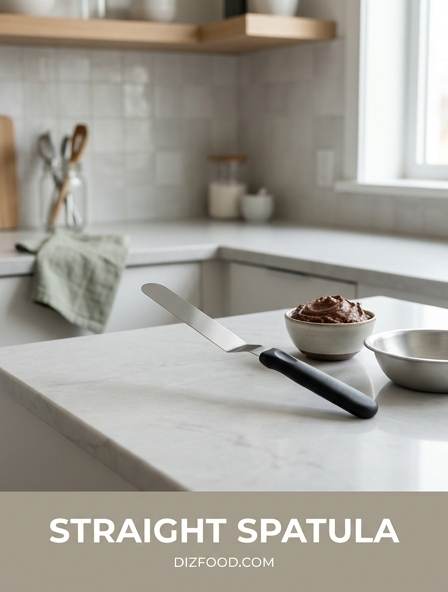
Choosing the right straight spatula
Selecting the ideal straight spatula requires balancing blade flexibility with structural integrity. Unlike offset models, the straight spatula provides a direct line of force from the handle to the tip, making it indispensable for vertical smoothing and detailed lifting. When browsing options, prioritize high-carbon stainless steel blades that offer a slight spring; the blade should bend under moderate pressure but return immediately to its original shape. A blade that is too rigid will gouge the frosting, while one that is too flimsy will fail to move denser buttercreams effectively.
Consider the handle material and ergonomics, as comfort is paramount during long decorating sessions. Slip-resistant textured plastic or classic rosewood handles offer different tactile experiences. The size of the tool should correlate with your specific project needs to ensure maximum control and efficiency:
| Blade Length | Recommended Use | Cake Diameter |
|---|---|---|
| 4 to 6 inches | Cupcakes and small details | Under 5 inches |
| 8 to 10 inches | Standard tier smoothing | 6 to 10 inches |
| 12+ inches | Large sheet cakes | 12+ inches |
Perfecting your grip and hand angle
The mastery of a straight spatula begins with an ergonomic grip that prioritizes precision over power. Rather than clutching the handle with a full fist, utilize a modified pencil grip. Place your index finger along the "spine" or the top edge of the blade near the handle junction. This positioning allows you to apply subtle pressure and feel the resistance of the frosting against the metal, providing essential sensory feedback. Your thumb and remaining fingers should stabilize the handle without squeezing tightly.
The angle at which the blade meets the cake surface determines the final texture. For spreading frosting, a 45-degree angle is generally preferred to move the medium forward. However, for smoothing, the angle must decrease significantly. Follow these steps to refine your positioning:
- Hold the spatula parallel to the cake surface for smoothing.
- Keep your wrist locked and move from the elbow or shoulder to maintain a consistent line.
- Ensure the blade is tilted slightly away from the direction of travel to prevent the leading edge from digging in.
- Keep your shoulder relaxed to avoid jerky, uneven movements.
Preparing the base with a crumb coat
A straight spatula is the primary tool for executing a flawless crumb coat, which serves as the foundational "primer" for any professional cake. This initial thin layer of frosting acts as a sealant, trapping loose cake particles and preventing them from migrating into the final decorative layer. To begin, apply a small dollop of frosting to the center of the top layer and work it toward the edges. The straight blade is particularly effective here because its flat profile allows you to scrape away excess icing until the cake layers are nearly visible through the translucent coating.
The crumb coat also serves to fill in gaps between layers and level out any imperfections in the cake's structure. After applying the frosting to the top, use the vertical length of the straight spatula to coat the sides. Focus on creating a relatively level surface rather than achieving aesthetic perfection. Once the cake is fully encased, it must be refrigerated for at least 20 to 30 minutes. This chilling process firms the buttercream, creating a stable, chilled canvas that makes the application of the final thick layer of frosting significantly easier and cleaner.
Loading the spatula for even distribution
Efficient frosting begins with how you transfer the medium from the bowl to the cake. Improper loading often introduces air bubbles or leads to uneven patches that are difficult to correct later. When using a straight spatula, aim to load frosting primarily on one side of the blade. Swipe the underside of the spatula against the edge of your mixing bowl to ensure the "back" of the tool remains clean. This prevents accidental smears and allows you to use the clean side to smooth areas without adding more volume.
To ensure even distribution across the cake, follow this systematic approach:
- Pick up a golf-ball-sized amount of frosting on the tip and mid-section of the blade.
- Deposit the frosting in the center of the cake and push outward toward the edges.
- For the sides, hold the spatula vertically and "dot" the frosting at regular intervals around the perimeter.
- Use long, sweeping motions to connect these dots, ensuring the blade remains in constant contact with the cake surface.
By loading the spatula consistently, you minimize the need to return to the bowl, reducing the risk of introducing crumbs into your main frosting supply.
Techniques for applying smooth side frosting
Achieving a professional finish on the sides of a cake requires the synchronized movement of the straight spatula and a revolving turntable. Start by applying a generous amount of frosting to the sides, ensuring the layer is thicker than the desired final result. Hold the straight spatula vertically, perfectly perpendicular to the cake board. The key is to keep the tool stationary while the turntable does the work. Place the blade against the frosting at a shallow angle, roughly 15 to 30 degrees, and begin rotating the stand slowly and steadily.
As the cake turns, the spatula will naturally distribute the frosting and scrape away any excess. It is vital to maintain a light touch; pushing too hard will strip the frosting down to the crumb coat. After one full rotation, stop and wipe the blade completely clean. A dirty spatula will leave streaks and drag marks. Repeat the rotation, focusing on maintaining a consistent distance between the blade and the cake center. This process relies on the straightness of the blade to ensure the cake sides remain plumb and do not taper inward or outward as you work.
Achieving flat sides with consistent pressure
Consistent pressure is the most difficult skill to master when using a straight spatula. The goal is to apply enough force to smooth the surface without deforming the cake or creating "valleys" in the frosting. To achieve this, your arm should act as a mechanical guide. Fix your elbow against your hip or the edge of the table to provide a steady anchor point. This stabilization prevents the common mistake of tilting the spatula at the top or bottom, which results in a conical cake shape rather than a perfect cylinder.
Use the following pressure guidelines for different stages of the process:
- Initial Application: Firm pressure to adhere the frosting to the crumb coat and remove air.
- Leveling: Moderate pressure to move bulk frosting and fill in low spots.
- Final Smoothing: Light, "feather-like" pressure to remove fine lines and create a polished sheen.
If you notice the spatula is skipping or "chattering" against the surface, it usually indicates that you are moving too fast or the frosting has become too cold. Slow down the rotation and ensure the blade is clean and slightly warm to facilitate a smoother glide.
Mastering the vertical stroke motion
While the horizontal rotation method is standard for smoothing, the vertical stroke motion is essential for finishing and specialized textures. This technique involves moving the straight spatula from the base of the cake upward toward the top edge in a single, fluid motion. It is particularly useful for clearing the "lip" of frosting that builds up at the top of the side walls. To execute this correctly, place the tip of the spatula at the bottom of the cake and gently pull upward. As you reach the top edge, flick the spatula slightly inward toward the center of the cake.
This motion serves two purposes: it ensures the frosting is flush with the cake board and it prepares the top edge for final sharpening. Vertical strokes can also be used to create decorative textures, such as rustic ridges or a "bark" effect. When performing these strokes, ensure the blade is cleaned after every single pass. Even a tiny amount of dried buttercream on the spatula will ruin the clean line of the next stroke. Mastery of the vertical motion allows a decorator to manipulate frosting in three dimensions, providing more control over the final silhouette of the dessert.
Correcting bubbles and uneven patches
Even with meticulous technique, air bubbles and uneven patches can appear in the final coat of frosting. These are often caused by air trapped during the mixing process or by a spatula that was not fully loaded. To fix a bubble, use the tip of the straight spatula to gently pop it, then fill the resulting void with a small amount of fresh frosting. Do not attempt to simply smooth over a bubble, as the air will likely remain trapped and expand. Once the gap is filled, use a warm, clean spatula to blend the area into the surrounding surface.
Uneven patches or "low spots" are best identified by looking at the cake at eye level while rotating the turntable. Areas where the blade does not touch the frosting are low spots. To correct these, follow this procedure:
- Apply a small dab of frosting specifically to the indentation.
- Sweep the straight spatula over the area to level the new frosting.
- Dip the spatula in hot water and wipe it dry to create a "warm blade" effect.
- Perform one final, light pass over the corrected area to melt the fats in the buttercream for a seamless finish.
Creating crisp top edges and corners
The hallmark of a professional cake is a sharp, clean top edge where the sides and the top meet at a crisp 90-degree angle. This is achieved through a technique known as "sweeping." After smoothing the sides, you will notice a ridge of frosting extending above the top plane of the cake. Hold your straight spatula horizontally, almost flat against the top of the cake. Starting from the outer edge, pull the spatula toward the center in one smooth, confident stroke. The goal is to "mow down" the standing ridge and blend it into the top surface.
The angle of the blade is critical here; if the blade is tilted too far down, you will gouge the top of the cake. If it is too high, you won't catch the ridge. Aim for a 5-to-10-degree lift on the leading edge. Crucially, you must wipe the spatula clean after every single sweep. If you carry frosting back to the edge on the next stroke, you will create a messy "overhang" rather than a sharp corner. For the sharpest possible results, chill the cake for ten minutes before the final sweep to give the frosting more structural resistance.
Essential maintenance for stainless steel tools
A high-quality stainless steel straight spatula can last a lifetime if maintained with care. Stainless steel is resistant to rust, but it is not impervious; prolonged exposure to acidic ingredients or harsh detergents can lead to pitting or discoloration. Always hand wash your spatulas in warm, soapy water immediately after use. Avoid the dishwasher, as the high heat and abrasive chemicals can weaken the bond between the blade and the handle, and may dull the polished surface of the metal. If the blade develops a "film" from butter-heavy frostings, a quick wipe with white vinegar will restore its shine.
Proper storage is equally important for maintaining a straight edge. If the blade becomes nicked or bent, it will leave visible tracks in your frosting. Follow these maintenance tips:
- Dry the tool thoroughly with a lint-free cloth to prevent water spots.
- Store spatulas in a dedicated tool roll or on a magnetic strip to prevent them from clashing with other utensils.
- Check the handle for cracks; for wooden handles, apply food-grade mineral oil occasionally to prevent drying.
- Inspect the blade edge for smoothness; if minor nicks occur, they can often be buffed out with a fine-grit honing stone.

Comments