
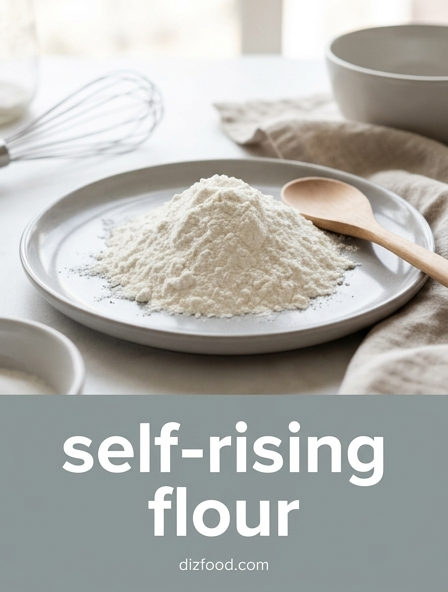
Understanding Self-Rising Flour Basics
Self-rising flour is a fundamental pantry staple designed to simplify the baking process by incorporating leavening agents directly into the flour itself. Originally patented in the mid-19th century to help sailors prepare fresh bread at sea, it has since become a cornerstone of Southern American cuisine and British baking. The product is typically milled from soft wheat, which possesses a lower protein content compared to the hard wheat used in all-purpose or bread flours. This lower protein level ensures a tender, delicate crumb in finished baked goods.
The standard composition of self-rising flour includes three specific ingredients mixed in precise proportions to ensure uniformity. Using this pre-mixed flour eliminates the need for manual measuring of salt and baking powder, which reduces the margin for error in fast-paced kitchen environments. To identify high-quality self-rising flour, look for the following components:
- Fine-milled soft wheat flour for a light texture.
- Chemical leavening agents, usually baking powder.
- A specific amount of fine salt to enhance flavor and control fermentation.
- Consistency in particle size to prevent clumping during the sifting process.
The Science Behind the Lift
The functionality of self-rising flour relies heavily on chemical reactions triggered by moisture and heat. Unlike yeast-based breads that require biological fermentation over several hours, self-rising flour utilizes a combination of an alkaline component and an acidic component found within baking powder. When a liquid, such as buttermilk or water, is introduced to the flour, the acid and base react to produce carbon dioxide gas. These gas bubbles become trapped within the gluten network formed during mixing, causing the batter or dough to expand rapidly.
Temperature plays a secondary but vital role in this scientific process. While the initial reaction begins at room temperature upon hydration, a second burst of carbon dioxide is often released when the dough enters the hot oven. This "oven spring" is essential for achieving the height and airy structure associated with high-quality biscuits and pancakes. Because the leavening is distributed evenly throughout the flour during the manufacturing process, the resulting lift is far more consistent than what many amateur bakers achieve when mixing individual ingredients by hand. This chemical precision ensures that every square inch of the baked good rises at the same rate.
Streamlining Your Quick Bread Recipes
Efficiency in the kitchen is often the primary reason bakers reach for self-rising flour. By using a pre-blended product, you effectively skip the steps of locating, measuring, and whisking together multiple dry ingredients. This streamlining is particularly beneficial for "quick breads," a category of baked goods that do not require kneading or rising time before hitting the oven. Because the salt and leavening are already homogenized, the risk of encountering a clump of baking powder or an overly salty bite is virtually eliminated.
To maximize the efficiency of your baking sessions when using this flour, consider the following workflow improvements:
- Measure the flour by weight rather than volume to ensure the leavener-to-flour ratio remains exact.
- Sift the flour once to aerate it, which helps the chemical leaveners react more quickly.
- Prepare your liquid ingredients and fats before adding them to the flour to minimize the time between hydration and baking.
- Use cold fats, such as butter or lard, to create steam pockets that work in tandem with the chemical lift.
Key Benefits of Using Self-Rising Flour
One of the most significant advantages of self-rising flour is its ability to produce a consistently soft and tender texture. Because it is derived from soft wheat, it naturally develops less gluten than all-purpose flour. This makes it the ideal choice for recipes where a "tough" or "chewy" result would be undesirable. Additionally, the convenience factor cannot be overstated; it reduces the number of containers on your counter and speeds up the cleanup process after baking is complete.
Beyond convenience, there are several practical benefits to keeping this flour in your kitchen rotation:
- Reliability: Manufacturers calibrate the leavening strength to be perfect for standard home ovens.
- Cost-effectiveness: Purchasing a single bag of self-rising flour is often cheaper than buying high-quality baking powder and salt separately.
- Reduced Error: Beginners are less likely to forget the salt or confuse baking soda with baking powder.
- Versatility: It serves as an excellent base for batters, such as those used for fried chicken or fish.
Perfecting Texture in Homemade Loaves
Achieving the perfect crumb in a homemade loaf of bread requires a balance between structure and tenderness. When using self-rising flour, the goal is often a "cake-like" or "biscuit-like" interior rather than the elastic, chewy texture found in sourdough or baguettes. To perfect this texture, the baker must be mindful of the moisture content. Because the flour is low in protein, it does not absorb water as aggressively as bread flour. Over-hydrating the dough can lead to a gummy center, while under-hydrating can result in a crumbly, dry loaf.
Another factor in texture is the interaction with fats. Incorporating ingredients like sour cream, whole milk, or butter can coat the flour particles, further inhibiting gluten development and ensuring the loaf remains moist. It is also important to avoid over-handling the dough. Since the leavening reaction starts immediately, excessive manipulation will crush the delicate air bubbles being formed. For the best results, fold your ingredients together until just combined, allowing the chemical leaveners to do the heavy lifting during the baking phase.
Essential Tips for Mixing Quick Batter
Mixing is the most critical stage when working with self-rising flour. Unlike yeast doughs that thrive on vigorous kneading, quick batters made with self-rising flour require a gentle touch. The moment the dry flour meets the liquid, the chemical leaveners begin to activate. If you stir the batter too much, you will deflate the carbon dioxide bubbles and overwork the small amount of gluten present, leading to a flat, dense, and tough final product. The "muffin method" is usually the best approach: mix the dry and wet ingredients separately, then combine them quickly.
Consider these essential tips to ensure your mixing technique preserves the integrity of the flour:
- Use a large spatula or a dough whisk to fold ingredients rather than a high-speed electric mixer.
- Stop mixing as soon as no large streaks of dry flour remain; small lumps are perfectly acceptable.
- Work in small batches to ensure the batter doesn't sit for too long before entering the oven.
- Ensure your liquid ingredients are at the temperature specified in the recipe to control the rate of the chemical reaction.
Comparing All-Purpose and Self-Rising Flour
While they may look identical in the bag, all-purpose and self-rising flours serve very different roles in the kitchen. All-purpose flour is a blank slate, providing a medium protein content (usually 10-12%) and no added leavening. This makes it versatile for everything from cookies to bread, but it requires the baker to calculate and add their own rising agents. In contrast, self-rising flour is a specialized tool with a lower protein content (8-9%) and built-in leaveners, making it less suitable for items that require a strong structure, like pizza dough.
| Feature | All-Purpose Flour | Self-Rising Flour |
|---|---|---|
| Protein Content | 10% - 12% | 8% - 9.5% |
| Leavening Agents | None | Baking Powder Included |
| Salt | None | Included |
| Best Use | Cookies, Yeast Breads | Biscuits, Scones, Pancakes |
Choosing the wrong flour can significantly impact the outcome of a recipe, so always check the label before starting.
Easy Substitution Ratios for Bakers
There are times when a recipe calls for self-rising flour, but you only have all-purpose flour on hand. Conversely, you might want to use self-rising flour in a recipe that calls for plain flour. Understanding the ratios is key to a successful substitution. To create a homemade version of self-rising flour, you must add both a rising agent and a seasoning to mimic the commercial blend. While it won't have the exact low-protein profile of professional self-rising flour, it will function similarly in terms of lift and flavor.
To make one cup of DIY self-rising flour, follow this standard ratio:
- 1 cup of All-Purpose Flour (levelled).
- 1 1/2 teaspoons of Baking Powder (ensure it is fresh).
- 1/4 to 1/2 teaspoon of Fine Sea Salt.
- Whisk or sift the ingredients together at least three times to ensure even distribution.
If you are substituting self-rising flour for all-purpose in a recipe, you must omit the baking powder and salt called for in the original instructions. However, be cautious when substituting in recipes that require baking soda, as the acidity levels may differ.
Achieving Consistent Results with Leavening
The primary challenge with self-rising flour is that the leavening agent loses its potency over time. Baking powder is sensitive to moisture and heat, meaning that an old bag of flour may not provide the "oomph" needed to lift your biscuits. To achieve consistent results, always check the "best by" date on the packaging. Unlike plain flour, which can remain usable for a long time if kept dry, self-rising flour has a definitive shelf life dictated by its chemical components. If your baked goods are coming out flat or heavy, the flour's leavening power has likely expired.
Another factor for consistency is altitude. Bakers at high altitudes may find that the pre-measured amount of baking powder in self-rising flour causes dough to rise too quickly and then collapse. In these cases, you might need to "dilute" the self-rising flour with a bit of all-purpose flour to reduce the concentration of leavener. Conversely, always ensure your oven is fully preheated before your batter is ready. If the dough sits on the counter while the oven warms up, the initial chemical reaction will exhaust itself, leaving no gas for the crucial oven spring.
Storage Tips for Fresh Self-Rising Flour
Proper storage is essential for maintaining the chemical integrity of self-rising flour. Because it contains baking powder, it is more susceptible to spoilage and loss of function than other flour types. Exposure to humidity is the greatest threat; moisture in the air can trigger the acid-base reaction inside the bag before you even start baking, effectively "killing" the leavening power. To prevent this, never store your flour in the paper bag it came in once it has been opened. Instead, transfer it to a high-quality container that offers a complete seal.
Follow these guidelines to keep your flour fresh for as long as possible:
- Use an airtight plastic or glass container to block out ambient moisture.
- Store the container in a cool, dark place, such as a pantry or a low cabinet away from the stove.
- Label the container with the original "best by" date from the packaging.
- For long-term storage in humid climates, consider keeping the flour in the refrigerator, provided it is in a moisture-proof container.
- Avoid mixing old flour with new flour to ensure the leavening strength remains predictable.



Comments