
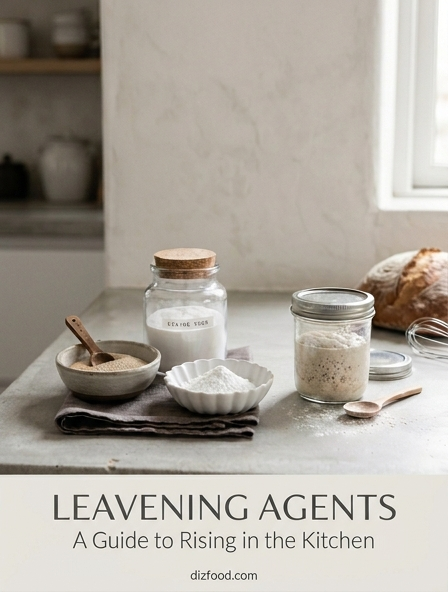
Understanding Biological Leavening and Yeast Fermentation
Biological leavening relies on living organisms, primarily Saccharomyces cerevisiae, commonly known as baker's yeast. This microscopic fungus consumes simple sugars present in the dough, converting them into carbon dioxide gas and ethanol through anaerobic respiration. As the yeast metabolizes the carbohydrates, the released gas becomes trapped within the dough's protein matrix, causing the mixture to expand and rise. This process is not instantaneous; it requires specific conditions to thrive, including moisture, warmth, and time.
- Fresh Yeast: High moisture content, requires refrigeration, and must be dissolved in liquid.
- Active Dry Yeast: Dormant granules that need "blooming" in warm water before use.
- Instant Yeast: Smaller particles that can be mixed directly into dry ingredients.
The fermentation period also contributes significantly to the flavor profile of the bread. Beyond gas production, yeast enzymes break down complex starches into simpler sugars and organic acids, resulting in the characteristic yeasty aroma and tangy notes found in sourdough or long-fermented loaves. Managing fermentation time is crucial for balancing gas volume and flavor development.
Chemical Reactions of Baking Soda and Acids
Baking soda, or sodium bicarbonate, is a powerful base that requires an acidic partner to trigger a leavening reaction. When these two components meet in the presence of moisture, they undergo a chemical neutralization that rapidly releases carbon dioxide gas. Unlike biological leavening, this reaction begins the moment the ingredients are combined, necessitating a quick transition to the oven to prevent the gas from escaping before the structure is set.
| Acidic Ingredient | Primary Active Acid | Effect on Crumb |
|---|---|---|
| Buttermilk | Lactic Acid | Tender, moist texture |
| Lemon Juice | Citric Acid | Tight, bright crumb |
| Molasses | Organic Acids | Dense, chewy profile |
Beyond aeration, baking soda influences the browning of the crust. By raising the pH level of the batter, it accelerates the Maillard reaction, leading to a deeper golden-brown color. However, an excess of baking soda without sufficient acid results in a soapy, metallic aftertaste and an unappealing yellowish hue in the final crumb.
Single Versus Double Acting Baking Powders
Baking powder is a complete leavening system containing both an alkaline base and a dry acid, usually stabilized with cornstarch. The primary distinction between varieties lies in the timing of their gas release. Single-acting baking powders react entirely upon contact with moisture. These are less common in modern retail but are still used in specific commercial applications where immediate gas production is required. In contrast, double-acting baking powder is the standard for home bakers due to its phased reaction.
- First Action: Occurs at room temperature when the powder is mixed into wet batter.
- Second Action: Triggered by the high heat of the oven, typically above 140°F.
The second stage is facilitated by heat-activated acids like sodium aluminum sulfate. This dual-phase approach provides a safety net for bakers; if the batter sits on the counter for a few minutes, the second burst of gas in the oven ensures the product still achieves the desired volume. Understanding this delay allows for more flexible kitchen workflows without sacrificing the height or lightness of cakes and muffins.
The Physics of Steam and Air Incorporation
Physical leavening utilizes mechanical energy and phase changes rather than chemical or biological agents. Air is incorporated into batters through techniques such as creaming butter with sugar or whisking egg whites into a foam. These tiny air pockets act as "seeds" for expansion. Steam leavening occurs when water within the dough reaches its boiling point and transitions into vapor. Since water expands approximately 1,600 times its volume when turning to steam, this process generates immense internal pressure.
- Creaming: Sharp sugar crystals cut into fat, creating millions of microscopic air voids.
- Whisking: Protein denaturation in eggs traps air, forming a stable, lightweight lattice.
- Lamination: Layers of fat separate dough sheets; heat turns water in the fat to steam, pushing layers apart.
In items like puff pastry or popovers, steam is the primary leavening force. The rapid evaporation of moisture, combined with a high initial oven temperature, forces the dough to inflate rapidly before the proteins coagulate and lock the structure in its expanded state.
How pH Balance Influences Dough Rise
The acidity or alkalinity of a dough significantly impacts the behavior of leavening agents and the physical properties of the final product. pH levels dictate the rate at which chemical leaveners react and influence the strength of the gluten network. An acidic environment generally speeds up the reaction of baking soda but can also weaken the gluten, leading to a more tender and delicate crumb. Conversely, a more alkaline environment can strengthen gluten but may result in a coarse texture if not balanced.
- High Acidity (Low pH): Results in faster CO2 release and a lighter crust color.
- High Alkalinity (High pH): Encourages deeper browning and can produce a crispier exterior.
Bakers often use pH-adjusting ingredients to fine-tune the "oven spring." For instance, adding cream of tartar (an acid) to egg whites stabilizes the protein foam by lowering the pH, which prevents the proteins from over-bonding and collapsing. Achieving the perfect balance ensures that the leavening agent is fully neutralized, preventing off-flavors while optimizing the structural integrity and aesthetic appeal of the baked good.
Temperature Control for Optimal Gas Expansion
Temperature is a critical variable that governs the kinetic energy of gas molecules and the metabolic rate of yeast. In biological leavening, yeast activity follows a bell curve; it is sluggish at cold temperatures, peaks between 75°F and 95°F, and ceases entirely above 140°F. Managing the "desired dough temperature" is essential for consistent results. Cold fermentation in the refrigerator slows down gas production, allowing for superior flavor development and a more controlled, even rise.
| Temperature Range | Effect on Leavening |
|---|---|
| 35°F - 45°F | Retarded fermentation; flavor development |
| 75°F - 95°F | Optimal yeast activity and gas volume |
| 105°F - 115°F | Rapid growth; risk of off-flavors |
| 140°F+ | Thermal death point; yeast is inactivated |
When the dough enters the oven, it undergoes "oven spring." This is a final burst of expansion where the existing gas bubbles heat up and expand according to Charles's Law. If the oven is too cool, the gas won't expand enough before the crumb sets; if it is too hot, the crust may harden too early, trapping the gas and causing internal ruptures.
Microscopic View of Carbon Dioxide Bubbles
On a microscopic level, leavening is the art of creating and managing gas cells within a viscous fluid. Leavening agents do not actually create new bubbles; instead, they release gas into pre-existing nucleation sites formed during mixing. The efficiency of a leavener depends on its ability to diffuse carbon dioxide into these tiny pockets. Surface tension plays a major role here; surfactants like fats or egg yolks can help stabilize these bubble walls, preventing them from merging into larger, uneven gaps.
- Nucleation: The initial formation of air pockets during the mixing of dry and wet ingredients.
- Coalescence: The undesirable merging of small bubbles into large ones, leading to coarse texture.
- Diffusion: The movement of CO2 from the aqueous phase into the air pockets.
As the temperature rises, the pressure inside these microscopic cells increases. The surrounding batter must be elastic enough to stretch without breaking, yet strong enough to eventually solidify. If the bubble walls are too weak, the gas escapes and the cake collapses. If they are too rigid, the gas cannot expand, resulting in a dense and heavy product.
Gluten Strength and Gas Retention Mechanics
Leavening is useless without a mechanism to trap the produced gas. In bread making, this role is filled by gluten, a protein complex formed by gliadin and glutenin. When flour is hydrated and kneaded, these proteins link together to create a stretchy, waterproof membrane. This network acts much like a series of interconnected balloons. The strength and elasticity of the gluten determine how much gas the dough can hold without the bubbles bursting and the gas leaking out.
- Hydration: Water allows proteins to move and bond.
- Development: Kneading aligns protein strands into a cohesive web.
- Relaxation: Rest periods allow the network to expand without snapping.
The balance between extensibility (the ability to stretch) and elasticity (the ability to bounce back) is key. In cakes, where gluten development is discouraged to maintain tenderness, egg proteins and starches take over the burden of gas retention. Without a proper structural framework, the carbon dioxide produced by chemical or biological agents would simply bubble to the surface and escape into the atmosphere.
Common Leavening Failures and Fixes
Most baking disappointments can be traced back to a failure in the leavening process. The most common culprit is expired chemical agents. Baking powder and soda lose their potency over time when exposed to humidity. To test baking powder, drop a teaspoon into hot water; it should bubble vigorously. For baking soda, use vinegar. Another frequent issue is over-mixing, which can either deflate incorporated air or over-develop gluten, making the walls too tough for the gas to push against.
| Problem | Likely Cause | Solution |
|---|---|---|
| Sunken Center | Too much leavener | Measure accurately; reduce by 10% |
| Dense/Heavy | Expired yeast/soda | Perform a potency test before mixing |
| Coarse Crumbs | Uneven mixing | Sift dry ingredients together thoroughly |
Altitude also plays a significant role. At higher elevations, air pressure is lower, meaning gases expand more rapidly. This can cause dough to rise too fast and collapse. Bakers at high altitudes often need to reduce the amount of leavening agent and increase the baking temperature to set the structure more quickly.
Essential Chemistry for Perfect Crumb Texture
The final "crumb" of a baked good is the solidified result of the leavening journey. This texture is defined by the size, distribution, and wall thickness of the gas cells. The chemistry involves a delicate handoff from the gas-producing agents to the structural components: starch and protein. As the internal temperature reaches approximately 180°F, starches undergo gelatinization, absorbing moisture and setting into a firm structure that permanently replaces the temporary gas bubbles.
- Fine Crumb: Characterized by many small, uniform bubbles (typical of pound cake).
- Open Crumb: Characterized by large, irregular holes (typical of artisan sourdough).
Achieving the perfect crumb requires precise control over the ratio of leaveners to flour and moisture. Too much gas creates a fragile structure that crumbles easily, while too little gas results in a gummy, dense interior. Fat also interacts with this chemistry by coating flour proteins and limiting gluten formation, which results in a shorter, more tender crumb. By mastering these chemical interactions, a baker can manipulate the sensory experience of every bite, from the airy snap of a cracker to the pillowy softness of a brioche.

Comments