
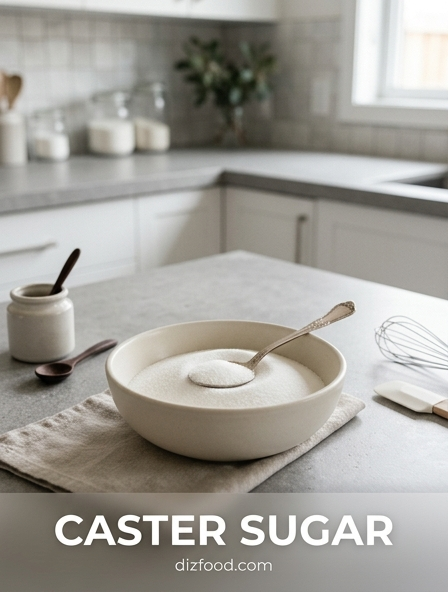
The Science of Fine Granule Aeration
Caster sugar, often referred to as superfine sugar, occupies a critical middle ground between granulated and powdered varieties. Its primary scientific advantage in the kitchen lies in the physical geometry of its crystals. These fine granules possess sharp, jagged edges that act as mechanical leavening agents when beaten with solid fats. In the initial stages of baking, these crystals carve thousands of microscopic voids into the butter or shortening. This physical abrasion is more effective with caster sugar because its smaller size allows for a higher number of crystals per gram compared to standard granulated sugar.
The resulting density of air pockets is significantly higher, providing a foundation for a light and airy texture. As the temperature rises in the oven, these tiny air cells expand, and the carbon dioxide produced by chemical leaveners migrates into these pre-existing voids. Without the efficient aeration provided by fine sugar granules, the gas would struggle to find space, leading to a dense and poorly risen product. This mechanical interaction is the cornerstone of successful sponge and butter cake production.
Maximizing Air Cell Formation During Creaming
The creaming process is the most vital stage for introducing air into a batter, and the choice of sugar directly dictates the success of this phase. Caster sugar is uniquely suited for this task due to its ability to integrate rapidly without weighing down the fat matrix. When utilizing caster sugar for creaming, several specific physical transformations occur that enhance the final quality of the bake:
- Increased Surface Area: More crystals are available to interact with the fat, creating a finer network of air bubbles.
- Lighter Color: Proper aeration via fine granules reflects more light, causing the butter-sugar mixture to turn a pale ivory color.
- Structural Stability: The air cells created are smaller and more numerous, which are less likely to collapse during the addition of eggs and flour.
- Reduced Friction Heat: Smaller granules dissolve faster, reducing the risk of overheating the fat through over-mixing.
By maximizing the formation of these air cells, the baker ensures that the crumb remains tender. The fine crystals ensure that the "foam" created during creaming is robust enough to support the weight of the dry ingredients, leading to superior lift and volume.
Caster Sugar vs Granulated Sugar Performance
While both sugars are chemically identical sucrose, their performance in the kitchen varies significantly due to particle size. Granulated sugar, with its larger crystals, is often too heavy and abrasive for delicate batters. It can lead to an uneven rise and a speckled appearance on the crust. In contrast, caster sugar offers a more refined performance that is essential for professional-grade pastry. The following table highlights the key differences in their functional performance:
| Performance Metric | Caster Sugar | Granulated Sugar |
|---|---|---|
| Dissolution Speed | Rapid and uniform | Slow; may remain gritty |
| Aeration Quality | Fine, stable micro-bubbles | Large, irregular air pockets |
| Crust Texture | Smooth, thin, and crisp | Crunchy and often pitted |
| Final Volume | Maximum expansion | Moderate expansion |
The switch to caster sugar is particularly noticeable in recipes with high fat-to-sugar ratios, where the ability to dissolve into the moisture of the fat is paramount for a smooth emulsion.
Achieving a Uniform and Delicate Crumb Structure
The aesthetic and sensory quality of a cake is often judged by its crumb structure. A "fine crumb" is characterized by small, even holes and a soft, velvety texture that dissolves easily on the tongue. Caster sugar is the primary tool used to achieve this professional finish. Because the granules are so small, they distribute themselves evenly throughout the batter, preventing the formation of large "tunnels" or uneven gaps.
When coarser sugar is used, the large crystals can sink or clump, creating localized areas of high sugar concentration. These areas liquefy during baking and can cause the surrounding structure to collapse or become gummy. Caster sugar, however, dissolves almost instantly into the liquid components of the batter. This rapid integration ensures that the sugar's hygroscopic properties are applied uniformly, drawing moisture into every part of the crumb. This leads to a consistent resistance when the cake is sliced and a professional appearance that is free from the irregular voids typically found in rustic or amateur bakes. The uniformity provided by caster sugar is essential for cakes that require precision, such as petit fours or layered gateaux.
The Impact of Rapid Dissolution on Batter Stability
Batter stability is a measure of how well a mixture retains its air and structure before it sets in the oven. One of the greatest risks to stability is over-mixing, which often occurs when a baker tries to eliminate the grittiness of undissolved sugar. Caster sugar's rapid dissolution significantly reduces the required mixing time. This is beneficial because it prevents the over-development of gluten in the flour, which would otherwise result in a tough, bread-like texture.
The stability of the batter is also enhanced by the sugar's immediate interaction with the liquid ingredients. As caster sugar dissolves, it increases the viscosity of the aqueous phase of the batter. This thicker liquid is better at holding the suspended air bubbles in place, preventing them from floating to the surface and escaping. In delicate mixtures like soufflés or meringues, this rapid dissolution is even more critical. The sugar must bond with the egg white proteins quickly to provide the necessary tension to hold the foam. If the crystals remain whole for too long, they act as physical weights that can pop the delicate bubbles, leading to a loss of volume and a runny consistency.
Structural Integrity in Professional Sponge Cakes
Professional sponge cakes, such as Genoise or Victoria sponges, require a balance between lightness and structural strength. Caster sugar is the ingredient that bridges this gap. In sponge production, eggs are often whisked with sugar to create a voluminous foam. The fine crystals of caster sugar dissolve into the egg proteins, creating a stable film that coats each air bubble. This film is remarkably strong; it protects the air pockets from the weight of the flour that is folded in later.
If granulated sugar were used, the heavy crystals would sink to the bottom of the bowl, dragging the air bubbles down and deflating the foam. Furthermore, the quick-dissolving nature of caster sugar ensures that the sugar is fully integrated before the cake enters the oven. This prevents the "weeping" effect, where undissolved sugar draws moisture out of the baked structure, causing it to become sticky or collapse upon cooling. By ensuring the proteins are properly supported and the moisture is evenly bound, caster sugar provides the structural integrity needed for cakes that must be sliced, filled, or stacked without crumbling or losing their shape.
Optimizing Texture with Superfine Sugar Crystals
Texture is a multi-sensory experience, involving both the initial bite and the way a food item breaks down during mastication. Superfine sugar crystals optimize this experience by refining the "mouthfeel" of baked goods. In shortbread and biscuits, the use of caster sugar results in a delicate "snap" followed by a melting sensation, rather than a hard, sandy crunch. This is achieved because the fine granules leave behind much smaller voids after they melt during baking.
- Melting Sensation: Smaller voids allow the fats and starches to collapse more readily on the tongue.
- Edge Definition: Fine sugar allows doughs to hold sharp, intricate shapes during baking without spreading excessively.
- Surface Finish: It creates a thin, crackled "meringue" style crust on brownies and chewy cookies.
- Reduced Grittiness: Ensures that fillings, such as buttercream or ganache, remain perfectly smooth without a sandy texture.
By controlling the size of the crystals, the baker can manipulate the final density and crunch of the product, moving away from coarse, home-style textures toward a more refined, professional finish that emphasizes delicacy and smoothness.
Enhancing Moisture Retention and Softness
Sugar is a powerful humectant, meaning it has a natural affinity for water. Caster sugar's increased surface area compared to granulated sugar allows it to bind with water molecules more effectively and rapidly. This characteristic is vital for enhancing the softness and shelf life of baked goods. When sugar is thoroughly dissolved and distributed, it holds onto moisture during the baking process, preventing the cake from drying out even at high temperatures.
This moisture retention is particularly important in low-fat recipes, where there is less oil or butter to provide the sensation of moistness. The sugar acts as a softening agent by interfering with the bonding of flour proteins and the crystallization of starches. Because caster sugar dissolves so completely, it creates a uniform syrup within the batter that coats the starch granules. This inhibits the starches from taking up too much water and becoming rigid, which keeps the cake soft for a longer period. As a result, products made with caster sugar tend to stay fresh and tender for several days longer than those made with coarser sugars, which may suffer from localized dry spots and faster staling.
The Role of Sugar in Volumetric Expansion
Volumetric expansion refers to the increase in size that a batter undergoes in the heat of the oven. Caster sugar contributes to this growth in two distinct ways. First, it ensures the presence of a vast number of microscopic air cells created during the mixing stage. These cells act as the "seeds" for expansion; as the air and moisture inside them heat up, they push against the surrounding batter, causing it to rise.
Second, sugar influences the temperature at which the cake's structure sets. It raises the temperature of starch gelatinization and protein coagulation. By delaying the "set point" of the cake, caster sugar allows the gases more time to expand before the structure becomes rigid. Because caster sugar is so well-distributed and dissolved, this delay happens uniformly across the entire cake. This leads to a higher, more even rise without the risk of the cake "crowning" or cracking in the center. The result is a lighter, more voluminous cake that maximizes the potential of the ingredients used. This controlled expansion is a hallmark of professional baking, where height and airy texture are highly prized benchmarks of quality.
Professional Standards for Light and Airy Results
In the world of professional pastry, consistency is the ultimate goal. Caster sugar is the industry standard because it removes the variables of dissolution and aeration that can plague recipes using granulated sugar. High-end patisseries rely on the predictable nature of superfine crystals to ensure that every batch of sponge, meringue, or biscuit meets strict quality standards. To achieve these results, professionals follow specific guidelines regarding sugar integration:
- Sifting: Always sift caster sugar to remove any clumps that may have formed due to humidity.
- Temperature: Ensure fats are at the correct temperature to allow the fine granules to carve air pockets effectively.
- Timing: Add caster sugar gradually to egg foams to allow for immediate dissolution and protein stabilization.
By adhering to these standards, chefs can consistently produce items with a superior lift and a delicate mouthfeel. Caster sugar is not merely a sweetener but a functional tool that enables the creation of textures that are otherwise impossible to achieve. Its role in professional kitchens is fundamental to the production of high-quality, light, and airy confectionery.


Comments