
Understanding Protein Content and Gluten Inhibition
The defining characteristic of cake flour is its remarkably low protein content, typically ranging between 7% and 9%. In the hierarchy of wheat flours, this sits at the bottom, far below all-purpose and bread flours. This low protein concentration is crucial because proteins like glutenin and gliadin are the building blocks of gluten. When liquid is added to flour, these proteins bond to create a stretchy, elastic network. While elasticity is desirable in a chewy baguette, it is the enemy of a tender sponge cake.
- Reduced gluten formation leads to a more fragile, tender structure.
- Low protein levels ensure the cake remains soft rather than bready.
- Inhibition of gluten allows for a higher rise without the resistance of a tough matrix.
By utilizing flour derived from soft winter wheat, bakers can effectively inhibit excessive gluten development. This scientific approach ensures that the resulting crumb is delicate enough to melt in the mouth. Understanding this balance is the first step in mastering high-ratio cakes where tenderness is the primary objective of the final product.
The Science Behind Finely Milled Flour Particles
Cake flour undergoes a rigorous milling process that differentiates it from other varieties. It is milled to an exceptionally fine consistency, often described as silky or velvet-like to the touch. This fine granulation is achieved through multiple passes in the mill, specifically targeting the endosperm of soft wheat kernels. The smaller particle size significantly increases the total surface area of the flour. This increased surface area allows for a more rapid and uniform distribution of ingredients throughout the batter.
When flour particles are this minute, they can be distributed more evenly among fats and sugars, preventing the formation of large clumps that could mar the internal appearance of the cake. The fine milling also ensures that the starch granules are more accessible. During the baking process, these starches gelatinize more efficiently, providing the necessary structure to support the cake's volume without requiring the heavy gluten networks found in coarser flours. This precision in particle size is what gives professional cakes their signature uniform appearance and smooth mouthfeel.
Mastering Sifting Techniques for Maximum Aeration
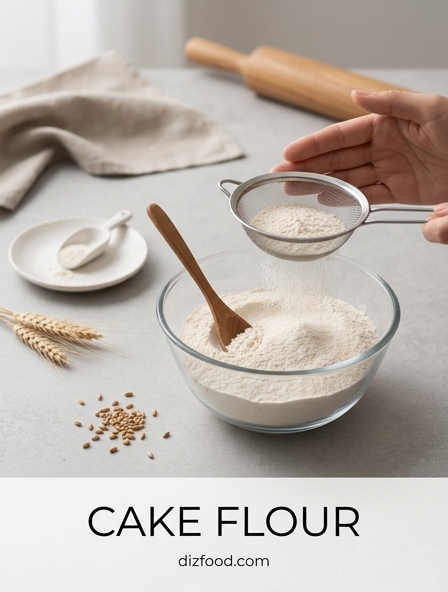
Due to its high starch content and fine milling, cake flour is notoriously prone to clumping during storage. Sifting is not merely a suggestion; it is a technical requirement for achieving the desired lightness in delicate sponges and chiffon cakes. Proper sifting aerates the flour, introducing microscopic air pockets that assist in the mechanical leavening process. This ensures that the dry ingredients integrate seamlessly into the wet components without the need for vigorous mixing.
- Sift the flour once before measuring to ensure an accurate, light weight.
- Sift again with other dry ingredients, such as baking powder and salt, to ensure uniform distribution.
- Perform a final sift directly into the mixing bowl to maintain maximum aeration just before incorporation.
Skipping this step often results in small, dry pockets of flour within the baked cake. Furthermore, aerated flour provides less resistance to the delicate air bubbles created during the creaming or foaming stages. By mastering these sifting techniques, the baker guarantees a batter that is light, voluminous, and free of textural inconsistencies.
The Role of Chlorination in Batter Stability
Most commercial cake flours undergo a specific bleaching process involving chlorine gas. Beyond simply whitening the flour, chlorination fundamentally alters the chemical behavior of the starch and proteins. This treatment slightly increases the acidity of the flour, which facilitates a faster set time in the oven. The acid environment helps the flour particles carry more weight, which is essential when working with recipes that call for high proportions of sugar and liquid relative to the flour.
Chlorination also modifies the starch granules, making them more porous. This allows the starch to absorb fats and liquids more effectively, leading to a batter that is highly stable. Without this chemical modification, the structural integrity of a high-sugar cake might fail, causing it to collapse as it cools. The stabilized starch granules swell quickly and hold their shape, ensuring that the air bubbles produced by leavening agents are trapped effectively. This process is the hidden hero behind the consistent, sky-high rise seen in professional-grade pound cakes and delicate layered sponges.
Optimizing Fat and Sugar Ratios for Tenderness
Cake flour is uniquely suited for "high-ratio" cakes, which are recipes containing a higher weight of sugar than flour. The unique properties of the flour-low protein and chlorinated starch-allow it to hold these heavy ingredients in suspension without losing structural integrity. When fat and sugar are creamed together, they create a network of air cells; cake flour supports these cells by coating them in a fine, protective layer that prevents them from merging or collapsing.
| Ingredient | Role in Cake Flour Batters |
|---|---|
| Fats | Coats proteins to further inhibit gluten and provide moisture. |
| Sugars | Interacts with fine starches to tenderize and retain hydration. |
| Fine Flour | Acts as the structural scaffold for high-weight additives. |
Balancing these ratios is a delicate science. If the sugar content is too high for the flour's protein level, the cake will be gummy. However, with the right cake flour, the crumb becomes exceptionally tender and moist, as the sugar attracts moisture and the flour provides just enough support to hold it all together.
Folding Methods to Maintain Delicate Air Cells
When working with cake flour, the method of incorporation is as important as the ingredients themselves. Folding is a gentle technique used to combine light, aerated components-like whipped egg whites or sifted flour-into a heavier base without deflating the trapped air. Because cake flour is so light, it is particularly susceptible to being overwhelmed by heavy-handed mixing. Using a wide rubber spatula, the baker must cut through the center of the mixture and lift the bottom over the top while rotating the bowl.
- Add the sifted cake flour in three separate additions to prevent weighing down the foam.
- Use a "down-across-up-and-over" motion with the spatula.
- Stop immediately once no streaks of dry flour remain to preserve the aeration.
This process protects the mechanical leavening achieved through whisking. If the air cells are crushed during this stage, the resulting cake will be dense and flat, regardless of the quality of the flour. Folding respects the fragile nature of the low-protein starch and ensures the final product remains buoyant and soft.
Liquid Absorption and Hydration of Fine Starches
The hydration capacity of cake flour is distinct from that of harder wheat flours. Due to the fine milling and the chlorination process, the starch granules in cake flour are primed for rapid liquid absorption. When milk, water, or eggs are introduced, the flour particles begin to hydrate almost instantly. This quick uptake of moisture is essential for creating a smooth, cohesive batter that flows easily into the baking pans. It also ensures that the moisture is evenly distributed, preventing "wet spots" in the crumb.
However, this high absorption rate means that the batter can thicken quickly if left to sit. Bakers must be mindful of the timing between mixing and baking. The efficient hydration also plays a role during the baking cycle; as the temperature rises, the hydrated starches gelatinize, transitioning the batter from a liquid state to a solid, velvety structure. This transition must happen at the precise moment the leavening gases have reached their peak expansion. The superior hydration of cake flour starches makes this synchronized dance possible, resulting in a perfectly set internal framework.
Preventing Toughness Through Precise Mixing Times
Even though cake flour has a low protein content, it is still possible to develop enough gluten to make a cake tough. Overmixing is the most common cause of textural failure in the kitchen. Once the flour contacts the liquid ingredients, the clock begins to tick. Precise mixing involves using the lowest speed setting on a stand mixer and only running it until the ingredients are just combined. In professional settings, this is often referred to as the "just-incorporated" stage.
Excessive agitation causes the few proteins present to align and strengthen, creating a rubbery texture that is undesirable in desserts. Furthermore, overmixing can knock out the air bubbles that provide the cake's lift. To prevent toughness, many bakers finish the final stages of mixing by hand with a whisk or spatula. This allows for greater tactile feedback and ensures that the gluten remains underdeveloped. By limiting the mixing duration, you preserve the natural tenderness of the soft wheat and ensure the cake retains its characteristic "short" crumb, which breaks apart easily and feels light on the palate.
Evaluating Crumb Structure and Internal Texture
The success of using cake flour is ultimately judged by the internal crumb structure of the finished bake. A perfect cake flour crumb is characterized by its uniformity and lack of large, irregular holes. It should appear "tight" but feel incredibly soft and compressible. This is often referred to as a velvety texture. When sliced, the cake should not crumble excessively, yet it should offer very little resistance when bitten. The pores within the cake should be small and evenly distributed, indicating a stable batter and controlled leavening.
- Uniformity: Small, consistent air cells throughout the slice.
- Elasticity: The ability to spring back slightly when touched, without being chewy.
- Mouthfeel: A smooth, melting sensation that leaves no graininess.
If the texture appears coarse or "bready," it usually indicates either the use of a higher-protein flour or improper mixing techniques. Evaluating the crumb allows a baker to troubleshoot their process, from the sifting stage to the final oven temperature. A refined crumb is the hallmark of professional pastry work and the primary reason for choosing cake flour over alternatives.
Professional Tips for Sourcing Quality Cake Flour
Not all cake flours are created equal, and sourcing the right product is vital for consistent results. Professional bakers often look for specific brands that utilize 100% soft winter wheat, as this variety provides the most reliable low-protein profile. When sourcing, it is important to check for the "bleached" or "chlorinated" label, as unbleached cake flour-while available-does not perform with the same structural stability in high-sugar recipes. Consistency in brand choice is also recommended, as protein levels can fluctuate between manufacturers.
- Check the expiration date; old flour can lose its ability to hydrate properly.
- Store in an airtight container in a cool, dry place to prevent moisture absorption.
- Avoid "self-rising" versions unless specifically called for, to maintain control over leavening agents.
In regions where cake flour is difficult to find, some attempt to mimic it by adding cornstarch to all-purpose flour. While this reduces protein, it lacks the fine milling and chlorination of true cake flour. For the best internal texture and crumb, sourcing a genuine, finely milled product remains the gold standard in the professional kitchen.

Comments