
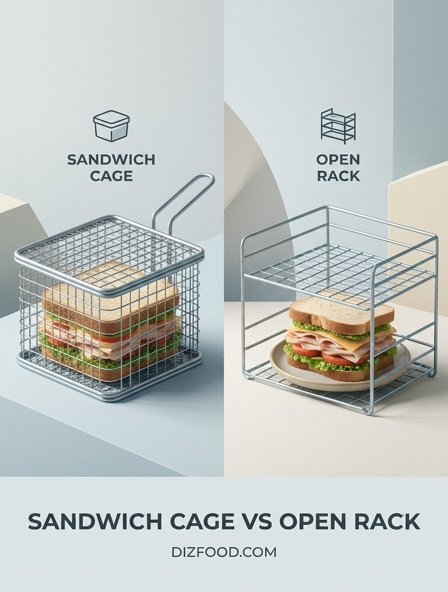
Achieving the ultimate toasted sandwich often boils down to a choice between structural security and maximum airflow. If you are a fan of overstuffed melts, the sandwich cage is your best friend, offering a pressurized "clamp" that keeps gooey fillings contained and makes retrieval from deep-slot toasters effortless. On the other hand, the open rack is the purist's choice for achieving a uniform, 360-degree crunch; by allowing heat to circulate freely around the bread without compression, it delivers a lighter, crispier texture. Whether you prioritize a mess-free experience for loaded sourdough or the airy golden finish of a classic grilled cheese, understanding the mechanical strengths of each tool is the secret to elevating your lunch game.
| Feature | Sandwich Cage | Open Rack |
|---|---|---|
| Heat Airflow | Shielded; heat focused on faces. | Maximum; 360° convection. |
| Filling Security | High; prevents "filling slide." | Low; ingredients may shift. |
| Bread Texture | Dense and compressed. | Light and airy "shatter" crunch. |
| Capacity | Limited by cage width. | Flexible for various shapes. |
| Ease of Cleaning | Simple; usually dishwasher safe. | Requires crumb tray maintenance. |
| Best Used For | Loaded melts and artisan slices. | Standard toast and pastries. |
Data Center Infrastructure Sandwich Cage vs Open Rack
In the evolving landscape of data center design, selecting the appropriate structural enclosure for hardware is a critical decision that impacts security, airflow, and spatial efficiency. The "sandwich cage" configuration-typically referring to an aisle containment system where two rows of cabinets are enclosed by a roof and end doors-represents a premium approach to infrastructure. This setup creates a dedicated, secure environment within a larger facility, often utilized in colocation spaces to provide an extra layer of physical separation. By contrast, open rack systems offer a more traditional, accessible framework that lacks peripheral walls or integrated containment ceilings.
While open racks are prized for their simplicity and low entry cost, the sandwich cage provides a robust physical barrier that is essential for multi-tenant environments. The choice between these two often hinges on the specific operational requirements of the facility. Factors such as the volume of traffic in the data hall, the sensitivity of the data being processed, and the long-term thermal management strategy play pivotal roles in this determination. Organizations must weigh the following structural characteristics:
- Floor space utilization and footprint efficiency.
- Integration with existing fire suppression and lighting systems.
- Structural integrity and weight-bearing capacity for heavy server loads.
- Aesthetic and professional presentation for client-facing facilities.
- Ease of assembly and modularity for rapid deployment.
Ultimately, the sandwich cage acts as a "room within a room," offering a controlled micro-climate and high-security perimeter, whereas the open rack serves as a versatile, low-profile skeletal structure for rapid hardware rotation and high visibility.
Cooling Efficiency and Airflow Management Comparison
Airflow management is perhaps the most significant technical differentiator between sandwich cage enclosures and open rack systems. In an open rack environment, air circulation is often prone to "bypass air" and "re-circulation," where cold air from the CRAC units mixes with hot exhaust before reaching the server intakes. This inefficiency forces cooling systems to run at lower temperatures and higher fan speeds, significantly increasing energy consumption. The open nature of these racks means that without external shrouding, maintaining a consistent thermal gradient is challenging.
Sandwich cages, particularly when configured with hot or cold aisle containment, provide a superior thermal solution. By physically isolating the supply air from the exhaust air, these structures ensure that the cooling energy is used exclusively for the hardware. This allows for higher set points on cooling units, leading to substantial operational savings. The comparison below highlights the primary thermal differences:
| Feature | Open Rack System | Sandwich Cage Containment |
|---|---|---|
| Air Mixing | High; frequent hot spots | Minimal; segregated airflow |
| Cooling Precision | Low; relies on room ambient | High; directed pressure |
| Energy Efficiency | Variable; often lower | High; optimized PUE |
| Fan Power Usage | High due to air resistance | Lower due to optimized paths |
By implementing a sandwich cage, data center managers can achieve a much more predictable environment, which is vital for high-performance computing clusters that generate extreme heat loads in concentrated areas.
Physical Security Benefits of Sandwich Cage Enclosures
Physical security is a non-negotiable requirement for many enterprises, particularly those in the financial, healthcare, and government sectors. Sandwich cages offer a multi-tiered security approach that open racks simply cannot match. While an open rack may have locking cabinet doors, the entire unit remains exposed to anyone with access to the data hall floor. A sandwich cage adds a perimeter layer, ensuring that even if an unauthorized individual gains access to the general room, they are still blocked by a reinforced mesh or solid wall enclosure.
This "defense-in-depth" strategy is essential for meeting various regulatory compliance standards. The benefits of the caged approach include:
- Enhanced Access Control: Integration of biometric scanners or card readers at the cage entry point.
- Visual Privacy: Use of perforated or opaque panels to hide specific equipment configurations from competitors in colocation sites.
- Tamper Resistance: Prevention of "drive-by" tampering where cables could be accidentally or intentionally unplugged from the rear of an open rack.
- Audit Trails: Better logging of who entered the specific aisle containing sensitive hardware.
For businesses operating in shared facilities, the sandwich cage provides peace of mind by creating a private vault for digital assets. It mitigates the risk of human error or malicious intent by creating a physical buffer zone between the public walkway and the critical server infrastructure.
Cost Analysis of Open Rack Systems vs Cage Solutions
When analyzing the financial implications of data center infrastructure, one must distinguish between initial Capital Expenditure (CAPEX) and ongoing Operational Expenditure (OPEX). Open rack systems are undeniably the budget-friendly choice for initial setup. They require less raw material, fewer specialized components, and can be installed quickly with minimal labor. For startups or smaller server rooms where security and extreme density are not immediate concerns, the open rack provides a fast ROI by keeping upfront costs low.
However, sandwich cage solutions, while more expensive at the outset, often prove more cost-effective over a five-to-ten-year lifecycle. This is primarily due to energy savings and the avoidance of costly security breaches. The specialized doors, roofing, and structural reinforcement of a cage system require a higher investment in materials and professional installation. Key financial considerations include:
- Initial Hardware Costs: Open racks are typically 30-50% cheaper than full cage enclosures.
- Installation Labor: Cages require specialized assembly and integration with overhead utilities.
- Cooling Costs: Cages can reduce cooling bills by up to 25% through efficient containment.
- Insurance and Compliance: Some insurance premiums are lower for equipment housed in secure cages.
- Scalability Costs: Adding to a cage may require more planning than simply bolting down a new open rack.
Decision-makers should view the sandwich cage as a strategic investment in infrastructure longevity and efficiency, whereas the open rack is a tactical solution for rapid, low-cost deployment.
Maintenance Accessibility and Equipment Handling Differences
Day-to-day operations and maintenance tasks vary significantly depending on whether a technician is working in an open rack or a sandwich cage. Open racks provide 360-degree accessibility. Technicians can easily walk around the equipment, access the rear for cabling, and swap out components without navigating doors or narrow aisles. This is particularly advantageous in environments where hardware is frequently cycled or where "hands-on" troubleshooting is a daily occurrence.
Sandwich cages, by design, are more restrictive. The containment doors and side panels can create tighter working quarters. However, many modern sandwich cages are designed with modularity in mind, allowing panels to be removed for major upgrades. The trade-off for this reduced mobility is a cleaner, more organized workspace. Consider the following operational factors:
- Tool Clearance: Open racks allow for easier use of server lifts and heavy equipment transport.
- Lighting: Cages often require dedicated internal lighting, whereas open racks rely on ambient room light.
- Environmental Protection: Cages protect equipment from dust and accidental bumps from floor traffic.
- Cable Exposure: In open racks, cables are more vulnerable to snags; cages keep them protected within a perimeter.
While the open rack wins on sheer ease of movement, the sandwich cage provides a safer, more controlled environment for the equipment itself, reducing the likelihood of accidental downtime caused by external physical contact during routine floor maintenance.
Optimizing High Density Server Environments
High-density computing-characterized by 15kW to 30kW or more per rack-requires a sophisticated infrastructure approach to prevent thermal runaway. In these environments, open racks often fail because the ambient cooling cannot keep up with the concentrated heat output. The air simply becomes too turbulent, and hot spots become inevitable. Optimizing these densities requires the architectural control provided by a sandwich cage or an integrated containment system.
In a high-density sandwich cage, every cubic inch of airflow is accounted for. By using blanking panels and floor grommets, the cage ensures that high-pressure cold air is forced through the server inlets. This allows for the deployment of dense blade servers and GPU-heavy clusters that would otherwise overheat in an open environment. Optimization strategies include:
- Vertical Power Distribution: Using high-amperage PDUs that are integrated into the cage structure.
- Pressure Monitoring: Using sensors to maintain a higher air pressure inside the cold aisle of the cage.
- Overhead Clearances: Cages allow for massive cable bundles to be managed without blocking exhaust paths.
For organizations pushing the limits of Moore's Law with high-performance computing (HPC), the sandwich cage isn't just an option; it is a thermal necessity. It provides the structural and environmental "envelope" required to maintain hardware reliability at peak performance levels, ensuring that thermal throttling does not degrade system throughput.
Cable Management Solutions in Caged vs Open Frames
Effective cable management is essential for both airflow and troubleshooting. Open racks offer the most flexibility for cable routing, as they can utilize vertical managers that are accessible from any angle. This makes them ideal for networking "patch" environments where thousands of fiber or copper connections must be managed and frequently changed. However, without the boundaries of a cage, cable "sprawl" can occur, leading to messy, unmanageable "spaghetti" cabling that blocks airflow.
Sandwich cages provide a more structured framework for cable management. They often include integrated overhead cable trays (raceways) that move the bulk of the wiring off the floor and away from the server exhaust. Because the cage has a fixed perimeter, it encourages a more disciplined approach to routing. The differences are summarized below:
| Management Aspect | Open Rack | Sandwich Cage |
|---|---|---|
| Routing Flexibility | Maximum; any direction | Fixed paths; cleaner layout |
| Cable Density | Can become congested easily | Handles high volumes via trays |
| Ease of Traceability | High (full visibility) | Moderate (hidden in raceways) |
| Protection | Exposed to external snags | Fully enclosed and protected |
Choosing the right architecture depends on the frequency of cable changes. Open racks are superior for high-change environments like patch bays, while sandwich cages are better for stable, high-density server deployments where protection and organization are the priorities.
Scalability and Future Proofing Your Server Room
Future-proofing a data center requires a balance between current needs and anticipated growth. Open racks are the ultimate "pay-as-you-grow" solution. They can be added one by one as the server count increases, requiring no complex modifications to the room's structural layout. This modularity makes open racks highly scalable for businesses with unpredictable growth patterns or those operating in smaller, non-traditional server rooms.
Sandwich cages require more foresight but offer better long-term scaling for large-scale operations. When a cage is installed, it is usually sized for a certain number of racks. While the internal racks can be populated over time, the "envelope" is fixed. However, this allows the facility to pre-configure power and cooling for the entire cage, making the "plug-and-play" deployment of future racks much smoother. To ensure scalability in a caged environment, consider:
- Over-provisioning the cage footprint to allow for additional racks later.
- Using modular cage panels that can be expanded or reconfigured.
- Installing busway power distribution above the cage for easy tapping.
- Choosing a "cageless" containment system that can grow rack-by-rack.
While the open rack offers easier short-term scalability, the sandwich cage provides a structured growth path that ensures the cooling and security infrastructure remains robust as the hardware density increases over time.
Thermal Performance and Energy Savings in Data Centers
The global push for "Green Data Centers" has put thermal performance under the microscope. Power Usage Effectiveness (PUE) is the standard metric used to measure efficiency, and the architecture of the rack system is a major factor in this calculation. Open racks often lead to a higher PUE because the cooling system must over-compensate for inefficient air delivery. In many cases, open racks result in "short-cycling," where cold air returns to the cooling unit before it ever reaches the servers.
Sandwich cages are designed to maximize the Delta T (the temperature difference between supply and return air). By creating a rigid barrier, they ensure that only the hottest air returns to the CRAC units, which allows the cooling coils to operate at peak efficiency. The energy-saving potential of a caged containment system is driven by:
- Reduced Bypass Air: Every CFM (cubic foot per minute) of cold air is utilized.
- Lower Fan Speeds: Variable frequency drives can run slower when air paths are optimized.
- Economizer Usage: Higher return air temperatures allow for more hours of "free cooling" using outside air.
For large-scale operators, the energy savings from a sandwich cage can amount to thousands of dollars per month. This makes the "efficient" choice not just an environmental one, but a core financial strategy for reducing the total cost of ownership (TCO) for the data center.
Selecting the Right Rack Architecture for Your Business
The final decision between a sandwich cage and an open rack system should be guided by a comprehensive risk and requirement assessment. There is no "one size fits all" answer, as the optimal choice depends on the specific intersection of budget, security needs, and technical density. Businesses must look beyond the initial purchase price and consider how the infrastructure will support their operations over the next five to ten years.
To help guide the selection process, consider the following organizational profiles:
- Choose Open Racks if: You have a limited budget, operate in a private/secure building, require frequent hardware changes, or have low-density thermal loads.
- Choose Sandwich Cages if: You are in a colocation facility, handle sensitive/regulated data, deploy high-density server clusters, or are focused on minimizing long-term energy costs.
- Consider a Hybrid Approach if: You have a mix of standard office networking and high-performance production servers, allowing you to use open racks for the former and cages for the latter.
By carefully evaluating these variables, IT directors and facilities managers can build a data center environment that is both resilient and cost-effective. Whether opting for the accessibility of the open rack or the controlled security of the sandwich cage, the goal remains the same: ensuring the continuous, efficient operation of the critical hardware that powers the business.



Comments