
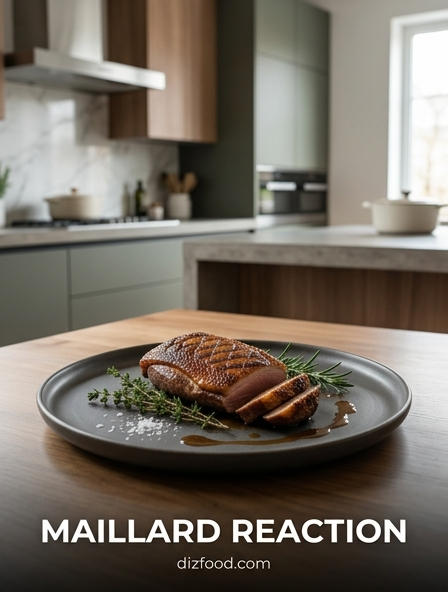
The Science of the Maillard Reaction
The Maillard reaction is a fundamental chemical process in the kitchen that transforms the flavor and texture of food through heat. Named after French chemist Louis-Camille Maillard, this reaction occurs between amino acids and reducing sugars when exposed to high temperatures, typically starting around 285°F (140°C). Unlike caramelization, which involves only the pyrolysis of sugars, the Maillard reaction creates a complex array of molecules that produce the savory, "meaty" aromas and deep brown colors associated with roasted, toasted, and fried foods.
- Rearrangement: Sugars and amino acids form N-substituted glycosylamine.
- Amadori Rearrangement: This intermediate stage shifts the molecular structure.
- Final Polymerization: Small molecules link up to create large, brown pigments called melanoidins.
This process is responsible for the distinct character of seared steaks, toasted bread, and roasted coffee. Because the reaction requires significant energy to break chemical bonds, it proceeds slowly at room temperature but accelerates rapidly as moisture evaporates and surface temperatures rise, allowing for the generation of hundreds of different flavor compounds simultaneously.
Optimizing Heat for Perfect Toasting
Toasting requires precise thermal management to ensure that the surface undergoes the Maillard reaction without burning the interior. The temperature must be high enough to trigger the chemical rearrangement but controlled enough to allow for moisture escape. If the heat is too low, the food dries out into a hard, flavorless mass; if it is too high, the sugar-protein bond collapses into carbonization and bitterness.
| Temperature Range | Effect on Food |
|---|---|
| 212°F (100°C) | Moisture evaporation begins; little browning occurs. |
| 285°F - 330°F (140°C - 165°C) | Optimal Maillard zone; golden brown color develops. |
| Over 355°F (180°C) | Pyrolysis and carbonization; bitter flavors and charring. |
Efficient heat transfer is best achieved through radiation or conduction. In a toaster or oven, infrared radiation penetrates the surface layers, while in a pan, direct conduction rapidly raises the temperature. Professional chefs often manipulate heat by adjusting the distance from the source or using fats to distribute thermal energy more evenly across uneven surfaces.
Amino Acids and Reducing Sugars Explained
The Maillard reaction is highly dependent on the specific chemical precursors present in the food. The two essential players are reducing sugars, which have a free carbonyl group, and amino acids, the building blocks of proteins. The variation in these components determines whether a food will taste like toasted nuts, grilled meat, or chocolate. Different sugars react at different rates, with pentose sugars like ribose being more reactive than hexoses like glucose or fructose.
- Reducing Sugars: Glucose, fructose, lactose, and maltose are primary drivers.
- Amino Acids: Lysine and glycine are particularly reactive due to their molecular structure.
- pH Levels: Alkaline environments accelerate the reaction by deprotonating amino groups.
In the kitchen, cooks can manipulate these variables to enhance browning. For example, adding a pinch of baking soda raises the pH of a solution, making amino acids more available for the reaction. Similarly, brushing dough with a wash containing milk proteins and lactose provides the necessary concentrated precursors to ensure a deep, lustrous crust even during short baking cycles.
Finding the Golden Brown Sweet Spot
The "sweet spot" of the Maillard reaction is the point where flavor complexity is at its peak and the visual appeal is most intense. This is identified by the formation of melanoidins, which provide the signature golden-brown hue. Achieving this requires a balance between time and temperature to ensure the reaction proceeds through the early stages of flavor development without entering the stage of thermal degradation.
- Preheat the surface to ensure immediate reaction upon contact.
- Monitor the color change from pale white to straw, then to mahogany.
- Remove the heat source slightly before the desired darkness to account for carry-over cooking.
Visual cues are the most reliable indicators for a home cook. A pale crust indicates under-development, lacking the savory notes of pyrazines. Conversely, a black or very dark brown crust indicates the presence of acrid compounds. The ideal target is a rich, variegated brown, which signifies a high concentration of aromatic compounds such as furans and thiophenes that contribute to the perceived depth and richness of the food's profile.
Impact of Moisture on Crust Texture
Moisture is the primary inhibitor of the Maillard reaction because water limits the surface temperature to its boiling point of 212°F (100°C). As long as the surface of the food is wet, the temperature cannot rise high enough to trigger the browning process. Therefore, drying the surface of ingredients is a critical step in achieving a crisp, flavorful crust. This is why meat should be patted dry before searing and why bread dough develops a better crust in a dry heat environment after an initial burst of steam.
When moisture evaporates, the concentration of sugars and amino acids increases, facilitating more frequent molecular collisions. In the later stages of cooking, the dehydration of the outer layer creates a porous, brittle structure that we perceive as crispness. If moisture is trapped-for instance, by overcrowding a pan-the food will steam rather than sear, resulting in a rubbery texture and a lack of the complex flavors associated with toasted ingredients. Managing the "water activity" at the interface of the food and the heat source is the secret to textural contrast.
Developing Complex Savory Flavors
The Maillard reaction is responsible for creating hundreds of flavor compounds that do not exist in the raw ingredient. These compounds are categorized into several chemical families, each contributing a specific sensory note. As the reaction progresses, it produces a layering effect, where simple sweetness is replaced by savory, nutty, and roasted characteristics. This complexity is why toasted grains or seared proteins provide more satiety and "umami" perception than boiled alternatives.
- Pyrazines: Provide toasted, nutty, and cocoa-like aromas.
- Thiophenes: Contribute meaty and savory "roasted" notes.
- Furans: Offer sweet, caramel, and slightly burnt flavor nuances.
To maximize these flavors, it is important to allow the reaction enough time to reach the intermediate stages. Rapid, high-intensity heat might brown the surface quickly but fail to develop the full spectrum of aromatic volatiles. By using moderate heat and fat as a flavor carrier, cooks can ensure that these volatile compounds are trapped and concentrated, resulting in a more profound and lingering taste profile on the palate.
Precision Timing for Ideal Results
Timing is perhaps the most volatile variable in the Maillard reaction. Once the water has evaporated and browning begins, the reaction rate increases exponentially. This is known as an autocatalytic process, where the heat generated and the changes in the food's chemistry make subsequent reactions happen faster. A few seconds can be the difference between a perfectly toasted slice of bread and a charred remnant.
- Start with high heat to drive off surface moisture quickly.
- Reduce heat once browning begins to slow down the chemical transition.
- Utilize constant motion or flipping to prevent localized hot spots.
Chefs often rely on the "tipping point" concept, where they watch for the transition from light tan to deep brown. Because the reaction continues for a short period after the food is removed from the heat (due to residual thermal energy), precision timing involves anticipating this finish. Understanding the thermal mass of the food helps in deciding exactly when to stop the process to ensure the crust remains within the desirable flavor window.
Essential Equipment for Even Browning
The tools used in the kitchen significantly influence the uniformity and speed of the Maillard reaction. Equipment with high thermal conductivity and high heat capacity is preferred because it maintains a stable temperature when cold food is added. This prevents the surface temperature from dropping below the reaction threshold, ensuring that browning begins immediately and occurs evenly across the entire surface area of the food.
| Material | Heat Retention | Browning Quality |
|---|---|---|
| Cast Iron | Excellent | Superior, even crust formation. |
| Stainless Steel | Moderate | Good for fond development and deglazing. |
| Non-Stick | Low | Poor; difficult to achieve deep browning. |
| Copper | Low (Fast Response) | Excellent for precision control. |
Beyond pans, the geometry of the equipment matters. Wide, shallow pans allow for better steam dissipation, whereas high-sided pots can trap moisture and inhibit browning. Heavy-gauge baking sheets are also essential for even toasting in the oven, as they prevent warping and provide a consistent heat floor for ingredients like nuts, seeds, or vegetables.
Preventing Acrylamides and Bitter Overcooking
While the Maillard reaction is desirable, it can produce unwanted side effects if not managed correctly. Acrylamides are chemical byproducts that form primarily in starchy foods like potatoes and grains when they are cooked at very high temperatures. These compounds are considered potential carcinogens and are associated with a bitter, acrid taste. Preventing their formation requires avoiding extreme temperatures and excessive cooking times that lead to charring.
- Avoid cooking until dark black; aim for golden or light brown.
- Soak potatoes in water before frying to reduce surface sugars.
- Blanch vegetables to shorten the required high-heat frying time.
Bitter flavors also arise when nitrogen-containing compounds in proteins are over-heated, leading to the formation of carbon. This carbonization masks the delicate aromatic profiles created earlier in the reaction. To avoid this, cooks can use acids like lemon juice or vinegar toward the end of cooking to balance the heavy, roasted flavors, or use a "low and slow" approach followed by a very brief high-heat finish to achieve browning without deep thermal damage.
Aromatic Profiles of Toasted Ingredients
The sensory experience of the Maillard reaction is largely defined by its aromatic output. As the reaction progresses, volatile molecules are released into the air, creating the irresistible smell of a bakery or a grill. These aromas are not just pleasant; they actually prime the digestive system by stimulating salivary and gastric secretions. Each ingredient produces a unique aromatic "fingerprint" based on its specific ratio of amino acids and sugars.
For instance, toasting oats releases malty and biscuity notes, whereas searing a steak releases sulfurous and fatty aromas that signal high protein content. In pastry, the reaction between flour and butter in a hot oven creates the complex, nutty scent of puff pastry. These aromatic profiles are highly volatile and tend to dissipate quickly, which is why freshly toasted or seared foods have a much more intense flavor than those that have been allowed to cool. Understanding how to capture and enhance these scents is the key to creating food that appeals to the nose as much as the tongue, making the Maillard reaction the ultimate tool for culinary excellence.



Comments