
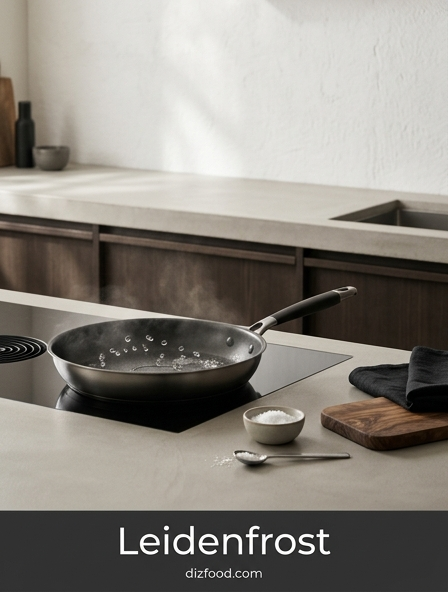
The Science of the Leidenfrost Effect
The Leidenfrost effect is a fascinating physical phenomenon that occurs when a liquid comes into contact with a surface significantly hotter than its boiling point. In a culinary context, this typically involves water droplets on a stainless steel or cast iron skillet. When the pan reaches a critical temperature, the bottom layer of the water droplet evaporates instantaneously. This rapid evaporation creates a thin, insulating sheath of vapor that suspends the remaining liquid above the metal surface.
This vapor barrier acts as a thermal insulator, dramatically slowing down the heat transfer from the pan to the water. Instead of boiling away immediately, the droplet appears to levitate and glide across the surface with nearly zero friction. The science relies on the specific Leidenfrost point, which varies depending on the surface material and the liquid's properties. Understanding this principle is essential for modern home cooks who wish to transition away from chemical non-stick coatings toward professional-grade metal cookware. By manipulating this physical boundary, chefs can control how food interacts with intense heat at a molecular level.
The Water Droplet Test for Pan Temperature
Mastering the Leidenfrost effect begins with a simple diagnostic tool known as the water droplet test. This technique allows a cook to visually verify if a pan is ready for searing without the need for an infrared thermometer. By flicking a small amount of water onto the heating surface, you can observe distinct physical stages that indicate the current thermal state of the metal.
- The Evaporation Stage: At low temperatures, the water simply sits on the pan and slowly evaporates or sizzles weakly.
- The Sizzling Stage: As the pan approaches the boiling point, the water bubbles violently and disappears quickly, indicating it is still too cool for non-stick cooking.
- The Leidenfrost Stage: When the pan is sufficiently hot, the water forms distinct, spherical beads that move rapidly across the surface like mercury balls.
- The Overheated Stage: If the water splits into dozens of tiny, frantic micro-droplets, the pan may be too hot, potentially causing oil to smoke or burn upon contact.
Performing this test ensures the metal pores have expanded and the surface is prepared to generate the necessary vapor pressure for food release.
Achieving Natural Non Stick Surfaces
Many home cooks struggle with food sticking to stainless steel, often blaming the cookware rather than the temperature. The Leidenfrost effect provides a natural, mechanical solution to this problem. When a protein, such as a scallop or a piece of chicken, is placed on a pan that has reached the Leidenfrost point, the moisture within the food creates an immediate steam barrier. This barrier prevents the protein fibers from bonding with the microscopic fissures in the metal surface.
- Minimal Oil Requirement: Because the steam provides the initial lift, you often need less fat to prevent sticking.
- Cleaner Release: Food will naturally "release" from the pan once the Maillard reaction has formed a solid crust.
- Health Benefits: Reducing reliance on PTFE or PFOA coatings minimizes chemical exposure in the kitchen.
- Professional Results: This technique allows for high-heat searing that is impossible in traditional non-stick pans.
To succeed, the cook must resist the urge to move the food prematurely. The natural non-stick properties are most effective when the vapor layer is allowed to stabilize during the first few seconds of contact.
Optimal Temperatures for Stainless Steel
Precision is key when utilizing the Leidenfrost effect for professional culinary results. While every stove and pan combination behaves differently, certain temperature ranges consistently produce the desired physical reactions. Achieving the "Mercury Ball" state requires the metal to be significantly hotter than the boiling point of water, usually settling between 320°F and 450°F (160°C to 232°C).
| Temperature Range | Water Reaction | Cooking Outcome |
|---|---|---|
| 212°F - 300°F | Rapid Bubbling | Food sticks; proteins bond to metal. |
| 320°F - 400°F | Leidenfrost Effect | Optimal searing; natural food release. |
| 450°F+ | Micro-droplet Shattering | Oil flash point reached; food burns quickly. |
Maintaining the pan within the middle range ensures that the vapor barrier is strong enough to support the weight of the food without being so hot that it degrades the quality of the cooking fats or scorches the delicate exterior of the ingredients.
Mastering the Mercury Ball Stage
The "Mercury Ball" stage is the visual gold standard for pan readiness. When a drop of water hits the pan and stays in a singular, cohesive sphere that glides effortlessly, the Leidenfrost effect is in full force. This state occurs because the surface tension of the water pulls the droplet into a sphere, while the cushion of steam beneath it eliminates friction. To master this stage, one must practice patience during the preheating process.
Start with a dry pan over medium heat. Gradually increase the heat, testing with a few drops of water every thirty seconds. Once the mercury ball forms, it is critical to add your cooking oil immediately after the water has been tossed out. The oil will shimmer and reach its smoke point quickly at this temperature, so the food should follow shortly after. Mastering this timing ensures that the pan is at its peak performance level, providing a frictionless environment that allows for the perfect sear on delicate items like fish or eggs in a stainless steel environment.
The Secret to Perfectly Toasted Crusts
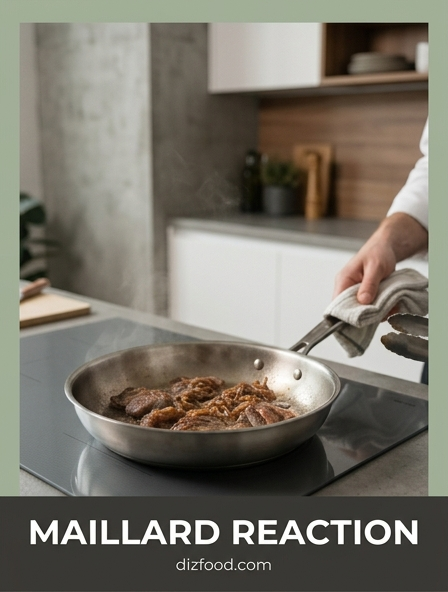
The Leidenfrost effect is the silent partner of the Maillard reaction. For a crust to become perfectly golden and crisp, the exterior of the food must be dehydrated rapidly. When food is placed on a Leidenfrost-ready surface, the immediate generation of steam forces moisture away from the contact point, allowing the surface proteins and sugars to caramelize without being boiled in their own juices. This results in a texture that is deeply flavorful and crunchy rather than gray and soggy.
This technique is particularly effective for thick-cut steaks and skin-on poultry. The vapor barrier prevents the meat from "welding" to the pan, which often tears the surface of the food when you try to flip it. By utilizing the Leidenfrost effect, you ensure that the entire surface area of the ingredient receives uniform heat. This uniformity is what produces that professional, edge-to-edge browning seen in high-end restaurants. The secret lies in the equilibrium between the repulsive force of the steam and the conductive heat of the metal.
Reducing Food Adhesion on Metal
Food adhesion occurs when the microscopic pores of a metal pan expand and contract around food particles, effectively "grabbing" the ingredient. This is most common with lean proteins and starches. The Leidenfrost effect mitigates this by creating a physical gap between the metal and the food. To further reduce adhesion, it is important to understand the role of thermal mass. A heavy-bottomed pan will maintain the Leidenfrost state more effectively than a thin pan when cold food is introduced.
When cold food hits the pan, the local temperature drops. If the temperature falls below the Leidenfrost point, the vapor barrier collapses, and the food will immediately stick. To prevent this, ensure your ingredients are brought closer to room temperature and patted dry. Removing surface moisture prevents the pan from losing too much energy through excessive evaporation, keeping the temperature high enough to maintain the protective steam cushion. This synergy between temperature management and ingredient preparation is the hallmark of a skilled technician in the kitchen.
Transitioning from Cold to Searing Heat
Success with the Leidenfrost technique requires a controlled transition from a cold pan to searing heat. Rushing this process by using the highest heat setting can lead to uneven heating or "hot spots," where the effect works in the center but fails at the edges. A gradual preheat on medium to medium-high heat allows the entire thermal mass of the cookware to saturate with energy. This ensures that when food is added, the pan has enough "heat overhead" to maintain the vapor barrier.
During this transition, the cook must be observant of the visual and audible cues of the metal. If the pan begins to take on a blueish or rainbow tint, it may be exceeding the optimal range. Once the water test confirms the Leidenfrost state, the transition to adding fat and food must be swift. This window of opportunity is precise; waiting too long after the pan is ready can lead to the polymerization of oils, creating a sticky residue that is difficult to clean and counterproductive to the non-stick goal.
The Leidenfrost Technique for Even Browning
Even browning is often difficult to achieve when food sticks and tears. By leveraging the Leidenfrost effect, you allow the food to move freely, which is essential for certain techniques like tossing vegetables or gliding a delicate omelet. Because the food is essentially floating on a microscopic layer of steam, the heat is distributed more evenly across the contact surface. This prevents the "leopard spotting" effect where only small patches of the food are browned while others remain pale.
To maximize even browning using this technique:
- Use a pan with a flat, heavy base for consistent heat distribution.
- Dry the surface of the food thoroughly to avoid cooling the pan too quickly.
- Allow the food to sit undisturbed for the first 60-90 seconds to establish the crust.
- Deglaze the pan after cooking to capture the fond, which is the flavorful caramelized remains left behind.
This approach transforms a standard stainless steel pan into a precision instrument capable of producing restaurant-quality textures and flavors through physics alone.
Maintaining Your Metal Cookware Performance
Utilizing high-heat techniques like the Leidenfrost effect requires diligent maintenance to keep your cookware performing at its peak. Over time, high temperatures can cause oils to carbonize, creating a brownish film that disrupts the smooth surface of the metal. This film increases friction and can cause the Leidenfrost effect to become inconsistent. Regular deep cleaning with an acidic agent, such as vinegar or a specialized stainless steel cleaner, helps remove these mineral deposits and burnt oils.
Furthermore, avoid "shocking" your pan by running it under cold water immediately after cooking. This can lead to warping, which ruins the flat contact surface necessary for even heating. Allow the pan to cool naturally to a safe handling temperature before washing. By keeping the surface polished and smooth, you ensure that the water droplets-and your food-can continue to glide effortlessly on a cushion of steam. Proper maintenance ensures that the physics of the Leidenfrost effect remains a reliable tool in your culinary repertoire for years to come.

Comments