
Streamlining your kitchen workflow often comes down to selecting the right tool for the task: do you need the precision of a manual apple corer or the all-in-one efficiency of a multi-blade slicer? While a manual corer is the go-to choice for preserving the fruit's integrity for baking or creating elegant rings, the multi-blade slicer is a powerhouse for high-volume snacking, turning a whole apple into uniform wedges in a single motion. Choosing the right tool depends on whether you value the versatility of keeping the fruit whole for stuffing or the raw speed required for lunchbox prep and fruit platters. By understanding the trade-offs between storage footprint, cleaning ease, and output style, you can significantly reduce your fruit preparation time and minimize food waste.
| Feature | Manual Apple Corer | Multi-Blade Slicer |
|---|---|---|
| Primary Function | Removes core only; keeps fruit intact. | Cores and divides into 8-12 wedges. |
| Prep Speed | Moderate; requires secondary slicing. | Instant; one-press operation. |
| Recipe Versatility | High (Baking, poaching, rings). | Limited (Snacks, salads, pies). |
| Storage Size | Slim, handheld, fits in utility drawers. | Bulkier; circular footprint with handles. |
| Effort Required | Moderate; twisting and pulling motion. | Higher initial force; downward pressure. |
| Waste Precision | Highly precise; minimal flesh loss. | Fixed diameter; may trim extra flesh. |
Streamlining your kitchen workflow often comes down to selecting the right tool for the task: do you need the precision of a manual apple corer or the all-in-one efficiency of a multi-blade slicer? While a manual corer is the go-to choice for preserving the fruit's integrity for baking or creating elegant rings, the multi-blade slicer is a powerhouse for high-volume snacking, turning a whole apple into uniform wedges in a single motion. Choosing the right tool depends on whether you value the versatility of keeping the fruit whole for stuffing or the raw speed required for lunchbox prep and fruit platters. By understanding the trade-offs between storage footprint, cleaning ease, and output style, you can significantly reduce your fruit preparation time and minimize food waste.
| Feature | Manual Apple Corer | Multi-Blade Slicer |
|---|---|---|
| Primary Function | Removes core only; keeps fruit intact. | Cores and divides into 8-12 wedges. |
| Prep Speed | Moderate; requires secondary slicing. | Instant; one-press operation. |
| Recipe Versatility | High (Baking, poaching, rings). | Limited (Snacks, salads, pies). |
| Storage Size | Slim, handheld, fits in utility drawers. | Bulkier; circular footprint with handles. |
| Effort Required | Moderate; twisting and pulling motion. | Higher initial force; downward pressure. |
| Waste Precision | Highly precise; minimal flesh loss. | Fixed diameter; may trim extra flesh. |
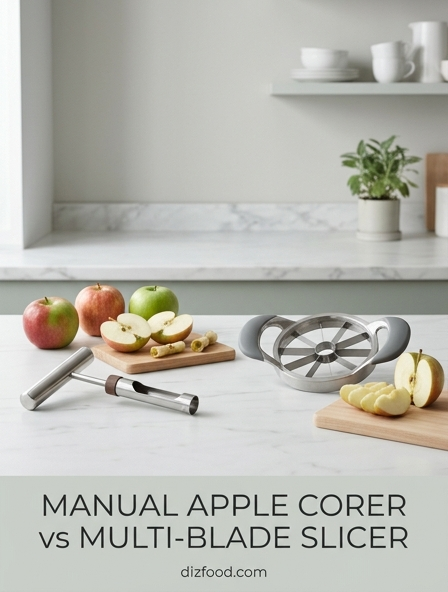
Manual Apple Corer vs Multi Blade Slicer Overview
The culinary world offers a variety of specialized gadgets designed to simplify fruit preparation, with the manual apple corer and the multi-blade slicer standing as the most prominent contenders. At its most basic, a manual apple corer is a cylindrical tool designed to penetrate the center of the fruit, removing the seeds and fibrous core while leaving the rest of the apple intact. This tool is favored by those who need whole apples for specific recipes or prefer custom-sized slices. In contrast, the multi-blade slicer, often referred to as an apple divider, features a central coring ring surrounded by radial blades that simultaneously core and divide the fruit into uniform wedges.
The fundamental difference between these two tools lies in their output and the level of control they offer the user. While the corer focuses on a single task with surgical precision, the slicer is a high-speed efficiency tool meant to streamline the transition from whole fruit to ready-to-eat snack. Understanding which tool is appropriate for your kitchen requires an evaluation of your most frequent preparation tasks. Both tools have evolved from simple wooden-handled devices to sophisticated ergonomic implements, yet they serve distinct roles in the workflow of a modern kitchen.
- Manual Corer: Best for keeping the apple whole for baking or stuffing.
- Multi-Blade Slicer: Ideal for immediate consumption or garnishing.
- Manual Corer: Takes up minimal drawer space.
- Multi-Blade Slicer: Provides consistent wedge thickness every time.
Efficiency and Speed Comparison for Fruit Prep
When evaluating efficiency, the multi-blade slicer is the undisputed champion for speed. In a single downward motion, a slicer can transform a whole apple into eight, twelve, or even sixteen uniform wedges while removing the core in the same second. This makes it an essential tool for parents packing school lunches or hosts preparing large fruit platters where volume is a priority. The time saved per apple becomes significant when processing a dozen or more fruits, reducing the physical labor involved in repetitive cutting.
The manual corer, however, requires a two-step process if slices are desired. First, the user must drive the tool through the fruit to remove the core, and then they must use a knife to cut the apple into pieces. While the coring action itself is relatively fast-often involving a simple twist and pull-it does not provide the immediate "ready-to-eat" result that the multi-blade slicer offers. However, for a professional baker who needs to core fifty apples for whole-baked desserts, the manual corer is faster because it eliminates the need to reconstruct or stabilize the fruit after the core is removed.
| Feature | Manual Apple Corer | Multi-Blade Slicer |
|---|---|---|
| Time per Apple | 10-15 seconds | 3-5 seconds |
| Output Result | Whole cored fruit | Uniform wedges |
| Effort Level | Moderate (Twisting) | High (Pushing) |
| Batch Capacity | Low to Medium | High |
Precision Coring vs Uniform Wedge Slicing
Precision is where the manual apple corer shines. Because the user guides the cylindrical blade directly through the center, it is easier to adjust the angle to account for lopsided or unusually shaped fruits. Many modern corers feature a serrated tip and a lever-release mechanism that allows for the cleanly extracted core to be ejected without manual digging. This precision ensures that the maximum amount of edible flesh is preserved while ensuring no seeds or tough membrane fragments remain in the center of the apple.
Multi-blade slicers, conversely, prioritize uniformity over precision. While they create perfect wedges that are aesthetically pleasing and great for dipping, they are less forgiving with fruit anatomy. If the apple is off-center or has a curved core, the radial blades may miss a portion of the seeds or cut through the seed pod, leaving undesirable bits on the edges of the wedges. For the casual snack, this is a minor inconvenience, but for those who demand a clean cut, the slicer can sometimes be frustrating. The trade-off for perfectly identical slices is a slight loss in the ability to adapt to the natural variance of the fruit.
Furthermore, the diameter of the central ring in a slicer is fixed. If an apple has an exceptionally large core, the slicer may leave core material on the wedges. If the core is very small, the slicer might waste perfectly good fruit. A manual corer allows the user to feel the resistance and ensure the path is true, providing a level of craftsmanship that a multi-blade press simply cannot replicate.
Versatility of Single Purpose vs Multi Blade Tools
Versatility is a critical factor when choosing between these two kitchen gadgets. The manual corer, while seemingly a single-purpose tool, actually offers a surprising range of applications. Beyond apples, it can be used to core cupcakes for filling, remove the centers of pears, or even de-seed bell peppers and jalapeños. Because it is a simple hollow tube, it can penetrate various textures without the obstruction of outer blades. This makes it a favorite for creative cooks who enjoy making stuffed fruits or vegetables.
The multi-blade slicer is more restricted by its physical design. Its diameter is fixed, meaning it can only handle fruits that fit within its outer frame. While it works excellently for pears and certain varieties of small potatoes (for making home fries), it is useless for larger fruits or vegetables that exceed its circumference. However, some high-end multi-blade tools come with interchangeable blades, allowing for different slice counts or even dicing capabilities, which can slightly bridge the versatility gap.
- Corer Applications: Cupcake filling, pear coring, potato hollowing, and pepper de-seeding.
- Slicer Applications: Quick wedges for apples, pears, and small onions.
- Corer Limitation: Requires a separate knife for any further cutting.
- Slicer Limitation: Restricted by the size and shape of the fruit.
Safety Features and Ergonomic Design Differences
Safety is a significant concern when dealing with sharp blades and the force required to cut through dense fruit. Multi-blade slicers generally feature two large handles on either side, allowing the user to apply downward pressure using both hands. This design distributes the force and keeps fingers away from the blades during the cutting process. However, if the apple is particularly hard, the slicer can slip or require significant force that might lead to a sudden "snap" through the fruit, which can be jarring for users with joint pain or limited hand strength.
Manual corers require a different ergonomic approach, usually involving a vertical grip and a twisting motion. Modern designs often include a soft-grip, non-slip handle to prevent the hand from sliding down onto the blade. Because the corer is used with one hand while the other hand stabilizes the fruit, there is a slightly higher risk of the tool slipping and making contact with the stabilizing hand. To mitigate this, many manufacturers have added "guards" or wider handles to ensure a secure grip.
- Slicer Stability: Dual handles provide balanced pressure and keep fingers clear of the cutting zone.
- Corer Control: Direct vertical alignment allows for more controlled, incremental force.
- Blade Exposure: Slicers have more exposed blade surface area than most corers.
- Ergonomic Impact: Slicers require shoulder and arm strength; corers require wrist and grip strength.
Cleaning and Maintenance Requirements for Each Tool
Hygiene is often the deciding factor for busy home cooks. The manual apple corer is remarkably easy to clean. Most models are constructed of a single stainless steel shaft with a plastic or silicone handle. Because there are no hidden crevices, a quick rinse under hot water is often sufficient to remove fruit residue. Many manual corers also feature a "split" design or a hinged lever that opens the tube, making it incredibly simple to wipe the inside of the blade where juice and pulp tend to accumulate.
The multi-blade slicer presents a more complex cleaning challenge. With eight or more blades intersecting at a central point, there are numerous tight corners where fruit fibers and sugars can become trapped. If not cleaned immediately, these residues can harden, making them difficult to remove without a specialized brush. While most are labeled as dishwasher safe, the high heat of a dishwasher can eventually dull the multiple blades or weaken the plastic housing that holds the blades in place. For those who prefer a "zero-fuss" cleanup, the simplicity of the corer is superior.
- Corer Cleaning: Simple tube structure, easy to wipe, minimal crevices.
- Slicer Cleaning: Complex intersections, requires thorough scrubbing or high-pressure rinsing.
- Maintenance: Corers are easier to sharpen with a round file; slicers are virtually impossible to sharpen at home.
- Drying: Corers dry quickly; slicers can trap water at the blade-frame junctions, leading to potential rust.
Durability and Material Quality of Modern Corers
Durability in kitchen tools is usually tied to the quality of the stainless steel and the integrity of the handle-to-blade connection. Manual corers are generally very durable because they are subjected to less structural stress. The force is applied vertically through the axis of the tool. High-quality corers use 304-grade stainless steel which resists bending and corrosion. Since the tool is essentially a reinforced pipe, it is very difficult to break or warp even when used on the hardest Granny Smith apples.
Multi-blade slicers are more prone to structural failure over time. The blades are often thin to allow for easier cutting, and they are held in place by a plastic or cast-metal ring. If one blade becomes slightly bent or if the plastic frame develops a hairline crack, the entire tool becomes useless. The tension required to push multiple blades through a firm fruit places significant stress on the points where the blades meet the frame. Consequently, a cheap slicer is far more likely to break during use than a cheap corer. Investing in a slicer with an all-metal construction is often necessary for long-term reliability, whereas even an inexpensive corer can last for years.
When shopping for either tool, weight is often an indicator of quality. A heavier tool usually signifies thicker steel and more robust construction. For the corer, look for a seamless weld between the handle and the tube. For the slicer, ensure the blades are deeply embedded into the surrounding frame to prevent them from popping out under pressure.
Storage and Portability for Small Kitchen Gadgets
In a crowded kitchen drawer, every inch of space matters. The manual apple corer is the clear winner in terms of storage and portability. Its slim, wand-like profile allows it to fit into narrow spaces or even hanging utensil racks. It is the size of a standard whisk or a large spoon, making it easy to tuck away. For those who enjoy camping or picnicking, the corer is a lightweight addition to a travel kit, allowing for fresh fruit prep on the go without taking up much room.
The multi-blade slicer is significantly bulkier. Its circular or rectangular footprint, combined with protruding handles, means it cannot be easily tucked into a shallow drawer. It often requires its own dedicated spot or must be stacked carefully to avoid the sharp blades catching on other utensils. While some models are designed to be "flat-stacking," they still occupy more cubic volume than a corer. However, for those with ample kitchen storage, this may be a minor drawback compared to the functionality it provides.
| Storage Factor | Manual Apple Corer | Multi-Blade Slicer |
|---|---|---|
| Drawer Footprint | Very Small (Linear) | Medium to Large (Circular) |
| Stackability | Excellent | Poor |
| Portability | High (Fits in pockets) | Low (Bulky) |
| Safety in Drawer | Blades are mostly shielded | Blades are fully exposed |
Best Use Cases for Baking and Snacking
The choice between a corer and a slicer often comes down to the intended end-use of the apple. If you are a baker, the manual corer is an indispensable tool. Recipes such as baked whole apples stuffed with cinnamon and walnuts require the fruit to remain intact. Similarly, when making apple rings for dehydrating or frying, a corer allows you to remove the center before slicing the apple horizontally with a mandoline or knife. This produces perfect, continuous circles that are visually stunning and cook evenly.
For snacking and casual use, the multi-blade slicer is the superior choice. It is perfectly designed for the "grab and go" lifestyle. Whether you are serving a toddler who needs manageable pieces or preparing a healthy side for a sandwich, the slicer provides instant gratification. It is also the better tool for making apple salads or pies where "rough-cut" wedges are the standard. The speed at which you can process a bowl of apples for a quick crumble or tart makes it a favorite for seasonal cooking when the harvest is plentiful.
- Use Corer for: Whole baked apples, apple rings, stuffed fruit, and decorative garnishes.
- Use Slicer for: School lunches, fruit platters, apple pies, and dipping in peanut butter.
- Baking Tip: Use a corer for tarts to ensure slices are thin and consistent.
- Snacking Tip: Use a 12-blade slicer for thinner wedges that are easier for children to eat.
Final Verdict on the Best Apple Processing Tool
Determining the "best" tool depends entirely on your personal kitchen habits and the volume of fruit you process. The manual apple corer is a precision instrument that offers versatility, ease of cleaning, and long-term durability. It is the tool of choice for the culinary enthusiast who values control and needs a gadget that can handle more than just one type of fruit. Its small footprint and simple design make it a reliable companion for a wide array of cooking and baking tasks, from the simple to the complex.
On the other hand, the multi-blade slicer is a marvel of efficiency. It is designed for the high-traffic kitchen where speed is the most valuable commodity. While it lacks the versatility of the corer and can be more difficult to clean and store, its ability to turn a whole fruit into a ready-to-eat snack in seconds is a significant advantage for families and busy individuals. If your primary goal is to get healthy food on the table with as little effort as possible, the slicer is your best bet.
Ultimately, many well-equipped kitchens find room for both. The corer handles the delicate prep work for gourmet meals, while the slicer manages the daily demand for quick snacks. However, if you must choose only one, the manual corer's durability and multi-use potential often give it a slight edge for the serious home cook, whereas the slicer's sheer speed makes it the favorite for the average consumer.


Comments