
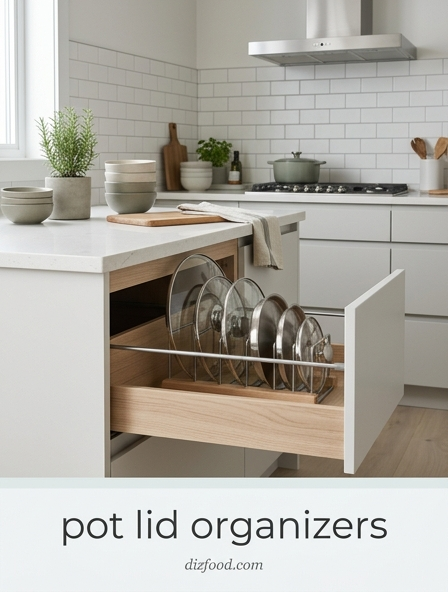
Tired of the chaotic clatter every time you reach for a pan? Pot lid organizers are the ultimate game-changer for managing bulky kitchenware. These robust storage solutions are specifically engineered to support heavy cookware, featuring wide slots that easily accommodate thick lid handles without tangling or scratching. By positioning your items vertically, you not only maximize cabinet space but also ensure every piece is instantly accessible, saving you from the frustration of unstacking heavy piles. It is a simple yet effective way to streamline your culinary workflow. For more storage insights, explore our comparison of Pot Lid Organizers Vs Vertical Plate Racks.
Maximized Cabinet Vertical Space Utilization
Traditional kitchen cabinets often suffer from significant wasted space in the upper regions of each shelf. By implementing vertical lid organizers, homeowners can reclaim this "dead air" and transform their storage capacity. Instead of laying lids flat and stacking pots precariously on top, vertical dividers allow each lid to stand upright. This configuration exploits the full height of the cabinet, leaving the lower surface area free for heavier items like Dutch ovens or sauté pans. When lids are stored vertically, the footprint they occupy is reduced by up to seventy percent, allowing for a more dense and efficient arrangement.
- Utilize tiered racks to stagger lid heights for better visibility.
- Install pull-out vertical drawers for deep base cabinets to prevent reaching.
- Use tension rods as makeshift vertical dividers in narrow slots.
- Prioritize the tallest lids toward the back of the cabinet to maintain a clear line of sight.
This approach not only increases the total number of items a single cabinet can hold but also improves the overall structural integrity of the storage. By separating the lids from the pots, you eliminate the top-heavy stacks that are prone to tipping over when you try to retrieve a single item from the bottom.
Preventing Scratches on Heavy Nonstick Surfaces
Nonstick cookware is an investment that requires careful handling to maintain its release properties. One of the primary causes of coating degradation is the abrasive contact between the metal edges of lids and the interior surfaces of pans. When lids are tossed haphazardly into a drawer or stacked directly onto a nonstick skillet, the friction leads to micro-scratches that eventually cause food to stick and the coating to flake. Dedicated lid organizers act as a protective barrier, ensuring that no two pieces of cookware ever make direct contact.
- Choose organizers with silicone-coated wires to provide a soft landing for metal rims.
- Ensure the spacing is wide enough so lids do not rub against one another during removal.
- Place the organizer on a stable surface to prevent shifting during high-traffic meal prep.
- Separate glass lids with stainless steel rims from ceramic-coated pans to avoid chipping.
By isolating each lid in its own slot, you preserve the longevity of your cookware collection. This systematic separation ensures that the delicate polytetrafluoroethylene or ceramic layers remain pristine for years. Ultimately, a small investment in a lid rack saves significant money by reducing the frequency of expensive pan replacements.
Streamlined Access to Bulky Lid Handles
Modern cookware often features oversized, ergonomic handles or high-domed knobs designed for heat resistance and grip. While beneficial during cooking, these bulky features make lids notoriously difficult to store in conventional stacks. They create uneven surfaces that lead to wobbling and instability. A specialized lid organizer addresses this by providing dedicated clearance for these protrusions. By orienting the lids so the handles face outward or upward within a rack, the user can easily grasp the specific lid they need without disturbing the rest of the collection.
This accessibility is crucial during time-sensitive cooking tasks, such as when a pot begins to boil over and a lid is needed instantly. Organizers with U-shaped or notched dividers are particularly effective for accommodating loop handles, allowing the handle to nestle securely within the frame. This design prevents the lids from rolling or sliding, keeping them in a fixed position. Furthermore, streamlining access reduces the physical strain on the cook, as it eliminates the need to lift heavy stacks just to reach a single lid hidden at the bottom of a pile.
Eliminating the Chaos of Stacked Cookware
The "avalanche effect" is a common frustration in many kitchens, where opening a cabinet door results in a clatter of sliding lids and shifting pots. This chaos stems from the lack of a defined structure for disparate shapes and sizes. Implementing a lid organizer brings immediate order to this environment by establishing a permanent home for every component. It shifts the storage philosophy from a pile-based system to a slot-based system, which is inherently more stable and visually organized.
| Storage Method | Stability Level | Retrieval Speed |
|---|---|---|
| Traditional Stacking | Low (Prone to sliding) | Slow (Requires unstacking) |
| Vertical Racks | High (Individual slots) | Fast (Direct access) |
| Drawer Piles | Medium (Hidden clutter) | Moderate (Requires digging) |
As shown above, vertical racks offer the most significant improvement in both safety and efficiency. When each lid is assigned a specific slot, the user no longer has to guess where a matching pair might be located. This eliminates the mental fatigue associated with searching through cluttered cabinets and ensures the kitchen remains a calm, functional workspace even during complex meal preparations.
Ergonomic Storage for Cast Iron Collections
Cast iron cookware is prized for its heat retention, but its extreme weight presents unique storage challenges. Standard plastic organizers often buckle under the pressure of heavy cast iron lids. Therefore, ergonomic storage for these items requires heavy-duty steel or reinforced wood racks that can handle the load without deforming. Properly storing these lids vertically is not just about organization; it is about physical safety. Lifting a ten-pound lid off the top of a stack at an awkward angle can strain the wrist and back.
- Look for racks with a wide, weighted base to prevent tipping when holding heavy iron.
- Install the organizer at waist height to minimize deep bending or high reaching.
- Ensure the dividers are welded securely to the base for maximum weight bearing.
- Use rubber feet to prevent the rack from sliding on the cabinet shelf.
When heavy lids are stored in an organized, upright fashion, the user can use a natural grip to slide the lid out toward their body. This reduces the torque on the joints and makes the cooking process more inclusive for those with limited grip strength or mobility issues. A sturdy rack transforms a cumbersome collection into a professional-grade station.
Door Mounted Solutions for Small Kitchens
In apartments or compact kitchens, every square inch of counter and cabinet space is a premium commodity. Door-mounted lid organizers are a brilliant solution that utilizes the frequently ignored interior surface of cabinet doors. This method moves the lids entirely out of the main storage cavity, freeing up the shelves for larger items like mixers or stockpots. These racks are typically designed with a slim profile to ensure the cabinet door can still close flush against the frame without hitting the internal shelves.
- Measure the depth between the door and the shelf edge before installation.
- Use adhesive-backed hooks for a rental-friendly, no-drill installation.
- Mount larger, heavier lids on the bottom hinge side for better weight distribution.
- Check that lid handles do not protrude far enough to block the door from latching.
This storage strategy keeps lids at eye level and within arm's reach. By clearing the clutter from the cabinet floor, it becomes much easier to maintain cleanliness and visibility. Door-mounted systems turn an unusable surface into a highly functional organizational tool, making even the smallest kitchen feel significantly more spacious and managed.
Protecting Glass Lids from Impact Damage
Glass lids offer the benefit of monitoring food without releasing steam, but they are inherently more fragile than their metal counterparts. Even tempered glass can shatter if it sustains a sharp impact on its edge or if it is subjected to the weight of several heavy pans pressing against it. A lid organizer provides the necessary cushioning and isolation to prevent these accidents. By holding each glass lid in a fixed, upright position, the rack ensures that there is no "clinking" when the cabinet is moved or when other items are retrieved.
Many high-quality organizers feature rubberized or vinyl-coated dividers. These soft touchpoints act as shock absorbers, dampening vibrations and protecting the perimeter of the glass. Additionally, storing glass lids separately prevents the knobs from being crushed or the rims from being bent. This level of protection is especially important for lids that have integrated strainers or silicone seals, as these components can easily be torn or warped in a congested drawer. Keeping glass lids in a dedicated rack ensures they remain crystal clear and structurally sound, preventing the hazard of broken glass in a food preparation area.
Categorizing Cookware by Size and Function
An effective lid organizer does more than just hold items; it serves as a visual filing system for the kitchen. To achieve maximum efficiency, lids should be categorized logically. Most cooks find it helpful to arrange lids by size, ranging from the smallest butter-melter lids to the largest stockpot covers. Alternatively, grouping by material or function-such as keeping all frying pan lids together and all saucepan lids in another section-can speed up the cooking process. This systematic approach allows the subconscious to quickly locate the correct tool.
- Small lids (under 6 inches) for specialized pans and small pots.
- Medium lids (8 to 10 inches) for standard skillets and daily saucepans.
- Large lids (12 inches and up) for Dutch ovens, woks, and large stockpots.
- Universal lids with stepped rims that fit multiple pot sizes.
When a kitchen is categorized this way, the "guesswork" is eliminated. You no longer have to test three different lids to find the one that fits the steaming pot on the stove. This organization also makes the unloading of the dishwasher significantly faster, as every item has a predetermined and labeled spot, turning a mundane chore into a quick and orderly task.
Reducing Noise During Meal Preparation
Kitchens are naturally loud environments, but the cacophony of metal lids banging against one another can be particularly jarring. This acoustic clutter is often a byproduct of unorganized storage, where lids must be shifted and shuffled to find the right size. An organized lid rack significantly reduces the decibel level in the kitchen by eliminating the need for metal-on-metal contact. Each lid resides in its own dampened slot, which prevents the resonant "ringing" that occurs when stainless steel plates strike each other.
| Noise Source | Stacked Impact | Organizer Impact |
|---|---|---|
| Retrieval | High (Clanging) | Minimal (Sliding) |
| Search | High (Rattling) | None (Visual search) |
| Cabinet Closing | Moderate (Shifting) | Low (Secure) |
Beyond the simple reduction of noise, a quieter kitchen contributes to a more focused and less stressful cooking experience. This is particularly valuable in open-concept homes where kitchen noise can disrupt conversations or media in the living area. By investing in a lid organizer with non-slip surfaces, you ensure that the only sounds in your kitchen are the ones you want, like the sizzle of a steak or the simmering of a sauce.
Customizing Adjustable Racks for Large Pots
Not all cookware sets are created equal, and a one-size-fits-all organizer often fails to accommodate professional-grade or specialty items. Adjustable lid racks solve this problem by allowing the user to reposition the dividers based on the specific thickness and handle height of their lids. This is especially useful for collections that include deep-domed lids or extra-thick cast iron covers that require more width than a standard wire rack provides. Customization ensures that the rack fits the collection, rather than the user having to buy new cookware to fit the rack.
- Identify the widest lids in the collection and set the primary dividers first.
- Space out the remaining slots to accommodate thinner, flat glass lids.
- Tighten the locking mechanism to ensure dividers don't migrate under weight.
- Periodically reassess the layout as new pieces are added to the kitchen.
The versatility of an adjustable system means it can evolve with your culinary skills. Whether you are transitioning from a basic starter set to a comprehensive collection of copper and iron, the adjustable rack remains a permanent fixture. This adaptability maximizes the value of the organizational tool, ensuring it remains useful even as the contents of your cabinets change over many years of use.


Comments