
Tired of the "who's going where" morning chaos? While both magnetic fridge calendars and traditional dry erase boards promise to save your sanity, the magnetic fridge calendar is the undisputed heavyweight champion for busy households. By turning your refrigerator-the literal heart of the home-into a high-visibility command center, these organizers ensure that soccer practices, meal plans, and doctor appointments are front and center where they can't be ignored. Unlike bulky wall boards that require drilling and often get tucked away in home offices, a sleek magnetic calendar utilizes the vertical space everyone visits a dozen times a day, providing a structured, pre-formatted grid that keeps your family synchronized with zero effort and maximum style.
| Feature | Magnetic Fridge Calendar | Standard Dry Erase Board |
|---|---|---|
| Location Hub | Kitchen/Fridge (High-traffic central zone) | Walls/Offices (Often isolated or out of sight) |
| Layout Structure | Pre-printed monthly/weekly dated grids | Blank slate; requires manual line drawing |
| Installation | Instant magnetic snap; zero tools required | Requires hooks, screws, or wall-safe adhesive |
| Surface Durability | Non-ghosting acrylic or premium PET film | Prone to staining and "shadowing" over time |
| Space Economy | Zero-footprint; uses existing appliance real estate | Consumes valuable wall space; adds bulk |
| Accessibility | Perfect height for both kids and adults | Often mounted too high for younger children |
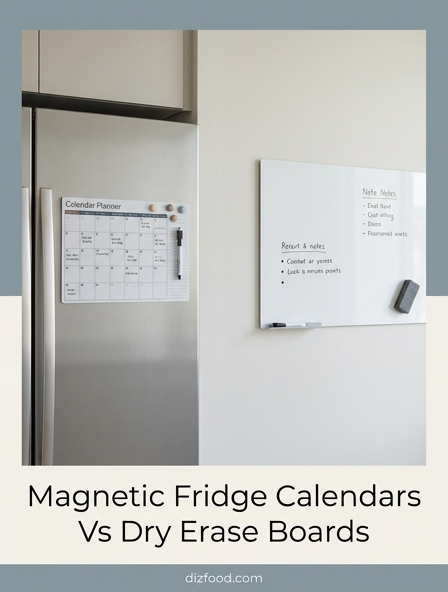
Magnetic Fridge Calendar vs Dry Erase Board Comparison
When deciding between a magnetic fridge calendar and a traditional dry erase board for the kitchen, the primary difference lies in their physical integration and intended use. A magnetic fridge calendar is designed specifically to adhere to metallic surfaces, usually featuring a flexible magnetic backing or an acrylic plate with corner magnets. In contrast, a dry erase board is often a rigid structure made of melamine, painted steel, or glass, intended to be mounted on a wall using screws, adhesive strips, or hooks. The choice often depends on whether you want a dedicated planning tool or a multipurpose writing surface.
| Feature | Magnetic Fridge Calendar | Standard Dry Erase Board |
|---|---|---|
| Mounting Style | Magnetic adhesion to fridge | Wall-mounted or leaning |
| Primary Surface | Printed grid for dates | Blank white surface |
| Space Usage | Utilizes existing fridge space | Requires dedicated wall space |
| Portability | Easy to move or reposition | Fixed once mounted |
The fridge calendar is often preferred for those who need a structured monthly overview that is visible every time someone reaches for a snack or a drink. Traditional boards offer more creative freedom but can feel bulky in a compact kitchen. While both use dry erase markers, the magnetic version typically stays within the high-traffic "hub" of the home, whereas a wall board might be tucked away in a corner or pantry door.
Benefits of Using Magnetic Fridge Calendars for Families
For modern families, coordination is the key to a stress-free household. A magnetic fridge calendar acts as a central nervous system for daily operations. Since the refrigerator is the most visited appliance in any home, placing the schedule there ensures that every family member-from young children to busy parents-is aware of upcoming events without needing to check a digital app. This physical presence fosters a sense of shared responsibility and keeps everyone on the same page regarding appointments, school events, and deadlines.
- Visual Reminders: Provides an immediate visual cue for extracurricular activities and sports practices.
- Accessibility: Low-profile design allows children to see and interact with the schedule, teaching them time management.
- Centralization: Eliminates the "I didn't know" excuse by placing vital information in the kitchen's highest-traffic area.
- Marker Storage: Most magnetic sets come with magnetic markers that stick right next to the calendar, preventing lost pens.
Beyond logistics, these calendars often include dedicated sections for notes or "to-do" lists. This allows parents to delegate chores or leave encouraging messages for their children. By moving the digital calendar into a physical space, families reduce screen time and increase face-to-face communication regarding the week's priorities. The ease of wiping away a finished task also provides a satisfying sense of accomplishment that digital notifications simply cannot replicate.
Comparing Durability of Fridge Calendars and Whiteboards
Durability is a significant factor when selecting kitchen organization tools, as the environment is prone to heat, moisture, and frequent cleaning. Magnetic fridge calendars are usually manufactured from flexible vinyl or high-grade acrylic. Acrylic versions are particularly durable, offering a sleek look that does not yellow or warp over time. Because they sit flush against the refrigerator, they are less likely to be knocked off or damaged by kitchen traffic. However, lower-quality vinyl calendars may eventually suffer from "ghosting," where marker stains become permanent after repeated use.
Traditional dry erase boards vary wildly in durability based on their surface material. Melamine boards are the most affordable but also the least durable, as the porous surface absorbs ink over time. Porcelain or glass whiteboards are significantly more robust; glass, in particular, is non-porous and virtually impossible to stain or ghost. The trade-off is that these high-end wall boards are heavy and require secure mounting, which may not be ideal for renters or those with limited wall space. When comparing the two, the magnetic calendar offers better "lifestyle durability" for busy kitchens, while a high-end glass wall board offers better "surface durability" for long-term writing clarity.
Maintenance also plays a role in longevity. Magnetic calendars can be easily pulled off the fridge and rinsed under a sink if they get hit by a food splatter. A wall-mounted board requires on-wall cleaning, which can lead to drips on the floor or wall. For most homeowners, the flexibility and ease of cleaning a magnetic acrylic sheet outweigh the structural permanence of a heavy wall board.
Best Kitchen Organization Tools Magnetic vs Wall Boards
Choosing the best organization tool requires assessing your kitchen's layout and your family's habits. If your kitchen features a lot of cabinetry and windows with limited wall space, magnetic tools are undeniably superior. They utilize the "dead space" of the refrigerator door or side panels. Conversely, if you have a large open-concept kitchen with an empty accent wall, a large-format wall board can serve as a functional piece of decor. The best systems often involve a combination of both to handle different types of information.
- Magnetic Weekly Planners: Ideal for short-term goals, such as weekly menus and immediate tasks.
- Wall-Mounted Cork/Whiteboard Combos: Best for pinning physical mail, invitations, and school flyers alongside written notes.
- Acrylic Magnetic Calendars: Perfect for a minimalist aesthetic that doesn't clutter the look of modern stainless steel appliances.
- Oversized Glass Boards: Suited for large families who need to track multiple schedules simultaneously.
When selecting a tool, consider the "reach factor." Tools located at eye level are used more frequently than those placed too high or in low-traffic hallways. Magnetic calendars excel here because the fridge is a natural gathering point. Wall boards, however, offer more surface area for those who like to brainstorm or write detailed instructions. If your goal is strictly organization, the calendar grid of a magnetic sheet provides the necessary structure. If your goal is creative expression or long-form list-making, the blank canvas of a wall board is more appropriate.
Why Magnetic Fridge Calendars Save More Kitchen Space
Space optimization is a primary concern in kitchen design. Every square inch of counter and wall space is valuable, often reserved for appliances, shelving, or decor. Magnetic fridge calendars are the ultimate space-saving solution because they require zero footprint. They occupy a surface that is already present in the room, effectively turning an appliance into a piece of functional furniture. This is particularly beneficial in "galley" kitchens or small apartments where adding a wall-mounted board might make the space feel cramped or cluttered.
Furthermore, magnetic calendars eliminate the need for hardware. Installing a wall board usually involves drilling holes, using anchors, or applying adhesives that can damage paint or wallpaper. For renters, this is a significant disadvantage. A magnetic calendar can be slapped onto the fridge in seconds and removed just as quickly without leaving a trace. It also avoids the "visual weight" that a framed board adds to a room. Because many modern fridge calendars are made of clear acrylic, they blend into the background, maintaining the kitchen's aesthetic while providing high utility.
The thin profile of these calendars also means they don't interfere with the swinging of the fridge doors or the movement of people in tight spaces. Traditional boards, especially those with frames or trays for markers, can protrude several inches from the wall, creating a potential snagging hazard. By sticking to the fridge, the organization system stays out of the way of the actual cooking and cleaning activities, ensuring that the kitchen remains a place of efficiency rather than a cluttered office space.
Dry Erase Boards vs Magnetic Calendars for Daily Planning
The effectiveness of daily planning often hinges on how the information is structured. Dry erase boards are generally "blank canvases." This is excellent for people who prefer freestyle planning, mind mapping, or drawing. You can divide the board however you like, changing the layout from day to day. However, this lack of structure can be a drawback for those who need a consistent routine. Without pre-printed lines, a dry erase board can quickly become a chaotic mess of overlapping notes and scribbles.
Magnetic calendars, on the other hand, provide a fixed temporal structure. With pre-set boxes for each day of the month or week, they force the user to categorize information by date. This is inherently more efficient for tracking deadlines and appointments. For daily planning, many people find that a magnetic calendar with a "Notes" section offers the best of both worlds: the discipline of a calendar and the freedom of a blank board.
- Daily Planning on Boards: Great for long "To-Do" lists that don't fit into a calendar square.
- Daily Planning on Calendars: Best for time-sensitive tasks and ensuring nothing is double-booked.
- Micro-Planning: Wall boards allow for detailed hour-by-hour schedules due to their larger size.
- Macro-Planning: Fridge calendars provide a "big picture" look at the month ahead.
In a kitchen setting, daily planning usually revolves around meals and errands. A magnetic calendar allows you to see how today's tasks fit into the broader context of the week. For example, seeing a soccer game on Thursday might influence your plan to prep a slow-cooker meal on Wednesday. The structured nature of the calendar makes these connections more obvious than a standard white board would.
Pros and Cons of Magnetic Fridge Calendars and Boards
Both magnetic calendars and wall-mounted boards have distinct advantages and drawbacks. Choosing the right one requires weighing these factors against your specific household needs. While magnetic calendars are praised for their convenience and location, wall boards are valued for their size and versatility. Below is a breakdown of the pros and cons of each system to help simplify the decision-making process.
| System | Pros | Cons |
|---|---|---|
| Magnetic Calendar | No installation, uses existing space, structured layout. | Limited writing space per day, only works on magnetic surfaces. |
| Dry Erase Wall Board | Large writing surface, works in any room, versatile layout. | Requires drilling/mounting, takes up wall space, can look cluttered. |
One major "con" for magnetic calendars is that they do not work on high-end stainless steel refrigerators that are non-magnetic. In such cases, a wall board is the only option. On the flip side, wall boards can be a "pro" for those who want to keep their kitchen appliances clean and free of any attachments. Ultimately, the magnetic calendar is a specialized tool for scheduling, while the dry erase board is a general-purpose tool for information management. If you need both, many families find success placing a calendar on the fridge and a small board in the pantry for a running grocery list.
How to Choose the Right Dry Erase Planner for Home
Selecting the right planner involves more than just picking the first one you see online. You must consider the surface material, the strength of the magnets, and the overall dimensions. For magnetic planners, the most important factor is the magnet's strength. There is nothing more frustrating than a calendar that slides down the fridge every time the door is closed. Look for "full-back" magnets or high-strength neodymium magnets on acrylic models to ensure the board stays securely in place.
- Material Check: Choose acrylic or glass for a non-staining surface. Avoid cheap melamine if you plan to use it daily.
- Size Matters: Measure your fridge door or wall space before purchasing. Ensure it doesn't block handles or water dispensers.
- Design Style: Consider if you want a "Monthly," "Weekly," or "Daily" layout. Some sets include all three.
- Marker Compatibility: Ensure the surface works well with liquid chalk markers if you prefer vibrant colors over standard dry erase ink.
Another consideration is aesthetic. If your kitchen has a modern, minimalist vibe, a clear acrylic magnetic calendar is nearly invisible and very stylish. If you have a farmhouse-style kitchen, a framed whiteboard or a chalkboard-style magnetic sheet might fit better. Think about who will be using it; if it's for the whole family, ensure the writing spaces are large enough for everyone's handwriting. Finally, check if the kit includes accessories like an eraser and magnetic marker holders, as these add significant value and convenience.
Magnetic Fridge Calendars for Efficient Meal Planning
Meal planning is one of the most effective ways to save money and eat healthier, and a magnetic fridge calendar is the perfect tool for the job. By placing your menu right on the appliance where the food is stored, you create a seamless workflow between planning and cooking. You can easily see what needs to be defrosted or prepped ahead of time. Many specialized magnetic calendars even feature a split design: one side for the monthly schedule and the other specifically for a weekly menu or grocery list.
- Inventory Tracking: Use the "Notes" section to list perishable items that need to be used soon.
- Theme Nights: Easily assign "Taco Tuesday" or "Pasta Friday" to create a predictable shopping routine.
- Grocery Integration: As you run out of an item, write it immediately on the magnetic list next to the calendar.
- Leftover Management: Mark days for "Leftover Night" to reduce food waste and save time on busy evenings.
This level of organization reduces the "What's for dinner?" stress that many families face daily. It also allows other family members to help with prep; if a spouse or teenager sees that "Chicken Stir-fry" is on the calendar for 6:00 PM, they can start the rice or chop vegetables before the primary cook even gets home. The proximity of the plan to the ingredients makes the magnetic calendar an indispensable kitchen assistant that a wall board in another room simply cannot match.
Versatility of Wall Mounted Boards vs Magnetic Fridge Tools
While magnetic fridge tools are king in the kitchen, wall-mounted boards offer a level of versatility that extends to every room in the house. A wall board is not limited by the location of an appliance. It can be placed in a home office, a mudroom, or a child's bedroom. In the kitchen, a wall-mounted board can be larger than a fridge door, allowing for a "command center" approach where you combine a calendar, a key hook, and a mail sorter into one unit. This makes wall boards better for heavy-duty organizational needs.
The versatility of wall boards also shows in their surface options. You can find "combo boards" that are half white-board and half cork-board. This allows you to write the schedule while also pinning up physical items like wedding invitations, coupons, or school photos. Magnetic fridge calendars are strictly for writing and cannot hold physical papers unless you use additional magnets, which can quickly lead to a cluttered and messy look on the fridge surface.
However, the versatility of the fridge calendar lies in its "move-ability." If you decide to reorganize your kitchen, you can move the magnetic calendar to the side of the fridge or to a different metal surface in seconds. A wall board requires a more permanent commitment. If you are someone who likes to frequently change your layout or decor, the low-commitment nature of magnetic tools is a major plus. Both tools serve the same core purpose, but the wall board is a structural addition to the room, while the magnetic tool is a flexible accessory designed for maximum convenience.





Comments