
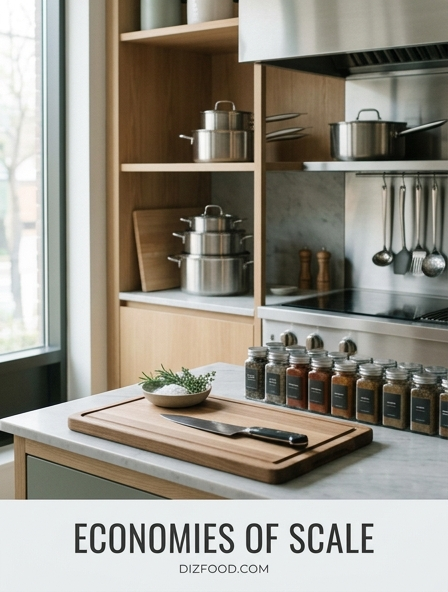
Bulk Buying for Maximum Savings
The primary driver of kitchen economies of scale is the strategic procurement of ingredients in high volumes. By shifting from small, consumer-sized packaging to institutional or bulk quantities, households can significantly reduce the price per unit. This approach is most effective for non-perishable goods and items with extended shelf lives, such as grains, legumes, oils, and various dry spices. Purchasing a twenty-pound bag of rice, for instance, often costs less than half the price per ounce compared to a two-pound box.
To maximize these savings, consumers should focus on the following categories:
- Dry goods: Flour, sugar, pasta, and beans.
- Canned staples: Tomato paste, broths, and preserved vegetables.
- Household consumables: Dish soap, parchment paper, and aluminum foil.
- Frozen proteins: Large packs of poultry or beef for portioning.
Success in bulk buying requires adequate storage space and a keen eye for unit pricing. While the upfront investment is higher, the long-term reduction in the grocery budget creates a surplus that can be reinvested into higher quality fresh ingredients or specialized equipment.
Mastering Batch Cooking Techniques
Batch cooking is the operational manifestation of industrial efficiency within a home setting. By preparing multiple meals simultaneously, you minimize the "setup" and "cleanup" time associated with daily cooking. The energy cost of heating an oven is largely the same whether it contains one tray of roasted vegetables or four. Consequently, utilizing the full capacity of your kitchen infrastructure reduces the total labor hours required per meal served.
- Select recipes with overlapping ingredients to streamline prep.
- Dedicate a specific block of time for high-volume chopping and marinating.
- Use multiple heat sources concurrently, such as the oven, stovetop, and slow cooker.
- Portion the finished products immediately to ensure consistency.
This method not only preserves time but also reduces decision fatigue. When a standardized system of production is applied, the cook transitions from a craftsman to a manager of an efficient food production line. This shift allows for a higher output of nutritious meals without a proportional increase in physical or mental effort, effectively lowering the marginal cost of each additional serving.
Strategic Freezer Management Systems
A freezer acts as a vital buffer in the kitchen supply chain, allowing for the decoupling of purchase time and consumption time. To leverage economies of scale, one must move beyond simple storage and implement a rigorous management system. This involves categorizing items by type and expiration, ensuring that the coldest parts of the unit are utilized for long-term preservation while the accessible areas hold items for immediate use.
Effective management prevents "lost" inventory, which is a common source of hidden costs in large-scale home kitchens. Vacuum sealing is a critical component of this strategy, as it extends the lifespan of bulk-purchased proteins and pre-cooked meals by preventing freezer burn. By maintaining a high-density storage environment, the freezer operates more efficiently, as the frozen mass helps maintain a constant temperature, reducing the workload on the compressor. Labeling every package with the date of entry and the exact contents is non-negotiable for maintaining a functional inventory flow and preventing the financial waste of discarded, unidentifiable food packages.
Investing in High Capacity Appliances
The throughput of a kitchen is fundamentally limited by the capacity of its hardware. To achieve true economies of scale, it is often necessary to transition from standard consumer-grade appliances to high-capacity or semi-professional models. For example, a six-quart stand mixer can handle double the dough volume of a four-quart model in the same amount of time, doubling the labor efficiency of baking tasks. Similarly, high-BTU burners and larger oven cavities allow for the use of commercial-sized sheet pans, which maximize the surface area for roasting.
| Appliance | Standard Capacity | High Capacity Benefit |
|---|---|---|
| Food Processor | 7-9 Cups | Reduces batches for large-scale shredding and slicing. |
| Pressure Cooker | 6 Quarts | Allows for bulk stock production and large bean batches. |
| Refrigerator | 20 Cu. Ft. | Essential for storing bulk purchases and prepped meals. |
While the initial capital expenditure for these appliances is higher, the return on investment is realized through significant time savings and the ability to process bulk ingredients before they spoil.
Standardizing Core Pantry Staples
Standardization is a cornerstone of efficiency. By narrowing the variety of ingredients kept in the pantry, a household can ensure a higher turnover of stock, which maintains freshness and simplifies the shopping process. Instead of purchasing niche ingredients for one-off recipes, focus on a versatile core that can be adapted to various cuisines. For example, a single high-quality olive oil can serve as a cooking fat, a salad dressing base, and a finishing oil.
This reduction in complexity allows for more aggressive bulk purchasing. When you know that every meal will utilize a specific set of base components-such as onions, garlic, rice, and canned tomatoes-you can buy these in the largest available quantities without fear of waste. Standardizing also streamlines the cooking process; the cook becomes intimately familiar with the properties of these staples, leading to more consistent results. This predictability reduces the likelihood of "failed" dishes, which are a significant drain on resources in a budget-conscious kitchen. A lean, standardized pantry is the foundation of a predictable and cost-effective culinary system.
Scaling Recipes for Large Groups
Scaling a recipe is more than simple multiplication; it requires an understanding of how ratios and cooking times change at volume. When increasing a recipe ten-fold, certain elements like salt and pungent spices do not always scale linearly. Often, the ratio must be slightly adjusted downward to prevent overpowering the dish. Furthermore, the thermodynamics of the cooking vessel change; a large pot of stew will take significantly longer to reach a boil and will retain heat much longer than a single serving size.
To scale effectively, cooks should utilize weight-based measurements rather than volume. Using grams ensures that the ratio of flour to liquid remains identical whether you are making one loaf of bread or twenty. Additionally, scaling requires consideration of the equipment's "fill level." Overcrowding a pan during a scaled-up sautéing process will lead to steaming rather than browning. Therefore, the scale of the recipe must be matched to the scale of the tools. Mastering this balance allows for the production of high volumes of food that maintain the quality and flavor profile of smaller batches.
Inventory Control and Rotation Methods
In a high-volume kitchen, inventory control is essential to prevent the financial loss associated with spoilage. The "First In, First Out" (FIFO) method is the gold standard for managing kitchen stock. This system ensures that older items are used before newer arrivals, maintaining a constant cycle of fresh ingredients. Without a formal rotation method, bulk-bought items can easily be pushed to the back of the pantry, eventually exceeding their optimal quality window.
- Store new purchases behind existing stock on shelves.
- Use clear bins to make inventory levels visible at a glance.
- Maintain a running list of "use first" items on the refrigerator door.
- Audit the pantry and freezer monthly to identify stagnating items.
Visual organization plays a major role in this process. When ingredients are decanted into uniform, clear containers, it is easy to see when supplies are running low. This prevents "panic buying" and ensures that the shopping list is based on actual need rather than guesswork, further tightening the economic efficiency of the household.
Minimizing Waste with Volume Preparation
One of the hidden advantages of processing food in large volumes is the ability to utilize secondary products that are usually discarded in smaller quantities. When peeling two carrots, the scraps seem negligible. However, when processing twenty pounds of carrots for a batch of mirepoix, the volume of peels and ends becomes a substantial resource. These "waste" products can be consolidated to create high-quality vegetable stocks, which in turn reduces the need to purchase pre-made broth.
Volume preparation also allows for higher yield percentages. Professional techniques, such as using a bench scraper to recover every gram of dough or a rubber spatula to clean every drop of sauce from a large mixing bowl, become more impactful when the total volume is high. Furthermore, buying whole primals of meat or whole chickens and fabricating them into portions allows for the use of bones for stock and fat for rendering. This "nose-to-tail" approach in the home kitchen is only commercially viable when done at a scale that justifies the labor involved in the butchery and preservation of the byproducts.
Organizing Kitchen Workflows for Efficiency
The physical layout and the sequence of operations in a kitchen determine the labor cost of every meal. Organizing for efficiency involves minimizing the number of steps taken between the refrigerator, the prep station, and the stove-often referred to as the "work triangle." In a high-volume environment, the mise en place must be absolute. All ingredients should be washed, chopped, and measured before the heat is ever applied to the pan. This prevents the "stop-and-start" workflow that leads to burnt food and increased stress.
Grouping similar tasks together also yields dividends. If three different recipes require minced onions, mincing them all in one session is faster than cleaning the knife and cutting board three separate times. Similarly, designating specific zones for "wet" prep (washing and peeling) and "dry" prep (portioning spices and flour) keeps the workspace organized and reduces the time spent on mid-task cleanup. By treating the kitchen as an assembly line rather than a hobby space, the cook can produce significantly more food in less time, maximizing the human capital involved in the cooking process.
Budgeting for Large Family Nutrients
When feeding a large group, the focus of budgeting shifts from individual ingredients to the cost per nutrient. This involves prioritizing "nutrient-dense" bulk items that provide the necessary calories, proteins, and vitamins at the lowest possible price point. This does not mean sacrificing quality, but rather being strategic about where to allocate funds. For instance, purchasing expensive cuts of meat for every meal is rarely sustainable; instead, these can be used as flavor accents in dishes dominated by bulk-purchased legumes and grains.
| Nutrient Source | Economical Choice | Benefit |
|---|---|---|
| Protein | Dried Lentils / Bulk Eggs | High protein-to-cost ratio. |
| Carbohydrates | Oats / Brown Rice | Satiety and long-term energy. |
| Vitamins | Seasonal / Frozen Veg | Peak nutrition at lowest price. |
A successful budget relies on the synergy between the previously mentioned techniques: bulk buying, waste reduction, and batch cooking. By tracking the total monthly expenditure against the nutritional output, a household can fine-tune its procurement strategy to ensure that every dollar spent contributes directly to the health and energy of the family.




Comments