
If you're chasing that perfect bite where every fiber of meat is bursting with moisture and spice, you've likely debated between the old-school surface soak and the precision of instant injection. While traditional marinating relies on osmosis to slowly permeate the outer layers of your protein, injection bypasses the "surface barrier" to deliver fats, juices, and seasonings directly into the core for immediate results. Whether you're prep-time pressed or planning a slow-roast masterpiece, understanding how these methods affect cellular structure and flavor depth is the key to elevating your culinary game from standard to spectacular.
| Feature | Instant Injection | Surface Soaking |
|---|---|---|
| Infusion Depth | Internal core; reaches center of thick cuts | Surface level; penetrates 1/8" to 1/4" deep |
| Prep Time | Instant; 5-10 minutes total | Slow; requires 2 to 24 hours |
| Moisture Retention | High; prevents drying during long cooks | Moderate; focuses on exterior humidity |
| Texture Impact | Tenderizes internal muscle fibers | Can make exterior "mushy" if over-soaked |
| Best For | Brisket, whole turkey, pork shoulder | Steaks, chicken wings, thin fish fillets |
| Equipment | Flavor injector / meat syringe | Bowl, vacuum sealer, or resealable bag |
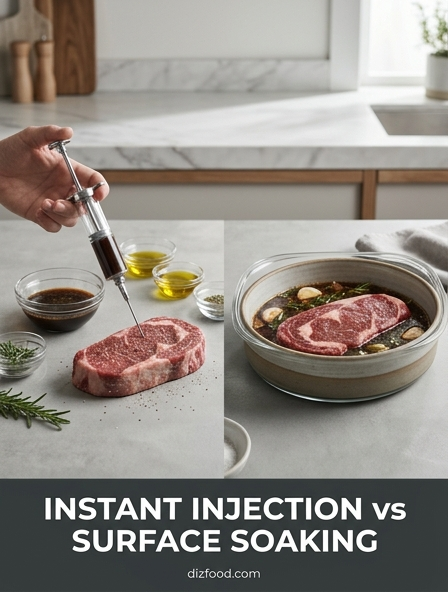
Flavor Depth Comparison: Instant Injection vs Surface Soaking
The primary distinction between instant injection and surface soaking lies in the geographic distribution of flavor molecules within the protein structure. When a cook utilizes surface soaking, also known as traditional marinating, the flavor profile is concentrated almost exclusively on the exterior millimeter of the meat. This creates a high-contrast experience where the first bite is intensely seasoned, but the interior remains bland and reliant on the natural juices of the protein. Because most flavor compounds, such as those found in garlic, herbs, and spices, are too large to pass through the dense network of muscle fibers, they remain trapped on the surface, often burning during high-heat searing.
In contrast, instant injection bypasses the physical barriers of the meat's exterior. By using a specialized syringe to deliver a brine or marinade directly into the center of the cut, the chef ensures that every cubic centimeter of the protein is seasoned from the inside out. This method eliminates the "flavor gradient" common in soaked meats, where the intensity drops off sharply toward the center. Instead, injection provides a uniform sensory experience. This is particularly critical for large, thick cuts of meat like turkey breasts or beef briskets, where the ratio of surface area to volume is low. When injected, the flavor depth is not merely a coating but an integral part of the meat's cellular structure, resulting in a more complex and satisfying profile that persists through every bite of the meal.
Maximum Moisture Retention: The Science of Meat Injection
Moisture retention in meat is governed by the ability of muscle proteins to bind water molecules during the cooking process. As heat is applied, muscle fibers contract and squeeze out internal moisture, which leads to the dry, stringy texture often associated with overcooked poultry or pork. Instant injection addresses this physiological challenge by introducing a liquid solution-usually containing salt and sometimes phosphates-directly into the deep tissue. The salt in the injection solution works to denature the myofibrillar proteins, causing them to unwind and form a gel-like matrix that traps and holds water more effectively than untreated muscle.
- Increased Yield: Injected meats typically retain 10% to 15% more weight after cooking compared to non-injected counterparts.
- Cellular Hydration: The mechanical action of the needle creates small pockets where the solution can pool and slowly redistribute during the rest period.
- Protective Buffer: The internal liquid acts as a heat sink, slowing down the rise of internal temperatures and providing a buffer against accidental overcooking.
While surface soaking relies on osmosis to pull moisture inward, this process is incredibly slow and rarely reaches the core of the meat before the exterior becomes over-salted or mushy. Injection provides an immediate and measurable increase in internal hydration, ensuring that the finished product remains succulent even when subjected to the dry heat of a smoker, oven, or grill. This scientific approach to moisture management is what differentiates professional-grade barbecue from standard home cooking.
Surface Soaking Limits: Why Marinades Fail to Penetrate
A common misconception in the kitchen is that leaving meat in a marinade for twenty-four hours will result in deep flavor penetration. However, basic food chemistry proves that surface soaking is a highly limited technique. Meat is a dense, semi-permeable biological structure composed of approximately 75% water. Because the muscle fibers are already saturated, there is very little "room" for a marinade to move inward. Furthermore, most flavor molecules-such as those found in peppercorns, onion powder, or rosemary-are chemically bulky. They are far too large to navigate the microscopic gaps between muscle cells, effectively hitting a "wall" at the surface.
Studies have shown that even after several days of soaking, most marinades only penetrate a few millimeters into the meat. The only component of a marinade that reliably travels to the center is salt, due to its small ionic size and the process of osmosis. However, the acids often used in marinades, such as vinegar or citrus juice, can actually be detrimental over long periods. Instead of tenderizing the center, these acids break down the surface proteins into a soft, mealy texture while leaving the interior untouched. This creates a structural inconsistency that is often unappealing to the palate. Therefore, surface soaking should be viewed as a method for enhancing the crust or "bark" of the meat, rather than a tool for transforming the internal flavor or texture of thick cuts.
Time Efficiency: Instant Injection for Faster Prep
In a fast-paced kitchen environment, whether professional or domestic, time is a critical resource. Traditional surface soaking requires a significant lead time to be even marginally effective, often necessitating a 12-to-24-hour commitment. This requires the cook to plan meals well in advance, leaving little room for spontaneity or last-minute adjustments. If the soaking period is cut short, the marinade has virtually no impact on the final dish, rendering the effort wasted.
Instant injection, as the name suggests, provides an immediate solution to this logistical hurdle. Because the seasoning is delivered mechanically to the interior of the meat, there is no need for a lengthy "soaking" period. A chef can inject a large roast and place it directly into the oven or smoker with the confidence that the interior is already seasoned and hydrated. This drastically reduces the total preparation time and simplifies the workflow.
| Preparation Method | Required Lead Time | Flavor Integration |
|---|---|---|
| Surface Soaking | 4 to 24 Hours | Minimal/Surface Only |
| Instant Injection | 0 to 30 Minutes | Maximum/Total Core |
| Dry Brining | 12 to 48 Hours | Moderate/Salt Only |
By eliminating the overnight wait, injection allows for more flexible menu planning. It also reduces the amount of refrigerator space required, as large containers of marinating meat are no longer necessary. For high-volume operations, this efficiency translates directly into lower labor costs and higher throughput without sacrificing the quality of the end product.
Sodium Distribution: Reaching the Core with Injection
Salt is the most important ingredient in meat preparation, not only for flavor but also for its structural impact on proteins. Achieving a uniform sodium distribution is the "holy grail" of roasting and smoking. When meat is surface soaked, the exterior can become unpleasantly salty while the center remains under-seasoned. This creates a disjointed flavor profile. While salt does eventually migrate toward the center through osmosis, the rate of travel is approximately one centimeter every 24 hours in a refrigerated environment. For a large brisket or a whole turkey, waiting for salt to reach the core naturally is often impractical.
Injection provides a surgical approach to sodium distribution. By creating a brine with a specific salinity percentage-usually between 5% and 10%-and injecting it at regular intervals throughout the muscle, the cook achieves instant equilibrium. This ensures that the salt can begin working on the internal proteins immediately, breaking down the tough connective tissues from the inside out. This uniform salinity also enhances the meat's natural flavors throughout the entire cut, rather than just on the edges. Furthermore, because the salt is distributed evenly, it draws more moisture into the cells via a balanced osmotic pressure, resulting in a more consistently seasoned and tender result that cannot be replicated by soaking alone.
Texture and Tenderness: Comparing Two Hydration Methods
The method of hydration chosen significantly influences the final texture of the meat. Surface soaking often relies on acidic components like wine, vinegar, or yogurt to "tenderize" the meat. While these ingredients do break down proteins, they do so from the outside in. If left too long, the exterior of the meat becomes mushy and loses its structural integrity, while the interior remain tough. This results in a "two-tone" texture that is often considered a culinary failure. The moisture added via soaking is also largely superficial and evaporates quickly once the meat hits the heat.
Instant injection, however, improves tenderness through a combination of mechanical and chemical means. The physical act of the needle piercing the muscle fibers provides a minor form of mechanical tenderization. More importantly, the internal delivery of a saline solution allows the myofibrils to expand and relax. This prevents the tight contraction of fibers during cooking, which is the primary cause of toughness. Because the hydration is internal, the moisture is "locked" behind the exterior crust, creating a contrast between a crisp outside and a buttery, tender inside. This method preserves the natural "snap" or "tooth" of the meat while ensuring it remains easy to chew and swallow. Injection is particularly effective for lean meats like pork loin or chicken breast, which lack the intramuscular fat (marbling) necessary to remain tender under high heat.
The Osmosis Barrier: How Surface Soaking Works
To understand why surface soaking has its limits, one must understand the principle of osmosis. Osmosis is the movement of water through a semi-permeable membrane from an area of low solute concentration to an area of high solute concentration. When you place a piece of meat in a salty marinade, the salt on the outside is at a higher concentration than the salt inside the meat cells. Initially, the salt draws some water out of the meat. Eventually, as the salt dissolves into the meat's surface moisture, it begins to migrate inward, and the water follows it back in. This is a slow, methodical process that requires hours or days to reach any significant depth.
The "barrier" in this scenario is the meat's own density. Muscle tissue is designed to be a protective container for fluids; it does not easily absorb external liquids without help. Additionally, fats on the surface of the meat can act as a waterproof shield, further preventing the marinade from penetrating. This is why surface soaking is most effective on very thin cuts of meat, such as flank steak, skirt steak, or sliced chicken for stir-fry. In these instances, the "surface" is essentially the entire thickness of the meat, allowing osmosis to complete its journey relatively quickly. For anything thicker than an inch, the osmosis barrier becomes an insurmountable obstacle for most of the marinade's ingredients.
Flavor Profiles: Deep Infusion vs Surface Coating
Flavor profile development is an art that requires a strategic choice between deep infusion and surface coating. Surface soaking excels at creating a "bark" or a flavorful crust. Because the marinade stays on the outside, it interacts directly with the heat of the grill or pan, undergoing the Maillard reaction and caramelization. This creates a complex, charred, and highly seasoned exterior that defines the first impression of the dish. Ingredients like sugar, honey, and dried spices in a soak are perfect for this role, as they coat the meat and transform into a delicious glaze.
Instant injection, conversely, is about deep infusion. It allows for the introduction of flavors that would otherwise never reach the center of the meat, such as melted butter, cognac, or concentrated stocks. This creates a "hidden" layer of flavor that surprises the palate. When you slice into an injected roast, the aroma is released from the center of the meat, providing a more aromatic and immersive experience.
- Soaking Profile: High intensity at the start, heavy on crust development, best for charred flavors.
- Injection Profile: Consistent intensity, heavy on buttery or savory "meatier" flavors, best for succulent roasts.
Often, the best results come from a hybrid approach: injecting the meat for internal moisture and flavor, while using a dry rub or a brief soak for the exterior. This ensures a multi-dimensional profile that covers the entire spectrum of the protein.
Best Use Cases: When to Inject and When to Soak
Choosing between injection and soaking depends entirely on the cut of meat and the desired outcome. There is no one-size-fits-all rule, but general culinary principles can guide the decision. Large, dense proteins with low surface-area-to-volume ratios are the primary candidates for injection. These meats take a long time to cook and are prone to drying out in the center. Conversely, thin or delicate proteins benefit more from soaking, as the process is fast enough to be effective without damaging the meat's structure.
- When to Inject:
- Whole Turkeys and Chickens: To keep the lean breast meat moist during long roasting.
- Beef Brisket and Pork Shoulder: To ensure salt and moisture reach the center of these massive cuts during a 12-hour smoke.
- Thick-cut Pork Chops: To prevent the lean meat from becoming "cardboard-like."
- When to Soak:
- Flank or Skirt Steaks: The thin, coarse fibers absorb marinades quickly for tacos or fajitas.
- Chicken Wings: The high surface area allows for maximum glaze and flavor adhesion.
- Shrimp and Seafood: Delicate proteins that can "cook" in acid or become rubbery if injected.
By matching the technique to the protein, the cook maximizes the strengths of each method. Injection is a tool of precision and internal management, while soaking is a tool of external enhancement and surface character.
Pros and Cons: Choosing Your Meat Preparation Technique
Evaluating the advantages and disadvantages of injection versus soaking is essential for any serious cook. Each method offers a different set of trade-offs regarding flavor, texture, and convenience. While injection is technically superior for large cuts, it requires specialized equipment and a bit more cleanup. Surface soaking is accessible to everyone but often fails to deliver on its promise of "deep flavor."
| Feature | Instant Injection | Surface Soaking |
|---|---|---|
| Flavor Depth | Excellent; reaches the core. | Poor; limited to the surface. |
| Moisture | High; increases internal weight. | Moderate; mostly external. |
| Preparation Time | Very Fast; immediate. | Very Slow; requires hours. |
| Texture | Uniformly tender. | Can lead to mushy exterior. |
| Equipment | Meat Injector required. | Bowl or bag only. |
| Complexity | Requires some technique. | Very simple. |
The "pro" of injection is undoubtedly its efficiency and the quality of the internal meat. The "con" is that it can occasionally create "flavor pockets" if the injection is not distributed evenly. The "pro" of soaking is the ease of use and the excellent crust it creates. The "con" is the lack of internal impact and the long wait time. Ultimately, a chef's decision should be based on the specific goals for the meal: if the center of the meat is the priority, inject; if the crust is the focus, soak.

Comments