
Understanding Sauce Stabilization Fundamentals
Sauce stabilization is the cornerstone of professional culinary production, ensuring that complex mixtures maintain their intended texture and appearance from the moment of creation until service. At its core, stabilization involves managing the kinetic energy and interfacial tension between immiscible liquids, such as oil and water. Without proper stabilization, sauces often succumb to coalescence, where droplets merge and eventually lead to complete system failure. This process is governed by the laws of thermodynamics, where the system naturally seeks its lowest energy state, typically resulting in separation.
To achieve a permanent state of equilibrium, chefs must utilize specific techniques and ingredients that provide structural integrity. The primary goals of stabilization include:
- Enhancing mouthfeel and viscosity for better palate coverage.
- Extending shelf life by preventing water migration or weeping.
- Ensuring visual appeal through a smooth, glossy, and uniform finish.
- Improving the suspension of solids like herbs or spices within the liquid matrix.
By mastering these fundamentals, a kitchen can produce high-quality results that withstand the rigors of modern food service, including reheating and prolonged holding times.
Impact of Viscosity on Marinade Adhesion
The efficacy of a marinade is largely determined by its ability to adhere to the surface of the protein or vegetable it intends to flavor. Viscosity plays a critical role in this mechanical process; a marinade that is too thin will simply run off the product, while one that is excessively thick may not penetrate effectively or may burn during cooking. Achieving the "sweet spot" involves balancing fluid dynamics with the surface tension of the food product itself.
Adhesion is also influenced by the shear-thinning properties of the liquid. In a professional kitchen, the following steps are vital for optimizing marinade performance:
- Assess the surface area of the product to determine the required cling factor.
- Incorporate thickening agents that respond well to cold application.
- Monitor the temperature of the marinade to ensure consistent flow rates during application.
- Test the "drip loss" after application to verify that the coating remains intact during the resting phase.
When viscosity is correctly managed, the result is a superior flavor profile and a more uniform sear, as the stabilized sugars and fats in the marinade remain in contact with the food throughout the thermal processing stage.
Essential Emulsifiers for Uniform Texture
Emulsifiers are bifunctional molecules that bridge the gap between oil and water phases, acting as a structural glue for dressings, mayonnaises, and pan sauces. These agents possess both hydrophilic (water-loving) and lipophilic (oil-loving) ends, which align themselves at the interface of droplets to prevent them from merging. In a commercial kitchen, the choice of emulsifier depends on the desired final texture and the temperature at which the sauce will be served.
| Emulsifier | Primary Source | Ideal Application |
|---|---|---|
| Lecithin | Egg Yolks/Soy | Vinaigrettes and light foams |
| Casein | Dairy Products | Cream-based sauces and soups |
| Mucilage | Mustard Seed | Stable cold-process dressings |
| Polysorbates | Synthetic/Processed | Long-life commercial glazes |
Using these agents correctly ensures that the lipid phase is finely dispersed throughout the aqueous phase, creating a creamy sensation on the palate without the greasiness associated with broken emulsions. Precision in measurement is key, as over-saturation can lead to off-flavors or gummy textures.
Preventing Phase Separation in Commercial Batches
Phase separation, often referred to as "breaking," is the most common failure in large-scale sauce production. It occurs when the dispersed droplets in an emulsion aggregate due to gravity, temperature fluctuations, or mechanical stress. In a commercial setting, where sauces are produced in high volumes, the risk is magnified because of the time elapsed between production and consumption. Preventing this requires a multi-layered approach to stabilization that accounts for syneresis-the expulsion of liquid from a gel.
To maintain homogeneity in large batches, the following factors must be addressed:
- High-shear mechanical blending to reduce oil droplet size to a micron level.
- The inclusion of secondary stabilizers to reinforce the primary emulsifier.
- Strict control over the rate of oil incorporation during the mixing phase.
- Ensuring ingredients are at compatible temperatures before marriage.
By implementing these safeguards, kitchens can produce gallons of sauce that remain perfectly unified even after multiple days of refrigeration or several hours in a steam table, protecting both the food cost and the reputation of the establishment.
Role of Hydrocolloids in Long Term Stability
Hydrocolloids are a diverse group of long-chain polymers that thicken or gel when dispersed in water. In modern stabilization, they are indispensable for creating "long-term memory" in a sauce's structure. Unlike traditional flour-based roux, hydrocolloids such as xanthan gum, guar gum, and agar-agar work at very low concentrations and do not mask the vibrant flavors of the ingredients. They function by trapping water molecules within a complex network, significantly slowing down the movement of other particles.
Commonly utilized hydrocolloids include:
- Xanthan Gum: Provides exceptional cold-stability and prevents spice settling.
- Carrageenan: Ideal for dairy-based stabilization and preventing fat separation in milks.
- Agar-Agar: Used for creating heat-stable gels that can be sheared into fluid gels.
- Pectin: Essential for fruit-based glazes where acid levels are high.
The strategic use of these substances allows for "freeze-thaw" stability, ensuring that a sauce can be frozen and defrosted without losing its original texture or experiencing significant water weepage, which is vital for efficient kitchen prep cycles.
Temperature Management during Sauce Production
Temperature is perhaps the most volatile variable in the kitchen, and its impact on stabilization cannot be overstated. Heat affects the kinetic energy of molecules; as temperature rises, the viscosity of most liquids decreases, making emulsions more prone to breaking. Conversely, extreme cold can cause certain fats to crystallize or starches to undergo retrogradation, leading to a grainy or rubbery texture. Precise thermal control is required at every stage: heating, holding, and cooling.
Effective temperature management involves a structured protocol:
- Standardize the "bloom" temperature for starches to ensure full hydration.
- Use ice baths for rapid cooling to lock in the emulsion structure.
- Monitor holding temperatures to stay below the point of protein denaturation.
- Avoid rapid thermal shocks, which can cause differential expansion in the liquid phases.
By maintaining a narrow temperature window, the integrity of the stabilizing agents remains intact. This is especially important for heat-sensitive emulsifiers like egg yolks, which can curdle and lose their functional properties if they exceed 180°F (82°C) during the incorporation of hot fats.
Achieving Batch Consistency in Large Scale Kitchens
Consistency is the hallmark of professional excellence. In large-scale operations, scaling a recipe from one quart to ten gallons is not always a linear process. Small errors in measurement or timing are magnified, and environmental factors like humidity can begin to play a role. Achieving batch-to-batch uniformity requires a rigorous adherence to standardized operating procedures and the use of precise equipment.
| Variable | Control Method | Critical Impact |
|---|---|---|
| Ingredient Weight | Digital scaling (grams) | Ensures ratio accuracy |
| Mixing Speed | Variable frequency drives | Controls aeration and shear |
| pH Levels | Electronic pH meters | Affects preservative efficacy |
| Order of Addition | Timed checklists | Prevents premature thickening |
By treating the kitchen like a laboratory, chefs can ensure that every guest receives the same experience, regardless of which cook is on shift or the volume of production. This level of control reduces waste and optimizes ingredient usage.
Chemical Synergy of Stabilizing Agents
The most robust stabilization systems often rely on the synergy between two or more agents rather than a single ingredient. Chemical synergy occurs when the combined effect of two stabilizers is greater than the sum of their individual parts. For example, the combination of Xanthan gum and Locust Bean Gum creates a much thicker gel than either could achieve alone at the same concentration. This allows chefs to use smaller amounts of additives, preserving the clean flavor profile of the sauce.
Synergistic pairs and their benefits include:
- Xanthan and Guar: Improved mouthfeel and better economy in large batches.
- Starch and Hydrocolloids: Prevents "skin" formation on sauces during holding.
- Acid and Pectin: Crucial for the gelation of high-sugar glazes.
- Protein and Polysaccharides: Enhances the stability of foams and aerated mousses.
Understanding these chemical relationships allows for the engineering of sauces that are tailor-made for specific environments, such as high-acid dressings or low-fat dips that still require a rich, creamy texture without the calorie load of heavy cream.
Influence of pH on Sauce Integrity
The acidity or alkalinity of a sauce, measured as pH, has a profound impact on its structural stability. Many common thickeners and emulsifiers are pH-sensitive. For instance, traditional starches can lose their thickening power in highly acidic environments, as the acid breaks down the starch granules. Similarly, proteins can reach their isoelectric point and clump together if the pH is not carefully managed, leading to a curdled appearance in cream or yogurt-based sauces.
To manage pH-related issues, consider the following sequence:
- Measure the base pH of the liquid components before adding stabilizers.
- Select acid-stable hydrocolloids, like xanthan gum, for vinaigrettes.
- Buffering agents can be added to maintain a stable pH during storage.
- Adjust acidity levels only after the stabilization network has been established.
By monitoring pH, kitchens can ensure that bright, acidic flavors (like lemon or vinegar) do not compromise the physical integrity of the sauce. This is particularly important for commercial products intended for retail, where a drop in pH over time could lead to unexpected separation on the shelf.
Advanced Mixing Technology for Homogeneity
Modern culinary technology has introduced tools that far exceed the capabilities of a hand whisk. High-shear mixing is essential for creating true homogeneity in stabilized sauces. These machines work by forcing the liquid through a small gap at high velocity, tearing oil droplets into such tiny particles that they become virtually immune to gravity-induced separation. This process, known as homogenization, results in a smoother texture and more vibrant color due to the way light scatters off the smaller droplets.
Key technologies used in the modern kitchen include:
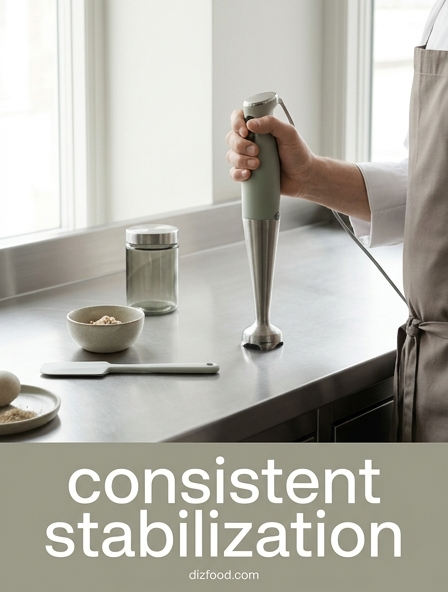
- Immersion Blenders: High-powered motors with specialized blades for medium batches.
- Colloid Mills: Used for creating extremely fine nut butters and smooth emulsions.
- Vacuum Blenders: Removes air to prevent oxidation and ensure a denser, more stable sauce.
- Ultrasonic Homogenizers: Uses sound waves to create microscopic bubbles that collapse and mix phases.
Investing in the right mixing technology not only improves the quality of the final product but also increases efficiency. A sauce that takes twenty minutes to emulsify by hand can be completed in seconds with a high-shear mixer, with a significantly lower risk of failure.


Comments