
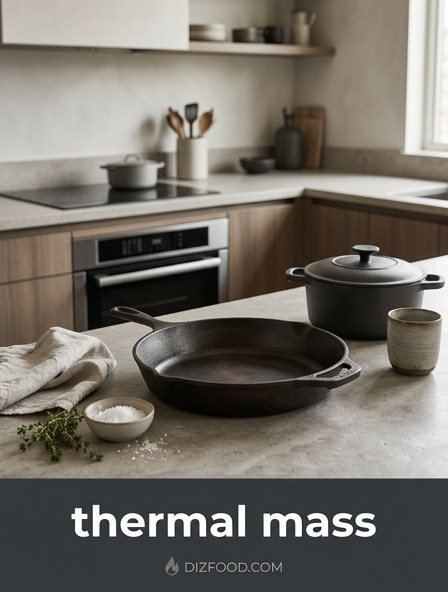
Understanding Thermal Mass in Cookware
Thermal mass in the kitchen refers to the ability of a cooking vessel to absorb, store, and eventually release thermal energy. This physical property is a product of the material's density, its specific heat capacity, and its total volume. In practical terms, a pan with high thermal mass acts like a heat battery, holding onto a significant reservoir of energy that can be discharged into food during the cooking process. This is why professional chefs often prefer heavy-bottomed vessels over thin, lightweight alternatives.
To understand how thermal mass functions, consider the following key components that determine a pan's capacity:
- Material Density: Heavier materials like cast iron or carbon steel contain more molecules per cubic inch to hold heat.
- Specific Heat Capacity: This measures how much energy is required to raise the temperature of one gram of the material by one degree.
- Thickness: Increasing the gauge of a metal directly increases the volume available for energy storage.
When these factors are optimized, the cookware provides a predictable and stable environment, reducing the erratic temperature swings often found in lower-quality kitchen tools.
Heat Retention and Surface Temperature Stability
The primary benefit of high thermal mass is heat retention, which ensures that the surface temperature of the pan remains stable regardless of external variables. When a cold ingredient, such as a chilled steak or a handful of vegetables, is introduced to a hot cooking surface, it naturally draws heat away from the metal. A pan with low thermal mass will experience a sharp decline in temperature, often falling below the threshold required for effective searing or sautéing.
In contrast, a high-mass vessel possesses enough stored energy to withstand the thermal shock of cold ingredients. The internal reservoir of heat flows toward the surface to replace the energy lost to the food, maintaining a consistent temperature. This stability is crucial for delicate tasks, such as making caramel or tempering chocolate, where even minor fluctuations can lead to graininess or scorching. By dampening the effects of the heating element's cycling-turning on and off-thick-walled cookware provides a smooth, continuous heat profile that simplifies the management of complex recipes and ensures uniform results across the entire cooking surface.
How Thermal Mass Triggers the Maillard Reaction
The Maillard reaction is a chemical process between amino acids and reducing sugars that creates the complex flavors and brown colors associated with roasted or fried foods. This reaction typically accelerates at temperatures between 285°F and 330°F. For this reaction to occur effectively, the cooking surface must provide immediate and sustained energy to the food's exterior. Thermal mass is the driving force behind this efficiency, as it prevents the pan from cooling down into a "steaming" range when food is added.
Without sufficient thermal mass, the moisture on the surface of the food absorbs the available heat and turns into steam, effectively boiling the exterior rather than browning it. By providing a deep well of energy, high-mass pans ensure the following:
- Rapid Dehydration: Surface moisture is evaporated almost instantly, allowing the browning reaction to begin immediately.
- Consistent Energy Flux: The steady flow of heat maintains the chemical transition without interruption.
- Deep Flavor Profiling: Sustained heat allows for a thicker, more flavorful crust to develop without overcooking the interior of the food.
Preventing Temperature Drops During Searing
Searing is an essential culinary technique that requires an intense burst of heat to create a flavorful crust. The biggest challenge during searing is the "quench effect," where the temperature of the pan plummets the moment food makes contact. Thermal mass is the only defense against this phenomenon. When using a lightweight aluminum pan, the temperature may drop by over 100 degrees instantly, resulting in grey, rubbery meat. A heavy cast-iron skillet, however, maintains its heat, allowing for a professional-grade sear.
The following table illustrates the typical performance differences observed when introducing room-temperature protein to various pan types:
| Pan Material | Initial Temp | Temp After 30s | Recovery Speed |
|---|---|---|---|
| Thin Aluminum | 450°F | 290°F | Slow |
| Standard Stainless | 450°F | 340°F | Moderate |
| Heavy Cast Iron | 450°F | 410°F | Fast |
This data highlights how the stored energy in high-mass cookware prevents the thermal "crash" that ruins high-heat preparations.
The Role of Pan Thickness in Frying
In the context of frying, pan thickness is the most critical variable related to thermal mass. Thickness provides a lateral buffer that aids in even heat distribution. While thin pans are prone to "hot spotting"-where the area directly above the flame is significantly hotter than the surrounding metal-thick-bottomed pans allow heat to spread horizontally through the material before it reaches the food. This creates a uniform temperature across the entire diameter of the pan.
For shallow frying or pan-frying, a thick base ensures that every piece of food, whether in the center or near the edge, cooks at the same rate. This is particularly important for items like breaded cutlets or delicate fish fillets. The increased thickness also prevents the pan from warping over time. Repeated exposure to high heat causes metal to expand; thin pans lack the structural integrity to manage this stress, often leading to a bowed bottom that prevents even contact with the burner. A thick, high-mass pan retains its flat profile, ensuring efficient conduction and consistent oil depth during frying.
Material Science Behind Consistent Heat Performance
Choosing the right material for high thermal mass requires an understanding of metal properties. While copper is an excellent conductor, its lower density means it doesn't store heat as effectively as other materials unless it is exceptionally thick. Cast iron and carbon steel are the champions of thermal mass because they are both dense and have high volumetric heat capacities. These materials are slow to heat up, but they offer a level of "thermal inertia" that is unmatched in the kitchen.
Engineered solutions, such as "clad" or "ply" cookware, attempt to balance these properties by layering different metals. A typical high-performance pan might feature:
- Stainless Steel Exterior: For durability and non-reactive properties.
- Aluminum Core: For rapid heat conduction and weight management.
- Heavy Base Plate: To add the necessary mass for energy storage.
By combining these materials, manufacturers can create cookware that conducts heat quickly while still possessing enough mass to provide the stability required for consistent professional results. Understanding these material trade-offs allows a cook to select the right tool for specific heat-intensive tasks.
Managing Moisture Evaporation Through High Thermal Mass
Moisture is the enemy of high-heat cooking. When food hits a pan, it releases juices and surface water that must be dealt with immediately to prevent the food from stewing in its own liquid. Converting water to steam requires a massive amount of energy-known as the latent heat of vaporization. If a pan lacks sufficient thermal mass, the act of evaporating this water will consume all the available surface heat, causing the pan temperature to bottom out.
High thermal mass cookware manages this by providing a surplus of energy. The reservoir of heat within the metal is so large that the energy required to vaporize moisture represents only a small fraction of the total stored heat. Consequently, the water flashes into steam instantly, and the pan remains hot enough to continue browning the food. This is particularly visible when sautéing mushrooms or onions; in a heavy pan, they brown quickly and remain firm, whereas in a light pan, they often release a puddle of liquid and become translucent and soggy due to the loss of thermal momentum.
Why Heavy Duty Pans Outperform Lightweight Alternatives
The performance gap between heavy-duty and lightweight pans is most evident during demanding cooking tasks. Lightweight pans are often favored for their agility and quick response to temperature changes, but they fail when a steady, high-output heat source is required. Heavy-duty pans provide a level of reliability that prevents common kitchen failures. Their superior thermal mass ensures that once the desired temperature is reached, it stays there, regardless of how much food is added to the vessel.
The advantages of heavy-duty cookware include:
- Greater Forgiveness: They are less likely to burn food if the burner flame is accidentally set too high for a short period.
- Better "Oven-Mimicry": Heavy pans radiate heat from the sides as well as the bottom, creating a mini-oven environment.
- Longevity: The additional material makes them nearly indestructible and resistant to thermal shock.
Ultimately, the physical weight of a pan is often a direct indicator of its thermal mass, and by extension, its ability to produce superior crusts and even doneness in proteins and vegetables.
Sustaining Heat Transfer for Professional Results
In a professional kitchen environment, speed and consistency are the two most important factors. Thermal mass facilitates both by sustaining a high rate of heat transfer. Heat transfer occurs most efficiently when there is a large temperature gradient between the pan and the food. By maintaining a high surface temperature, high-mass cookware ensures that the maximum amount of energy is being pushed into the food at all times. This results in shorter cooking times and better texture.
Furthermore, sustaining heat transfer is vital when cooking in batches. When a chef finishes one steak and immediately adds another, a high-mass pan is ready to go instantly. It does not require a long "re-heating" period between items because it has not lost its core energy. This continuous throughput is essential for high-volume service where every second counts. The ability of the cookware to act as a constant, unwavering heat source allows the chef to focus on technique and timing rather than constantly adjusting the flame to compensate for a cooling pan.
Optimizing Recovery Time for Better Crust Development
Recovery time is the duration it takes for a cooking surface to return to its target temperature after food has been added. In the pursuit of the perfect crust, recovery time must be as close to zero as possible. If the pan takes two minutes to get back up to searing temperature, the interior of the food will likely be overcooked by the time the exterior is sufficiently browned. High thermal mass is the primary factor in minimizing this recovery window.
When using a vessel with high thermal inertia, the recovery is nearly instantaneous because the heat is pulled from the deep interior of the metal to the surface faster than the food can cool it down. This leads to a superior crust that is thin, crisp, and intensely flavored, while the inside remains juicy and cooked to the precise desired level. To optimize this process, cooks should preheat high-mass pans thoroughly, ensuring the "heat battery" is fully charged before the first ingredient touches the surface. This preparation, combined with the physics of thermal mass, represents the pinnacle of heat management in culinary science.


Comments