
Deciding between a classic dining table and a modern kitchen island is about more than just floor plans; it's about choosing the stage for your home's most meaningful connections. While the dining table stands as a timeless sanctuary for lingering conversations and formal celebrations, the kitchen island has transformed into a high-energy social magnet that blurs the lines between meal prep and party hosting. To truly maximize your home's social potential, you must balance the structured, face-to-face intimacy of a dedicated table against the versatile, multi-functional flow of an island that invites guests right into the heart of the action. Whether you prioritize the cozy comfort of a three-course Sunday roast or the fluid, standing-room-only vibe of a cocktail evening, selecting the right anchor will redefine how your family and friends interact every single day.
| Feature | Traditional Dining Table | Integrated Kitchen Island |
|---|---|---|
| Social Atmosphere | Intimate, formal, and focused on face-to-face eye contact. | Casual, energetic, and conducive to "shoulder-to-shoulder" interaction. |
| Functionality | Purely for dining, games, or large-scale projects. | Hybrid: Food prep, storage, appliance housing, and dining. |
| Ergonomics | Standard height (30"); supports long-duration sitting comfort. | Counter (36") or Bar (42") height; better for short-term perching. |
| Seating Capacity | Highly flexible; easily expandable with leaves for 8-12+ guests. | Fixed by counter length; typically accommodates 2-5 guests comfortably. |
| Spatial Footprint | Requires 36-48" clearance; can be moved or rearranged. | Permanent fixture; requires plumbing/elec. clearance but saves prep space. |
| Best For | Holiday hosting, slow dinners, and multi-generational families. | Busy mornings, open-concept living, and frequent casual entertaining. |
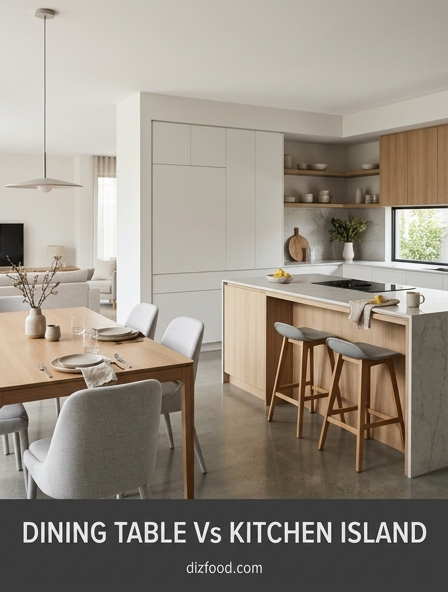
Dining Table vs Kitchen Island Pros and Cons
Choosing between a dining table and a kitchen island involves weighing the benefits of fixed utility against flexible comfort. Each serves a specific purpose in the culinary and social heart of the home, and understanding their inherent strengths is the first step in successful kitchen design.
| Feature | Kitchen Island | Dining Table |
|---|---|---|
| Primary Function | Meal preparation and storage. | Dedicated dining and gathering. |
| Flexibility | Fixed; often includes utilities. | High; can be moved or expanded. |
| Seating Style | Elevated stools; casual. | Standard chairs; ergonomic. |
| Storage | Integrated cabinets/drawers. | None (usually). |
The kitchen island is a modern workhorse, providing much-needed counter space and integrated storage for appliances. Its primary "pro" is its ability to centralize tasks, allowing the cook to face the room rather than a wall. However, its "con" is its permanence; once installed, it dictates the room's flow and cannot be easily adjusted for large parties.
Conversely, the dining table offers unparalleled versatility. It can be moved to accommodate different guest counts and serves as a softer, more inviting surface for long conversations. While it lacks the storage and prep capabilities of an island, its lower height makes it more accessible for children and the elderly, fostering a more inclusive environment for extended family gatherings.
Space Requirements for Islands and Dining Tables
Spatial planning is the most critical technical aspect of choosing between these two pieces. Without proper clearance, even the most beautiful kitchen becomes a frustrating bottleneck. Architects generally recommend a "clearance zone" of at least 36 to 42 inches between the edge of a furniture piece and any surrounding cabinets, walls, or appliances.
- Islands: Require a minimum of 40 inches of walkway space on all sides to allow for cabinet doors and dishwashers to open fully.
- Dining Tables: Require 36 inches from the table edge to the wall to allow for chairs to be pulled out and for people to pass behind seated guests.
- The Work Triangle: An island must not obstruct the path between the refrigerator, stove, and sink.
When calculating space, you must also consider "visual weight." A heavy, solid kitchen island can make a medium-sized kitchen feel cramped if it lacks enough open floor space around it. A dining table with thin legs and an open base can make the same square footage feel airier and more spacious. For those with narrow footprints, a "peninsula" often serves as a compromise, providing the utility of an island while requiring clearance on only three sides. Always measure your space with painter's tape on the floor before making a final purchase or installation decision to visualize the real-world flow of traffic during busy meal times.
The Role of the Kitchen Island in Modern Open Floor Plans
In contemporary architecture, the kitchen island serves as the "anchor" of the open floor plan. As traditional walls have disappeared to combine the kitchen, dining, and living areas, the island has become the functional boundary that defines where the cooking zone ends and the living zone begins. It acts as a social bridge, allowing the person preparing the meal to engage with guests or watch television without being isolated in a separate room.
Beyond its role as a room divider, the island facilitates a "grazing" culture that is prevalent in modern lifestyles. Instead of a formal three-course meal, many families prefer a buffet-style setup where the island serves as the serving station. This promotes a fluid movement through the home, where guests can linger near the food while still feeling connected to the rest of the living space. The island's height also creates a visual screen, hiding the inevitable clutter of meal prep-dirty dishes, vegetable peelings, and scattered utensils-from those sitting in the living area, maintaining a sense of order in an otherwise unified space. In this context, the island is less of a furniture piece and more of a structural element that facilitates the "great room" concept, making it indispensable for those who value a social, interconnected home environment.
Why a Traditional Dining Table is Better for Formal Hosting
Despite the rise of the multifunctional island, the traditional dining table remains the gold standard for formal hosting and holiday traditions. There is a psychological component to sitting at a lower, dedicated dining surface that signals a shift from the hustle of the kitchen to the relaxation of the meal. A dining table allows for elaborate table settings, including centerpieces and multiple courses, which are often impractical on a high-traffic kitchen island.
- Eye Contact: The rectangular or circular orientation of a table allows all guests to face one another, facilitating better conversation than a linear island.
- Legroom: Tables offer clear space underneath for legs, allowing guests to sit comfortably for hours without the discomfort of dangling feet or cramped knees.
- Atmosphere: A table can be draped in linens and set with fine china, creating a sense of occasion that a granite or quartz countertop simply cannot replicate.
Furthermore, the dining table accommodates varied seating options. You can easily add a leaf to extend the table for large dinner parties or use a mix of chairs and benches to fit more people. This adaptability is crucial for formal hosting, where guest counts can fluctuate. For events like Thanksgiving or celebratory birthdays, the dining table acts as a sanctuary of focused connection, removed from the noise and heat of the stove, allowing the host and guests to truly enjoy each other's company in a refined setting.
Multifunctional Kitchen Islands for Prep and Casual Dining
The modern kitchen island is a marvel of engineering, often incorporating more technology and utility than any other part of the home. When designed as a multifunctional hub, it transcends its role as a mere countertop. For households that prioritize efficiency, the island can be outfitted with a secondary "prep sink," a built-in microwave drawer, or even a wine cooler. This turns the island into a self-contained workstation, allowing multiple cooks to work simultaneously without crossing paths.
- Integrated Power: Pop-up outlets allow the island to serve as a charging station or a place for small appliances like blenders and mixers.
- Split-Level Design: Some islands feature a standard counter height (36") for prep work and a raised bar height (42") for seating, effectively separating the "work" and "eat" zones.
- Extended Overhangs: A deep countertop overhang allows stools to be tucked completely underneath, maximizing floor space when the seating is not in use.
For casual dining, the island is unbeatable. It is the perfect spot for a quick morning coffee, a child's homework station while a parent cooks, or a casual lunch. The convenience of being inches away from the fridge and stove makes cleanup effortless. This "task-oriented" nature makes the island the preferred choice for busy professionals and families who need their kitchen to work as hard as they do, providing a seamless transition between productivity and relaxation.
Comfort Comparison Seating Heights and Ergonomics
Ergonomics play a vital role in how much time you will actually spend at your chosen surface. The height of the seating and the relationship between the seat and the surface can determine whether a meal is a quick bite or a long, enjoyable experience. Dining tables and islands adhere to different standard measurements that cater to different physical needs.
| Surface Type | Surface Height | Seat Height | Comfort Level |
|---|---|---|---|
| Standard Dining | 28" - 30" | 18" - 20" | High (Feet on floor) |
| Counter Height | 35" - 37" | 24" - 26" | Medium (Casual) |
| Bar Height | 41" - 43" | 29" - 31" | Low (Perching) |
Dining tables provide superior ergonomics for long-term sitting. Because chairs are lower, the user's feet rest firmly on the ground, reducing pressure on the lower back and thighs. This makes them ideal for the elderly or individuals with mobility issues. Kitchen islands, which typically use counter or bar-height stools, require the user to climb up. While many modern stools include footrests, the "perched" position is generally less stable and can become uncomfortable during a long evening. If your lifestyle involves long dinner parties or using the table as a primary home office, the lower, more supportive nature of a traditional dining chair is significantly better for your posture and overall physical comfort.
Budget Considerations Built-in Islands vs Moveable Tables
From a financial perspective, the kitchen island and the dining table exist in completely different categories. A dining table is a piece of furniture, while a built-in kitchen island is a construction project. This distinction has massive implications for your home renovation budget. A high-quality solid wood dining table can cost anywhere from $500 to $5,000, but it is a "one-and-done" purchase with no installation costs. You can take it with you if you move, preserving your investment.
A built-in kitchen island, however, involves cabinetry, countertop fabrication, and often plumbing or electrical work. Costs can easily climb into the tens of thousands of dollars. You must account for the cost of the base cabinets, the stone or wood slab for the top, and the labor for installation. If you decide to add a sink or a cooktop, you must also pay for licensed plumbers and electricians to run lines through the floor, which can be prohibitively expensive if you are working on a concrete slab. Even a "moveable" island or a kitchen cart is generally more expensive than a basic table because it requires more durable, moisture-resistant materials to withstand kitchen prep. When budgeting, consider whether you want a permanent asset that adds to the resale value of your home or a flexible piece of furniture that offers more immediate financial relief.
Small Kitchen Solutions Maximizing Layout with the Right Choice
In a small kitchen, every inch must be fought for, and the choice between an island and a table can make or break the room's functionality. When square footage is at a premium, "hybrid" solutions often perform best. A small, narrow kitchen cannot accommodate a full-sized island, but it might benefit from a rolling butcher block cart that provides extra prep space when needed and can be tucked against a wall when not in use.
- Drop-Leaf Tables: These are ideal for small spaces, as the sides can be folded down to create a narrow console when you aren't eating.
- Island Peninsulas: By attaching one end of an island to a wall or existing cabinetry, you save the 36 inches of walkway required for a four-sided island.
- Trestle Tables: These allow for more chairs to be tucked in tightly because they lack corner legs that can bump into guests in tight quarters.
Another popular small-kitchen strategy is the "working table." This is a sturdy, counter-height table that lacks the bulk of cabinetry underneath. It provides the height and surface of an island for prep work but maintains the visual openness of a table. By choosing furniture with "leggy" profiles and glass or light-colored tops, you can provide the necessary surfaces without making the kitchen feel claustrophobic. Ultimately, in small spaces, the goal is to prioritize "multi-use" items that can shift roles throughout the day.
Design Aesthetics Coordinating Your Dining Area Style
The visual impact of your choice will define the "vibe" of your home. A kitchen island is typically designed to match or complement the existing cabinetry. This creates a cohesive, high-end look that feels integrated into the architecture of the house. You can use the island to introduce a "pop" of color-for example, a navy blue island base in a kitchen with white perimeter cabinets-which serves as a focal point without overwhelming the space.
Dining tables offer a different aesthetic opportunity. They allow you to introduce new textures and materials that break up the "hard" surfaces of the kitchen. While kitchens are full of cold stone, metal, and tile, a wooden dining table brings warmth and organic character to the room. It acts as a piece of art in its own right. Lighting also plays a major role in aesthetics; islands are typically lit by a series of pendant lights that provide task lighting, whereas dining tables are often anchored by a single, dramatic chandelier that sets a mood.
When coordinating styles, consider the "sightlines." In an open-plan home, the island and the dining table are often visible at the same time. They do not need to match perfectly, but they should share a common design language. For instance, if your island has a sleek quartz top and modern hardware, a rustic farmhouse table might create a jarring contrast. Aim for a "coordinated but not matched" look to create a sophisticated, curated interior.
Making the Final Decision Which Furniture Piece Fits Your Lifestyle
To make the final decision, you must look past the Pinterest photos and honestly evaluate your daily habits. No single solution fits every household; the "right" choice is the one that minimizes your daily frustrations and maximizes your enjoyment of the home. Ask yourself a series of lifestyle-based questions to narrow down your needs.
- How do you cook? If you do heavy meal prep or bake frequently, the extra counter space of an island is a necessity.
- How do you entertain? If you host formal dinners, you need a table. If you host casual "mingle" parties, an island is superior.
- Who lives in the house? Families with small children or elderly members often find the safety and height of a dining table much more practical.
- Is this your "forever" home? A built-in island is a permanent investment in the property, while a table is a portable asset.
In many modern homes, the answer is "both." If space allows, a medium-sized island for prep and a nearby dining table for meals offers the best of both worlds. However, if you must choose one, prioritize the function you perform most often. If you spend 90% of your time prepping food and only 10% sitting down for a formal meal, the island is the logical winner. If your kitchen is a secondary space and your life revolves around long, seated gatherings, the traditional dining table remains the heart of the home.





Comments