
Indestructible Countertop Materials
When selecting a kitchen countertop that prioritizes heat retention, natural stones like granite and soapstone stand out as premier choices. These materials are prized not just for their legendary durability and resistance to scratches, but for their incredible thermal mass. A thick granite slab acts as a heat sink, absorbing warmth from the environment or hot cookware and holding it for extended periods. This characteristic is particularly beneficial in bakeries or home kitchens where maintaining a consistent surface temperature aids in dough proofing or keeping served items warm.
- Soapstone: Chemically inert and famous for its use in wood stoves due to superior thermal storage.
- Granite: High density allows it to resist thermal shock while retaining heat from sunlight or appliances.
- Quartzite: Offers the hardness of quartz with better heat resistance than engineered composites.
Engineered surfaces, while durable, often use resins that do not manage heat as effectively as natural stone. For the serious cook, an indestructible natural stone surface provides a functional advantage by stabilizing the kitchen's microclimate through steady thermal radiation.
Shatterproof Glassware for Daily Use
Modern shatterproof glassware has revolutionized the way we handle hot beverages and soups. Using borosilicate glass or tempered soda-lime variants, these vessels are engineered to withstand extreme temperature fluctuations without cracking. The primary benefit regarding heat retention lies in the material's low thermal conductivity. Unlike thin, fragile glass, high-performance tempered glassware minimizes the rate at which heat escapes the liquid, ensuring your coffee or tea remains at the optimal temperature for longer durations.
| Glass Type | Heat Retention Level | Impact Resistance |
|---|---|---|
| Borosilicate | Excellent | High |
| Tempered Soda-Lime | Moderate | Very High |
| Double-Walled Glass | Superior | Moderate |
By integrating double-walled construction into shatterproof designs, manufacturers create a vacuum or air gap that further enhances insulation. This prevents the exterior from becoming too hot to touch while simultaneously locking in the internal thermal energy, making it an essential component for a high-traffic, safety-conscious kitchen.
Impact Resistant Flooring Options
Kitchen flooring must endure heavy foot traffic and the occasional dropped cast iron skillet, but its role in heat retention is often overlooked. Materials such as porcelain tile, natural slate, and polished concrete are highly impact-resistant and possess excellent thermal capacitance. When paired with underfloor radiant heating systems, these materials become a primary source of steady, comfortable warmth in the kitchen. They absorb the heat from the coils or pipes and radiate it upward slowly, maintaining a consistent temperature long after the heating system has cycled off.
- Choose porcelain over ceramic for lower porosity and better thermal density.
- Utilize natural stone to benefit from unique mineral compositions that hold heat.
- Consider polished concrete for a seamless, industrial look with maximum thermal mass.
Because these materials are dense, they do not fluctuate in temperature as rapidly as laminate or vinyl. This stability helps in reducing overall energy costs by preventing the kitchen from cooling down too quickly during winter months, proving that impact resistance and thermal efficiency go hand in hand.
Durable Dinnerware for Busy Families
For families that require dinnerware capable of surviving daily drops and dishwasher cycles, vitrified ceramic and stoneware are the gold standards. Beyond their ruggedness, these materials are exceptional at heat retention. There is nothing more disappointing than a hot meal served on a cold plate, which quickly siphons the thermal energy from the food. High-quality, durable dinnerware can be pre-warmed in a low-temperature oven, and because of its density, it will hold that heat throughout the duration of the meal.
Stoneware, in particular, is fired at extremely high temperatures, resulting in a non-porous and thick body. This thickness serves as an insulator. While lightweight plastics or melamine are shatterproof, they offer poor thermal properties, causing food to cool almost instantly. By choosing heavy-duty vitrified options, you ensure that even the busiest family dinner remains warm from the first bite to the last, combining the practical need for durability with the culinary necessity of temperature control.
Resilient Prep Surface Engineering
Resilient prep surfaces, such as end-grain butcher blocks and high-density composites, are designed to withstand heavy chopping while managing thermal energy. Wood, unlike metal or stone, acts as a natural insulator. While it does not "retain" heat in the sense of a heat sink, it prevents the rapid transfer of heat away from hot items placed upon it. This makes it an ideal surface for resting meats or preparing warm doughs that are sensitive to temperature drops.
- End-Grain Maple: Offers a self-healing surface that provides excellent thermal stability.
- Richlite: A paper-composite material that is incredibly tough and heat-resistant up to 350 degrees.
- Stainless Steel: While highly durable, it has high conductivity and requires specialized mats to prevent heat loss.
In a professional kitchen environment, the resilience of the prep surface ensures longevity, but the thermal characteristics of the material dictate how food interacts with the environment. A resilient surface that resists thermal shocks will not warp or crack when exposed to hot pots, maintaining a flat and safe workspace for years.
Tough High Performance Cabinetry
High-performance cabinetry is often evaluated by its resistance to steam, moisture, and physical impact. However, the insulation properties of cabinetry play a vital role in the heat retention of integrated appliances. Cabinets built with high-density fiberboard or solid wood cores act as thermal buffers for ovens and dishwashers. By containing the heat generated by these appliances, the cabinetry helps maintain internal operating temperatures, thereby increasing energy efficiency and reducing the workload on the appliance's heating elements.
Furthermore, robust cabinetry near windows or exterior walls helps insulate the kitchen from outside temperature shifts. Heavy-duty doors with high-quality seals prevent drafts from entering the storage areas where temperature-sensitive ingredients or oils are kept. This "thermal pocket" effect ensures that the kitchen remains a stable environment. When cabinetry is engineered for toughness, it typically involves thicker panels and better-fitting joints, both of which contribute to superior thermal barrier performance compared to flimsy, mass-produced alternatives.
Heavy Duty Cookware Selection
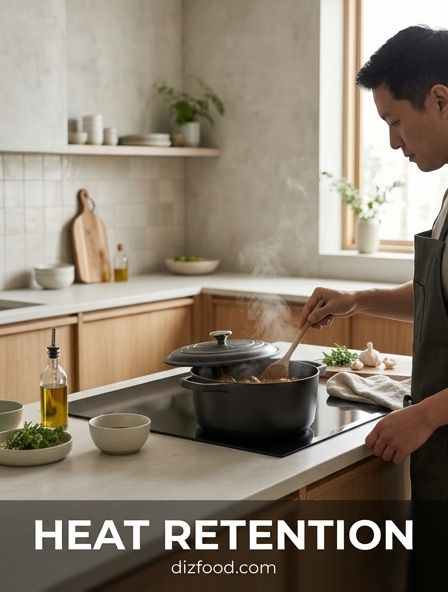
The hallmark of heavy-duty cookware is its ability to retain heat for professional-grade searing and even simmering. Cast iron and enameled Dutch ovens are the quintessential examples of this. Because of their significant mass, they require more time to heat up, but once they reach the desired temperature, they remain hot regardless of the ingredients added. This high thermal inertia is critical for maintaining a constant boil or achieving a perfect crust on a steak.
| Material | Heat Retention | Durability |
|---|---|---|
| Cast Iron | Highest | Virtually Indestructible |
| Enameled Steel | High | Resistant to Acids |
| Multi-Clad Stainless | Moderate | Very High |
Selecting cookware with a thick base and heavy lid further enhances heat retention by creating a pressurized environment that locks in steam and thermal energy. For the home chef, investing in heavy-duty pieces means food stays warm on the table longer and cooking results are more predictable, as the cookware compensates for fluctuations in stove output.
Shatter Resistant Kitchen Tiles
Shatter-resistant tiles, particularly those made from through-body porcelain, provide a kitchen with a rugged surface that excels in thermal management. These tiles are fired at higher temperatures than standard ceramic, making them much denser and less prone to cracking under impact. This density also makes them an ideal medium for heat retention. In a kitchen setting, tiles can absorb ambient heat from cooking processes and release it slowly, helping to stabilize the room temperature during heavy usage.
When used as a backsplash behind a range, these tiles absorb radiant heat that would otherwise be lost to the wall structure. This reflected and retained heat contributes to a more efficient cooking zone. Additionally, the slip-resistant textures often found on high-performance tiles do not interfere with their thermal properties. Whether used on the floor or the walls, the structural integrity of shatter-resistant tiling ensures that the thermal benefits remain consistent over the life of the kitchen, as no cracks emerge to allow heat to dissipate into the sub-structure.
Robust Hardware for Heavy Use
Kitchen hardware, including handles, pulls, and hinges, must be robust enough to withstand thousands of cycles, but their material composition also affects the kitchen's thermal feel. Solid brass and stainless steel are popular for their strength, yet they have different thermal conductivities. Robust hardware with a higher mass tends to feel more substantial and temperature-stable to the touch. In kitchens where heat retention is managed through insulation, the hardware acts as the final touchpoint.
- Solid metal pulls retain less ambient heat than wood but offer better structural longevity.
- Oversized handles allow for easier use with thermal mitts during high-heat cooking.
- Heavy-duty hinges ensure a tight seal on oven-adjacent cabinets, preventing heat loss.
While the hardware itself isn't the primary source of heat retention, its ability to maintain a tight seal on doors and drawers is crucial for preserving the thermal integrity of the kitchen's storage systems. High-quality, robust hardware prevents the warping of doors that can lead to "heat leaks," ensuring that the kitchen's energy-efficient design remains intact under heavy daily use.
Long Lasting Impact Proof Finishes
Impact-proof finishes, such as powder coatings and specialized heat-cured resins, are designed to protect kitchen surfaces from the rigors of a high-heat environment. These finishes are often applied to appliances and metal cabinetry to provide a layer of protection that won't chip or peel. From a heat retention perspective, these finishes can be engineered with low-emissivity properties, reflecting heat back toward the source. This is particularly useful on the exterior of ovens or warming drawers, where keeping the heat inside is paramount.
The durability of these finishes means they maintain their thermal properties over time. Standard paints may crack or flake when exposed to the repetitive thermal expansion and contraction of a kitchen, but impact-proof finishes remain flexible and intact. This creates a continuous thermal barrier that helps in maintaining the efficiency of heat-generating appliances. By investing in long-lasting finishes, homeowners ensure that their kitchen surfaces remain both aesthetically pleasing and functionally superior in managing the flow of thermal energy throughout the space.

Comments